The Channel Your Best Customers Already Live In Is the One Most Cross-Border Brands Still Can’t Legally Enter
Every cross-border operator I know has the same quiet frustration buried under the Shopify admin and the Amazon dashboard: the highest-intent conversations with customers happen in text threads, and almost none of that traffic is yours to own. Email open rates decay, SMS gets filtered, and Meta ad costs keep climbing — but the customer still taps a message icon twenty times a day. For years, the only way to reach iPhone users inside Apple’s own Messages app with a verified business identity was through a narrow, enterprise-gated program most DTC brands couldn’t qualify for. That’s why Blooio’s repositioning matters more than the average Product Hunt launch: it’s pitching itself as an Apple Messaging Service Provider with a unified API across iMessage, RCS, SMS, and WhatsApp. For a seller juggling five storefronts and three support inboxes, that’s not a developer tool — that’s a potential ownership layer over the post-purchase conversation.
What Problem Blooio Actually Solves (and What It Isn’t)
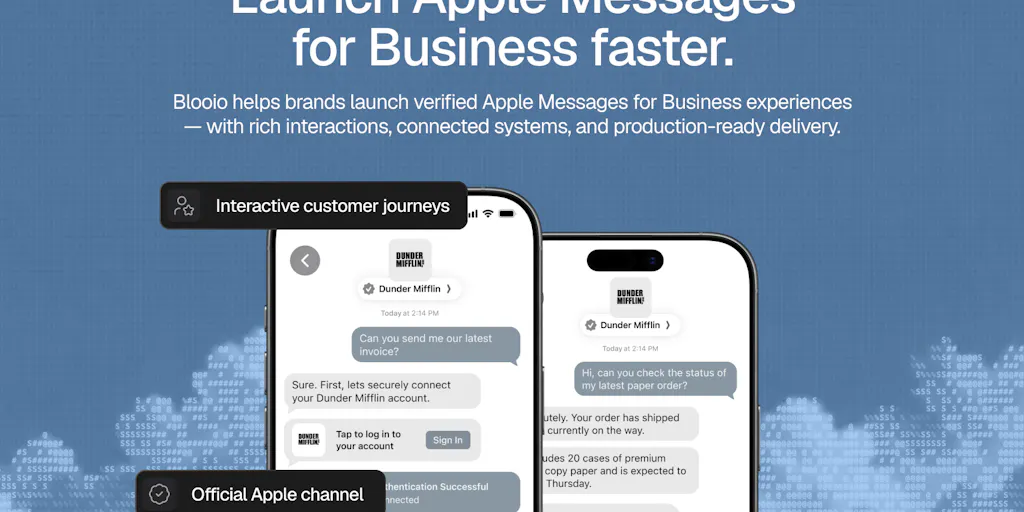
Strip away the launch-day framing and the core shift is this: the original Blooio was an iMessage API that let developers send and receive blue bubbles without physical Apple hardware. The relaunch, per maker David Harvey, is built around a different premise — that businesses didn’t just need to send blue bubbles, they needed verified conversations inside Apple’s Messages app. The distinction is legal, not cosmetic. The old approach was a workaround; the new one runs through Apple Messages for Business, which is a customer-initiated, verified channel with an approved invitation flow for opted-in customers, as Harvey spells out in the launch thread.
Concretely, that means customers see your verified business name and logo inside Messages, and can interact with quick replies, appointment pickers, interactive forms, rich media, and Apple Pay without leaving the thread. The API and webhooks are positioned for AI agents, CRMs, and existing workflows, with human handoff when automation stalls. And the multi-channel support — RCS, SMS, WhatsApp alongside Apple — is the part that should make a cross-border operator sit up, because it’s the first hint that this could become a single messaging layer rather than a sixth tab in your support stack.
What it is not: a magic bullet for cold outbound. The customer-initiated requirement is the whole ballgame, and I’ll come back to why that changes your funnel math.
Why this is an Apple problem before it’s a messaging problem
Here’s the thing most Shopify-first operators miss. Apple Messages for Business isn’t a marketing channel in the way Klaviyo or Attentive are. It’s a service channel with a verification gate. That means the value isn’t in blast volume — it’s in resolution speed, return handling, order-status deflection, and the kind of post-purchase conversation that currently dies in a Zendesk queue or, worse, in a public review. If your support cost per order is the metric you actually care about, this is a different category of tool than a campaign platform.
How It Stacks Up Against the Incumbents You’re Already Paying For
The honest comparison set isn’t other iMessage APIs — it’s the messaging and support stack you’re already running. Against Klaviyo and Attentive, Blooio is not a campaign engine; those platforms own list growth, segmentation, and broadcast orchestration, and they’ll keep winning the “send a promo to 200k subscribers” job. Against Zendesk or Gorgias, Blooio is not a helpdesk; it’s a channel that feeds one. The interesting overlap is with the conversational commerce layer — the WhatsApp Business API ecosystem and the various SMS gateways — where Blooio’s pitch is consolidation: one API, one webhook stream, four channels.
Where it genuinely differentiates is the Apple Messages for Business verification. Most SMS aggregators can’t offer a verified brand identity inside the native iPhone Messages app; that’s a program with its own approval process, and Harvey’s framing — “an approved invitation flow for opted-in customers” — tells you the compliance bar is real. For a brand selling into the US, UK, or Canada, where iPhone penetration among higher-AOV buyers is high, that verified presence is worth more than another 10% off SMS deliverability.
Why Amazon sellers should care more than Shopify ones
This is the counterintuitive take. Shopify DTC operators already have email, SMS, and a dozen owned channels; adding Apple Messages is incremental. But Amazon FBA brand owners are structurally starved of direct customer contact — Amazon Seller Central gives you a masked buyer messaging system with brutal policy constraints, and off-platform solicitation is a suspension risk. A verified, customer-initiated messaging channel that lives outside the marketplace, tied to your own brand identity, is the closest thing to a compliant bridge from Amazon buyer to owned relationship that I’ve seen pitched this year. The catch, of course, is that you have to earn the initiation — which means packaging inserts, post-purchase emails, and your own storefront have to do the recruiting.
Where the math breaks
Two places. First, the customer-initiated constraint means Blooio can’t replace your acquisition channels — it can only deepen the ones that already convert. If your post-purchase email flow is weak, this tool has nothing to plug into. Second, pricing isn’t disclosed on the launch page. For a cross-border operator modeling cost per resolved ticket across multiple storefronts, that’s a genuine gap — you can’t build a business case on “unified API” alone, and I’d want per-conversation or per-message economics before committing a support team to it.
What Cross-Border Sellers Can Borrow From This Launch
Even if you never touch Blooio, the strategic read is useful. The first borrow: treat messaging as a resolution channel, not a promotion channel. The brands winning in 2026 are the ones whose order-status, return, and sizing conversations happen in-thread rather than over email. The second borrow: the multi-channel consolidation thesis is correct and overdue. Running WhatsApp for EU, SMS for US, and whatever TikTok Shop’s native messaging does for social commerce, all in separate dashboards, is a hidden tax on every support hire. A single webhook stream into your CRM or helpdesk is the architecture you should be designing toward regardless of vendor.
The third borrow is subtler: AI agents with human handoff are now table stakes, not a differentiator. Blooio’s “connect your AI agents” line is the same line every conversational platform is running. The operators who win will be the ones who actually wire the handoff rules — when does the bot escalate, what context travels with the ticket — not the ones who buy the API and assume the automation writes itself.
Where My Judgment Says It Falls Short
I’ll be blunt: the launch page is long on vision and short on the operational detail a cross-border operator needs. No pricing, no per-channel coverage specifics (which countries get RCS? does WhatsApp support template approval workflows?), and no clarity on how Apple Messages for Business onboarding timelines look for a brand without an existing enterprise relationship. The “82 Reviews” badge on the launch page is also worth reading skeptically — launch-day reviews skew enthusiastic and rarely stress-test the compliance edges.
There’s also a category risk: Apple controls this channel. Any shift in Apple’s program terms, verification requirements, or invitation-flow policy flows straight through to your support operations. That’s not a reason to avoid it — it’s a reason to keep it as a layer over your owned channels rather than a replacement for them. And for sellers whose primary markets are Southeast Asia or Latin America, where WhatsApp and local super-apps dominate and iPhone share is lower, the Apple-first framing is simply less relevant than the multi-channel consolidation story.
What I’d Watch / Test Next
This week, before you evaluate any vendor: audit how many of your post-purchase conversations currently start with the customer wanting to talk to you — returns, sizing, delivery delays. That number is your addressable base for a customer-initiated channel, and if it’s small, fix the triggers first. Then pull your support ticket taxonomy and tag which ones are resolvable in a text thread versus which need email or portal — that tells you whether a messaging layer would actually deflect cost or just add a channel. Finally, if you sell into the US, UK, or Canada with AOV above roughly $80, put yourself through the Apple Messages for Business verification flow as a thought exercise: what would your brand need to prove, and does your current stack even capture opt-ins in a form Apple would accept? Do those three things and you’ll know within a month whether this category deserves budget — independent of which vendor wins.