The social distribution layer is where cross-border brands quietly lose margin — and the tooling is finally catching up
Most cross-border operators I talk to treat organic social as a brand-awareness tax: nice for the DTC homepage, irrelevant to the P&L. I think that framing is now wrong, and not for the reason the growth-twitter crowd claims. The real shift is that the platforms have started publishing their own ranking logic, which turns social distribution from a black-box art into something closer to ad-buy reconciliation. When the algorithm’s weights are a public Git repo, “we don’t know why that post worked” stops being an acceptable answer from your social hire — and it definitely stops being acceptable when you’re paying an agency retainer in three currencies. That’s the lens I want to use for LinkIntel, a solo-founder tool from Marcos Placona that launched on Product Hunt on August 18th, 2025. It’s an X (Twitter) analytics MCP server, not an e-commerce tool, and I’d argue that’s exactly why sellers should study it.
What LinkIntel actually solves — and why the framing is smarter than the product category
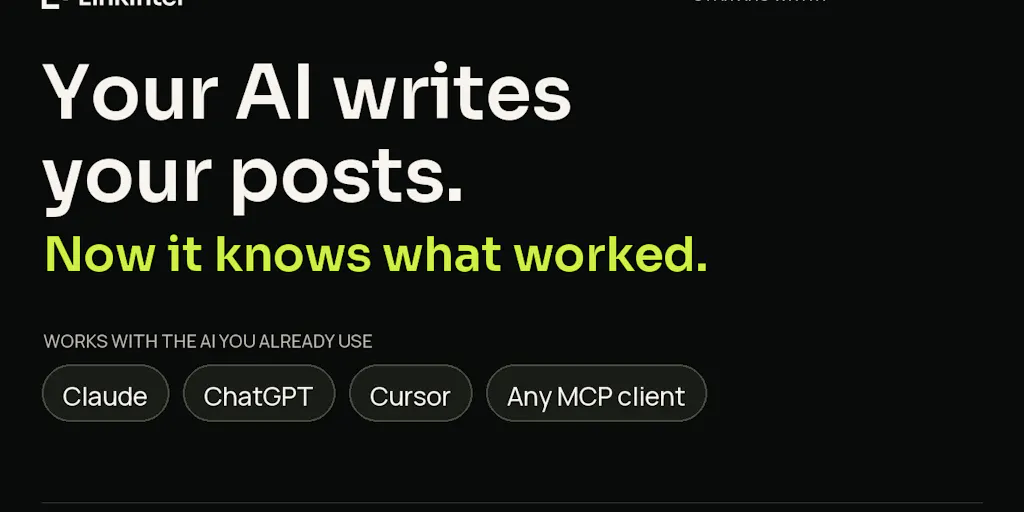
The pitch is almost aggressively narrow. Placona, a UK solo founder, describes writing most of his X drafts with Claude and getting confident predictions that had never seen a single one of his actual posts perform. Every draft started from the model’s generic idea of “good.” So he built a bridge: an MCP server — one URL to add to whatever assistant you already use — that gives the model three inputs. First, your own X results: connect the account once, and it records how recent original posts perform, daily. Second, X’s published ranking weights: the platform’s ranking code lives on GitHub, and LinkIntel re-reads it daily and flags every change, citing the commit as the receipt. Third, a sourced brief: ask “what should I post next?” and the assistant answers from your results plus those weights, and shows what informed the answer.
That third point is the one I’d underline. The current generation of AI marketing tools is mostly a vibes engine with a text box. You paste your brand voice doc, it generates twelve captions, you pick the least embarrassing one. There’s no feedback loop, no attribution, no memory of what actually shipped and what it did. LinkIntel’s contribution isn’t the AI — it’s the grounding. The model stops guessing and starts citing. In a launch thread, a commenter from Mailwarm made precisely this point: the daily re-read of the ranking code with a linked commit is the part they’d actually trust, because most tools just say “the algo changed” with zero receipts. Placona confirmed you can also point it at other accounts and even specific posts that worked well, and it tracks them all.
Why this matters more to Amazon and TikTok Shop sellers than to Shopify-only brands
If you sell purely on your own Shopify storefront, organic social is a top-of-funnel nice-to-have and this whole conversation is a hobby. If you sell on Amazon Seller Central or TikTok Shop, social distribution is load-bearing. TikTok Shop’s affiliate and live-shopping flywheel is driven almost entirely by creator content performance, and Amazon’s external-traffic incentives — the Brand Referral Bonus program, the way off-Amazon traffic lifts organic rank — mean a viral post isn’t just awareness, it’s a ranking input. Amazon sellers have spent a decade optimizing for an algorithm they can’t see; TikTok sellers are now doing the same on a platform that changes weekly. A tool that says “here’s the actual weight change, here’s the commit” is worth more to an operator whose livelihood depends on that algorithm than to a brand using social as a mood board.
How it differs from the incumbents — and where the comparison gets uncomfortable
The obvious comp set splits into three buckets, and LinkIntel sits awkwardly across all of them.
Social analytics dashboards. Sprout Social, Hootsuite, and Buffer all tell you what happened. Impressions, engagement rate, best time to post, a chart that goes up and to the right. What they don’t do is explain why, and they certainly don’t feed that explanation into a generative model that drafts your next post. They’re reporting layers, not reasoning layers. LinkIntel is trying to be the reasoning layer — or more precisely, the retrieval layer that makes someone else’s reasoning layer less stupid.
AI content tools. Jasper, Copy.ai, and the long tail of GPT wrappers generate copy. Almost none of them close the loop on performance. You can bolt on a feedback mechanism manually — export your top posts, paste them into a prompt, ask the model to imitate — but that’s a weekly ritual nobody sustains past week three. The MCP architecture is the interesting bet here: instead of building another dashboard you have to remember to open, Placona is plugging into the assistant you already have open all day. That’s a distribution strategy disguised as an integration.
Algorithm-tracking services. This is the closest analogue, and it’s a graveyard. SEO tools like Semrush and Ahrefs have built enormous businesses on tracking Google’s algorithm updates, and the pattern works because Google’s changes are opaque, infrequent, and consequential. X publishing its ranking code openly is a newer phenomenon, and a tool that diffs it daily is essentially an SEO-alert product for social. The difference is that Google never gave anyone a commit hash.
Where the math breaks
Here’s my skepticism, and it’s structural. X’s ranking code being public doesn’t mean the deployed ranking matches the repo. Platforms routinely run experiments, hold back features, and ship code that diverges from what’s visible on GitHub. A commit diff is a strong signal, not ground truth, and a founder selling “receipts” has an incentive to overstate how much the receipt proves. The commenter who asked whether it only looks at your own posts or can benchmark against niche accounts was asking the right question — Placona says yes, you can point it at other accounts and specific posts — but benchmarking against accounts you choose is a great way to confirm your own biases. You’ll pick the competitors you admire, not the ones whose success is actually reproducible.
There’s also a scale problem nobody on the launch page mentions. The tool records “recent original posts” daily. For a solo founder posting a few times a week, that’s a workable sample. For a cross-border brand running a content calendar across five markets and three languages, the per-market sample gets thin fast, and thin samples plus an LLM equals confident nonsense — the exact failure mode Placona built the tool to fix. I’d want to know the minimum post volume before the briefs stop being astrology. That number is not disclosed.
The brand-name problem is a real signal
One commenter, Fabian Maume of Warmup Inbox, said the brand name is odd and he’d expect a LinkedIn tool from something called LinkIntel. He’s right, and it’s not a trivial nitpick. Naming is positioning, and a name that misdirects costs you the first three seconds of every prospect’s attention. The LinkedIn confusion is especially unfortunate because Placona fielded an explicit question about LinkedIn — a commenter noted that’s where most of their B2B content goes — and the answer was effectively “not yet.” For cross-border sellers, LinkedIn matters enormously for B2B, wholesale, and distributor relationships, so a tool that’s X-only is leaving the highest-intent channel on the table. If I were advising the founder, I’d say the name is a bigger problem than the roadmap.
What cross-border sellers should borrow from this — regardless of whether you buy it
I don’t expect many Amazon FBA brand owners to install an X analytics MCP server this quarter. What I do want is for them to steal the pattern, because it generalizes to every channel they operate.
Ground your AI in your own performance data, not generic best practice. If you’re using ChatGPT or Claude to draft listings, ad copy, or creator briefs, the model has no idea which of your past listings converted. Build or buy a retrieval step that feeds your actual winners and losers into the prompt. This is the single highest-leverage change most operators can make to their AI workflow, and it costs nothing but discipline.
Track the algorithm, not just the outcome. Amazon’s A9/A10 changes, TikTok Shop’s ranking shifts, Etsy’s search updates — every one of these moves your revenue, and almost nobody on the seller side keeps a changelog. Start one. Even a shared doc where someone logs “search ranking felt different this week, here’s what we saw” beats the default state of collective amnesia. The commit-hash discipline is the transferable idea: when something changes, write down what changed and when.
Prefer tools that plug into your existing stack over tools that demand a new tab. The MCP approach is a bet that the assistant becomes the interface layer and point solutions become data sources behind it. Whether or not MCP wins, the principle is sound. Every dashboard you add is a dashboard someone stops opening by month two.
Treat “the algo changed” claims as unverified until someone shows you the diff. This applies to the agencies and gurus you pay, not just to software. If your TikTok agency blames a performance drop on “the algorithm,” ask for evidence. Most of the time there isn’t any.
A quick note on the tooling-stack implications for operators
The MCP server model deserves more attention from e-commerce people than it’s getting. If your analytics, your ad platform, your Klaviyo flows, and your Helium 10 data all expose themselves as MCP endpoints, you stop paying for a dozen dashboards and start paying for one good reasoning layer on top. That’s a meaningful shift in how the SaaS stack gets priced, and it’s the kind of thing operators should be watching when they renew contracts this year. LinkIntel is a tiny, single-channel proof of concept, but the architecture is the story.
Where my judgment says it falls short
Three things keep me from being more enthusiastic.
First, the value proposition is circular in a way that’s easy to miss. The tool tells your AI what X’s algorithm rewards. But X’s algorithm rewards engagement, and engagement is partly a function of what everyone else is already posting. Optimizing to the weights is a recipe for convergence — you’ll produce content that the ranking code likes and that looks like everyone else’s. The contrarian take: the highest-performing social content usually violates the current weights on purpose. A tool that optimizes toward the algorithm may systematically push you away from the outliers that actually break through. Placona’s own anecdote — the tool caught a weight change, his assistant drafted a post about it, he published it — is a great demo of the loop closing, but it’s also a post about the tool, which is the most self-referential possible test case.
Second, the single-channel constraint is a real ceiling for anyone operating at scale. Cross-border sellers don’t live on one platform; they live on four to six, in multiple languages, with different content norms per market. An X-only tool is a point solution, and point solutions get abandoned. The LinkedIn question in the comments is the tell — the founder knows where the demand is and hasn’t shipped it.
Third, and this is the one I’d press hardest on: there’s no evidence in the launch material about conversion. The tool optimizes for post performance, engagement, and algorithmic favor. But a cross-border seller doesn’t care about likes — they care about Shopify sessions, add-to-carts, and CAC. A post that the algorithm loves and that drives zero qualified traffic is a vanity metric with extra steps. Until someone connects social performance to downstream revenue, this is a tool for people whose job is social, not for operators whose job is the P&L. That’s a fine customer, but it’s a different customer than the one reading this essay.
What I’d watch / test next
If you run a cross-border brand and want to pressure-test the underlying idea this week, here’s what I’d actually do. Pick your highest-variance channel — for most of you, TikTok Shop or Amazon external traffic — and pull the last ninety days of content performance into a single sheet. Then, before your next content sprint, paste that sheet into your assistant of choice and ask it to identify the three attributes shared by your top decile and absent from your bottom decile. That’s a manual version of what LinkIntel automates, and it will tell you in an afternoon whether the grounding idea has legs for your business. If it does, the next question is whether you build the retrieval layer yourself or wait for a vendor to ship it for your platform. My guess: the MCP pattern spreads to commerce tooling within twelve months, and the operators who understand the architecture now will negotiate better contracts and pick better vendors. Watch the LinkedIn roadmap, watch whether the founder publishes any conversion-attribution case study, and watch whether the daily commit-diff holds up when X runs its next big experiment. The receipts are the product. If the receipts turn out to be theater, so does everything downstream.