The Agent Output Problem Is Now Your Supply Chain Problem
Here’s the uncomfortable truth for anyone running a cross-border operation in 2025: your competitive edge is no longer just the product you source or the ad creative you test. It’s whether your team can actually use the research, reports, and analysis your AI agents are generating. I’ve watched DTC brands burn weeks on duplicate competitor analysis because one ops manager’s Claude session produced a pricing matrix that lived and died on their laptop. I’ve seen Amazon sellers re-scrape review data that another contractor had already cleaned and structured, simply because the file was buried in a Slack thread named “FINAL_v3_reallyfinal.csv.” The tooling gap isn’t in generation anymore—it’s in distribution. This is why the launch of BearDrive from Runbear caught my attention. It’s not another AI workspace. It’s a shared folder for the files your agents are already producing, and for cross-border teams scattered across time zones and tooling stacks, that might be exactly the missing layer between “we have AI” and “AI actually helps us move faster.”
The 2007 Problem in a 2025 Workflow
The founder’s framing on the launch page is brutally accurate. Teams adopting Claude Code, Cursor, and Codex are producing genuinely valuable artifacts—competitive research docs, HTML dashboards, analysis CSVs—and then the sharing mechanism collapses into what the founder describes as “2007”: uploading files into Slack, creating version after version with increasingly desperate filenames, and losing all sense of what’s current or where it lives.
If you’re running a cross-border operation, you know this failure mode intimately. Your China-based sourcing team runs an agent to scrape 1688.com for supplier pricing. Your US-based brand manager runs another to analyze Amazon keyword trends. Both produce excellent work. Neither can find the other’s output. The result is redundant work, inconsistent data, and a slow bleed of trust in the AI tools themselves—not because the tools failed, but because the output pipeline broke.
The obvious fixes have all failed, and the founder walks through them honestly. Notion becomes a manual chore that nobody maintains. Git is technically correct but operationally wrong for non-engineers on the team. Dropbox syncs bytes but provides zero context about authorship, timing, or relevance. What’s needed is a system that treats agent output as a first-class citizen of the team’s shared knowledge—not as an attachment to be manually filed.
What BearDrive Actually Does Differently
The core insight here is deceptively simple: agents work in folders, not in workspaces. Claude Code writes to your local filesystem. Cursor generates files in your project directory. Codex produces artifacts on disk. The friction isn’t in creating the file—it’s in making that file team-owned without adding a manual step.
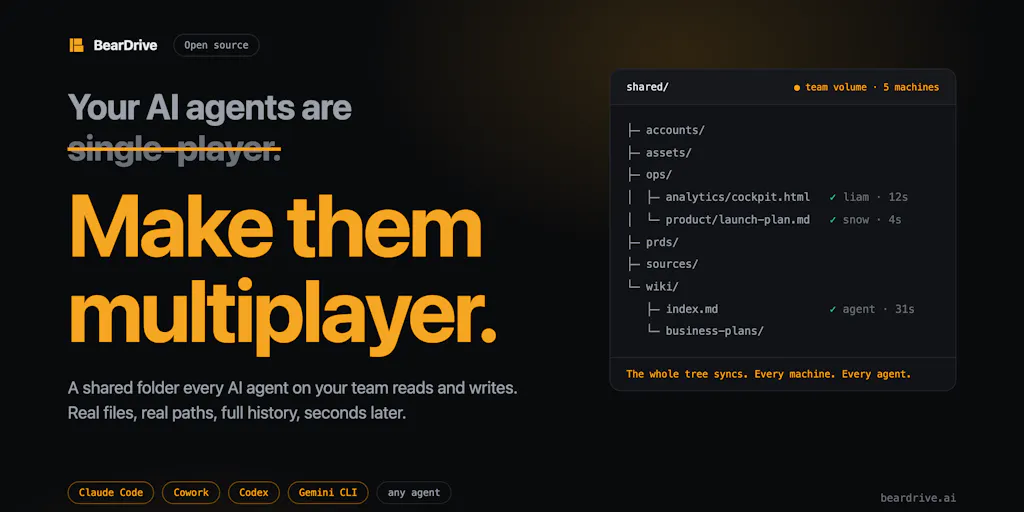
BearDrive’s approach is to sync a specific subfolder (the founder mentions their team uses shared/) to the whole team with full change history. Every file gets a link you can drop in Slack, and a web view that non-technical teammates can read without installing anything. The critical piece for cross-border teams is this: other people’s agents can read from the same folder, which means context moves between agents without a human having to re-explain it.
This matters more than it sounds. Consider the typical handoff problem in a DTC brand: your social media manager’s agent produces a competitor ad analysis in HTML. Your paid acquisition manager’s agent needs that data to adjust bidding strategy. In a traditional workflow, a human has to export, upload, and explain. With a shared agent-accessible folder, the second agent can read the file at a real local path, grep it, and build on it—no API fetches, no markdown-to-blocks conversion loss, no context re-explanation.
The founder’s response to the Notion comparison is worth reading carefully. He makes the distinction between a place agents write into versus a folder agents work in. Notion is excellent for prose that humans read. But when agents produce HTML reports, CSVs, and deck files, forcing those into a workspace turns them into attachments—and an attachment is a dead end for the next agent. In a real folder, they’re just files at real paths, immediately accessible to the next tool or agent that needs them.
Why Amazon sellers should care more than Shopify ones
If you’re running a Shopify DTC brand, your agent output is probably more prose-heavy: content briefs, email copy drafts, social captions. Notion might genuinely serve you fine. But if you’re an Amazon FBA operator, your agent output is data-heavy by nature: keyword research exports, inventory forecasting models, PPC performance CSVs, competitor price tracking tables. These are exactly the file types that get mangled when forced through a document workspace. An HTML report with embedded charts becomes a broken attachment. A CSV becomes a table that loses its formatting. The Amazon seller’s workflow is fundamentally file-based, and that’s where a tool like this earns its keep.
The founder’s team has clearly hit this wall themselves. They mention their agents produce “HTML reports, CSVs, PDFs, deck files”—the exact artifact types that Amazon sellers, logistics coordinators, and supply chain analysts generate daily. If your team is running agents for Helium 10 alternative research or inventory planning, you need a file system that treats those outputs as working artifacts, not as documents to be filed away.
The Security Question That Actually Matters
The sharpest exchange on the launch page comes from a commenter pressing on a genuine concern: what happens when an agent syncs something sensitive before a human reviews it? A contract draft, a research doc that accidentally captured an API key, a scraped page containing PII—the default model of “everything your agent writes locally is now everyone’s by default” is legitimately scary for any team handling customer data or proprietary sourcing information.
The founder’s answer is more thoughtful than most. There’s a .bdriveignore file, gitignore-style, that syncs with the folder itself—so exclusion rules become team-wide policy rather than per-person discipline. Crucially, the system doesn’t sync your whole project. You connect a specific subfolder, and only what’s written inside it ever syncs. The act of writing into the shared folder is the send, the same deliberate act as posting to Slack.
But here’s the honest limitation: there’s no review-before-sync step today. The founder acknowledges this directly, saying they’re planning to add more gates. The commenter’s suggestion—scoping review requirements by risk rather than by ceremony—is exactly right. A throwaway research note shouldn’t trigger a PR-style approval queue, but a finance folder or legal contract should. The founder’s response that “if a real API key syncs, rotate it, same rule as git” is honest but cold comfort for a cross-border team where a leaked supplier contract or customer PII could create real legal exposure.
Where the math breaks
The large-file question is worth watching if you’re considering this for agent memory systems or heavy data artifacts. The founder confirms 100 MB+ files sync fine, but there’s a catch: history is kept per change, so a large file rewritten frequently will cost storage and bandwidth on every write. If your agents are constantly updating a large database file, you’ll want to exclude it and sync periodic snapshots instead. For cross-border teams working with product catalogs or inventory databases that change hourly, this is a real consideration—not a dealbreaker, but something to plan around.
What Cross-Border Sellers Should Steal From This
Even if you don’t adopt BearDrive tomorrow, the underlying philosophy is worth borrowing. The founder’s team runs their entire company on it: strategy wiki, sales collateral, and research sync across teams, with each team’s agents reading and writing daily. The principle is that agent output should be born shared, not manually shared after the fact.
For a cross-border operation, this translates into concrete practices. Set up a shared folder structure that your agents write into by default. Define clear rules—via AGENTS/CLAUDE.md files or equivalent—about what belongs in the shared space and what stays local. Establish versioning and attribution so you know which agent session produced which artifact. And critically, make sure your agents can read each other’s output without human intervention.
The founder’s question to the community is the right one to ask yourself: when your teammate’s agent produces something useful, how does it reach you today? If the answer involves Slack uploads, email attachments, or a shared drive with no version control, you’re leaving value on the table. The teams that figure out agent-to-agent handoff will move faster than the ones still relying on human-mediated file sharing.
What I’d Watch / Test Next
Here’s what I’d do this week if I were running a cross-border team:
Audit your agent output flow. For the next seven days, track every file your agents produce. Where does it end up? How many times does someone re-create work that already exists? The answer will tell you whether you have a sharing problem worth solving.
Pilot a shared subfolder structure. Even without new tooling, create a
shared/directory in your agent projects and establish the rule that deliverables go there. See if your team can actually find and reuse files a week later. If they can’t, that’s your signal to evaluate dedicated solutions.Test BearDrive with a small, non-sensitive project. The Product Hunt page is live, and the founder is actively engaging with feedback. Try it with a competitive research project or a pricing analysis. Pay attention to whether your agents can actually read each other’s files, and whether the attribution model helps you trust the output.
Watch for the security gates. The founder has said review-before-sync is on the roadmap. If that lands in a way that lets you scope review requirements by folder risk, it becomes significantly more viable for teams handling sensitive customer or supplier data.
The era of agents producing files is here. The era of agents sharing files is just beginning. The teams that figure out the handoff first will be the ones that actually see ROI from their AI investments—not just in generation, but in compounding knowledge that doesn’t get lost in a Slack thread named “report-v2-FINAL.html.”


