The Real Lesson of Proto-Mind: Your Desktop Is the Next E-Commerce Ops Layer
Every cross-border seller I know runs the same ragged stack: Amazon Seller Central in one tab, a supplier thread in WeChat, a spreadsheet of FBA inbound shipments, a Klaviyo flow half-built, and a ChatGPT window somewhere in the corner doing the actual thinking. The interesting thing about Proto-Mind, a new Mac workspace built by Yurii Yaremenko for the GPT-6 Astra Challenge, isn’t that it’s another AI chat wrapper. It’s that it treats the desktop itself as the workspace — a floating cube you hover to peek at, detachable companion windows, parallel conversations, and tasks that keep running while the interface folds away. For operators drowning in context-switching, that framing is worth more than the product itself.
What Problem It Actually Solves — and Why “Floating Cube” Is Not a Gimmick
The pitch is deceptively simple: a Mac workspace where AI tasks, browser pages, and files stay together without taking over your screen. The small cube is the interaction primitive — hover to check on your workspace, click to keep it open, move away to get your screen back. Tasks continue in the background.
Read that against how you actually work. If you’re running a Shopify DTC brand, your day is a sequence of interruptions: a supplier confirms a revised MOQ, a TikTok Shop affiliate asks for a sample, a return lands in Amazon Seller Central, a Meta Ads manager flags a creative fatigue spike. Each context switch costs you the thread you were holding. The cube is a bet that ambient awareness beats full-screen attention — you glance, you don’t dive.
The more substantive feature is the detachable companion windows and parallel conversations. You can run separate AI conversations side by side and choose a different model or ChatGPT account for each chat. For sellers who’ve been pasting the same product description into one long ChatGPT thread and watching it hallucinate stale pricing from three prompts ago, per-conversation model selection is a real ergonomic win. It’s the difference between one overloaded assistant and a small team of specialists.
Why Amazon sellers should care more than Shopify ones
Shopify operators already live inside a reasonably coherent admin — Shopify’s own AI and app ecosystem keeps most of the workflow in one place. Amazon sellers don’t have that luxury. You’re bouncing between Seller Central, Helium 10 for keyword and listing research, a repricer, a PPC tool, and a separate inventory planner, none of which talk to each other natively. A persistent desktop layer that holds your AI tasks, reference files, and browser pages together is a bigger relative upgrade for the Amazon FBA crowd than for a DTC brand already living in one dashboard.
How It Differs From the Incumbents You’re Already Paying For
Let’s be honest about the comparison set. If you want AI in your e-commerce workflow today, your realistic options are:
- ChatGPT in a browser tab — cheap, capable, but stateless and screen-hogging.
- Claude or Gemini — same story, different flavor.
- Vertical AI tools like Jasper for copy or Copy.ai for marketing workflows — narrow, subscription-heavy, and often worse than a well-prompted frontier model.
- Automation layers like Zapier or Make — powerful for pipelines, useless for ad-hoc reasoning.
- OS-level assistants — Siri, Copilot on Windows — which most operators ignore because they don’t touch the actual workflows.
Proto-Mind sits in a gap none of these fill: a persistent, multi-conversation, file-aware workspace that lives on top of your desktop rather than inside a browser tab. The closest analog is probably Raycast with AI extensions, or a heavily customized Notion + AI setup — but neither gives you the hover-to-peek cube or per-chat model routing.
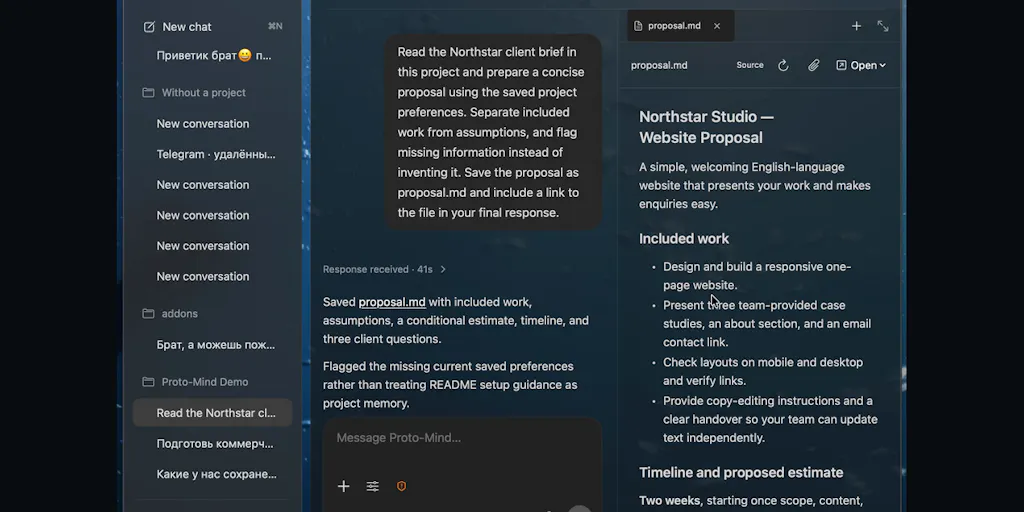
The genuinely differentiated bit is the task runner. Proto-Mind runs through Codex using your own ChatGPT account, and in the recorded demo, one request asks it to read a sample client brief and save a proposal while the interface is folded away. The output is a real project file to review, not just a generated answer. That distinction — artifact versus answer — is the whole ballgame for operators. An answer you have to copy-paste somewhere. An artifact lands in your workflow.
The “artifact, not answer” framing is the one to steal
Most e-commerce AI usage today is answer-shaped: “write me a listing,” “summarize this review,” “draft a supplier email.” You then manually move the output into Seller Central, Gorgias, or your 3PL portal. The Proto-Mind demo points at a better pattern: describe the outcome, let the agent produce the file, and treat the chat as a control surface rather than a text generator. If you’re building internal tooling — even just a Google Sheets + Apps Script stack — that’s the mental model to copy. Aim for artifacts.
What Cross-Border Sellers Can Borrow From This Launch
Strip away the Mac-specific chrome and there are four transferable ideas here, each of which you can apply this quarter without waiting for Proto-Mind to leave beta.
1. Ambient beats immersive for ops monitoring. The hover-to-peek cube is a UX pattern, but the principle generalizes. Your ops dashboard — whether it’s a Looker Studio report, a Triple Whale board, or a custom Metabase instance — should be glanceable, not a destination. If checking inventory health requires five clicks, you’re not checking it often enough.
2. Per-context model routing is table stakes now. Proto-Mind lets you pick a different model or ChatGPT account per conversation. You should be doing the equivalent in your own stack: use a cheap fast model for bulk translation of supplier messages, a frontier model for listing copy that actually converts, and a specialized tool where one exists. The OpenAI API and Anthropic API both make this trivially scriptable.
3. Long-term memory, editable, is the unlock. Proto-Mind ships with editable long-term memory. For a cross-border seller, that’s a place to store your brand voice rules, your supplier lead times, your MOQ floors, your return policy nuances. Every AI tool you use should be fed this context — Klавиyo for email, Gorgias for support, your PPC tools. If your AI doesn’t know your COGS, it can’t help you price.
4. Voice control is closer than you think. Live voice in Proto-Mind runs through a separate OpenAI API connection and billing. Voice-driven ops — “pull last week’s ACoS by campaign,” “draft a restock PO for SKU X” — is a 2025–2026 reality, not a 2030 one. Start structuring your data so it’s queryable by voice now.
Where the math breaks
Here’s the part the launch page glosses over. Proto-Mind is currently an early beta for Apple Silicon Macs running macOS 14 or later. The beta is not Apple-notarized, and the download page explains installation and its requirements. For a solo operator on an M-series MacBook, fine. For a team of five account managers on mixed hardware — some Windows, some Intel Macs, some Chromebooks — this is a non-starter today.
Then there’s the billing split. Astra runs through Codex using your own ChatGPT account, but live voice uses a separate OpenAI API connection and billing. That means two meters running, and if you’re already paying for a ChatGPT Plus or Team plan, you’re now stacking an API bill on top. Not disclosed is what the API usage looks like at scale — voice-driven ops can burn tokens fast. Budget accordingly before you standardize on it.
Finally, API and local-model connections have different capabilities from the Codex task runner. Translation: the “it reads your brief and saves a proposal” magic is tied to the Codex path. If you route through a local model for privacy — a real concern for sellers handling supplier contracts — you lose some of the artifact-generation capability. That’s a meaningful trade-off the launch copy doesn’t spell out.
Where My Judgment Says It Falls Short
Three honest concerns.
First, the Mac-only, Apple-Silicon-only constraint is a ceiling, not a floor. Cross-border e-commerce teams are geographically and hardware-distributed. A tool that only runs on one OS and one chip generation will never be the shared ops layer — it’ll be a power-user toy. That’s fine as a beta, but it caps the addressable audience hard.
Second, “workspace” tools have a graveyard problem. Notion, Craft, Obsidian, Coda — every few years a beautiful workspace tool launches and 90% of users churn within six months because the switching cost of moving their real work into it is too high. Proto-Mind’s cube is delightful; whether it survives contact with a Tuesday afternoon of supplier escalations is a different question. The launch page asks for feedback on the cube and companion windows — good instinct, because those are the retention surfaces.
Third, the AI task runner is the hard part and the least proven. Reading a sample client brief and saving a proposal is a clean demo. Real seller workflows are messier: multi-step, cross-tool, error-prone, and full of edge cases (partial shipments, split payments, marketplace-specific compliance). Not disclosed is how Proto-Mind handles failure states — what happens when the task runner misreads a PO quantity, or when a voice command gets transcribed wrong. Until that’s answered, treat the artifact-generation capability as promising, not production-ready.
The uncomfortable comparison
If I’m a cross-border seller with $2M–$20M in GMV and a small ops team, my honest question is: why Proto-Mind and not just a well-configured Raycast plus a few OpenAI API scripts plus Superhuman for email? The answer has to be the integrated workspace and the task runner. If those don’t deliver measurable time savings in a two-week trial, the switching cost isn’t worth it. That’s the bar.
What I’d Watch / Test Next
Three concrete moves this week.
Run a two-week parallel test. Install Proto-Mind on one operator’s Mac (Apple Silicon, macOS 14+, non-notarized install — read the download page carefully). Have them run their normal supplier-comms and listing-drafting workflow through it alongside their existing ChatGPT tab. Log hours saved and artifacts produced. If it’s under two hours a week, don’t roll it out.
Build a “context file” for your AI stack regardless of whether you adopt Proto-Mind. One markdown doc with your brand voice rules, supplier lead times, MOQ floors, return policy, top 20 SKUs, and current ad targets. Feed it to every AI tool you use — Klавиyo, Gorgias, your PPC tools. This is the highest-ROI AI move available to a cross-border seller right now, and it costs nothing.
Watch the billing meters. If you do adopt Proto-Mind, track the Codex/ChatGPT usage and the separate OpenAI API voice billing for the first month. Unknown cost curves are how SaaS quietly becomes expensive. Set a hard ceiling before you scale usage.
The broader signal here is bigger than one Mac app: the desktop is becoming the new ops layer, and the sellers who treat their AI stack as infrastructure — not a novelty — will be the ones compounding. Proto-Mind is one early sketch of what that looks like. The pattern is worth stealing even if the product isn’t ready for your team.