Why Every Cross-Border Operator Should Rethink AI Agents
If you manage inventory across Amazon, Shopify, and TikTok Shop, you’ve already learned that the most expensive resource in your operation isn’t warehouse space or ad spend — it’s your own attention. Every minute you spend babysitting a chat-based AI tool that requires you to prompt, wait, re-prompt, and confirm is a minute you aren’t analyzing competitor pricing, negotiating with suppliers, or fixing a broken listing. The real bottleneck in cross-border e-commerce has become the synchronous relationship between human and machine. Clark Agent is trying to break that pattern by giving an AI its own persistent cloud computer — a browser, a terminal, a filesystem — so you can fire off a task, walk away, and come back to finished artifacts you can actually use. That shift from “answer my prompt” to “complete the work and return proof” is exactly the kind of leverage a seller with three marketplaces and a day job needs. It’s not perfect yet, but the direction is more important than the current feature set.
What Problem Does Clark Actually Solve?
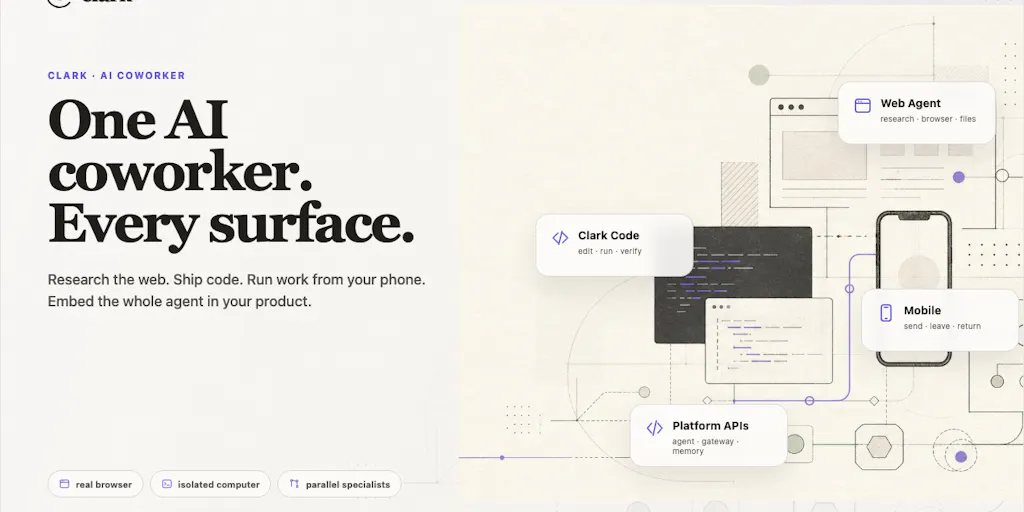
The standard AI workflow in e-commerce today goes like this: you open ChatGPT, Claude, or a custom GPT, paste a competitor’s ASIN, ask for a listing rewrite, get a wall of text, copy-paste it into Seller Central, adjust manually, and pray. That’s still a chat window — it’s faster than a human copywriter, but it’s not autonomous. Clark’s premise is fundamentally different. The product gives the agent a full environment — a cloud computer with a browser, terminal, files, code, and an async workspace. You send a task, leave, and come back to what the maker calls an “artifact”: a file, a screenshot, a source log, a URL, or a code patch. The jobs Clark is optimized for — browser research, website publishing, scheduled monitoring, document audits, decks, spreadsheets, and code patches — map directly to the repetitive, data-heavy tasks that consume a seller’s week.
Take a concrete cross-border scenario: you want to monitor five competitor listings on Amazon Germany for price drops, review changes, and keyword additions. Today you’d either use a scraper tool (which risks IP bans and TOS violations) or manually check. Clark could be tasked to visit those URLs daily, take screenshots, extract pricing data into a spreadsheet, and dump logs you can inspect. The key is that the agent does not need you to sit and watch. It works in its own environment, returns artifacts, and you decide whether to trust the output. For a seller running multiple Amazon marketplaces plus a Shopify store, that asynchronous delegation is the difference between scaling and burnout.
How It Differs from Existing Options
Most AI tools in the e-commerce tool stack are point solutions. Helium 10 gives you keyword data; Jungle Scout gives you product research; Klaviyo automates email flows. None of them offer a general-purpose agent that can open a browser, navigate Seller Central, fill out a listing form, and hand you back a confirmation screenshot. Clark is not trying to replace those specialized tools — it’s trying to be the brain that orchestrate them (or bypass them by using raw browser access). The maker claims that “what Hermes does with Opus 4.8, Clark can do with Gemini 3.1 Flash life (20x cheaper!).” Whether that cost claim holds under real workloads is an open question, but the architectural difference is real: Clark gives the AI its own cloud computer, not just an API to call.
Compare this to the wave of “agentic” frameworks like AutoGPT or LangChain. Those tend to run in your own environment, require heavy setup, and produce unpredictable results because they lack a persistent workspace. Clark’s approach of giving each task an isolated environment — with its own browser, filesystem, and terminal — avoids the shared-state race conditions that plague many multi-step agents. In the Product Hunt comments, the maker confirmed that when parallel specialists split a task, each gets a fully isolated environment, and artifacts are merged afterwards. That’s a design choice that matters for cross-border operators: you don’t want a price-monitoring agent to accidentally overwrite a listing-optimization agent’s data because they share a temp folder.
Where Clark falls short of incumbents is in integration depth. It does not have native connectors to Amazon SP-API, Shopify Admin API, or TikTok Shop’s backend. Its value today is in browser-based interaction — essentially RPA (robotic process automation) powered by an LLM. For sellers who have already built internal tooling using Make or Zapier, Clark might feel like a step backwards because it replaces deterministic API calls with probabilistic browser clicks. But for sellers who don’t have API access (e.g., Temu, SHEIN, Etsy) or who need to interact with bespoke supplier portals, browser automation is the only game in town.
What Cross-Border Sellers Can Borrow from the Clark Model
Even if you never install Clark, its architecture offers three mental models that should reshape how you think about AI in your operation.
Async Delegate, Don’t Chat
The most important principle is that AI should not require your ongoing attention. Every time you pause to read a chat response and type a follow-up, you’ve lost the flow state that drives high-value decisions. Clark’s “send task, leave, come back to artifact” model is something you can replicate with any capable LLM by packaging your prompt as a script that runs in a headless environment — or by using Zapier to trigger an AI step and store results in a database. The key is designing workflows where the AI delivers a concrete output (a CSV, a PDF, a URL) rather than a conversational answer.
Parallel Specialists
The idea of spawning multiple isolated agents to work concurrently on subtasks is powerful. In practice, a seller could have one agent doing competitor research while another drafts listing copy and a third audits your inventory report — all running in parallel, all returning separate artifacts. Clark’s architecture handles the isolation and merge automatically. If you’re building your own toolchain, consider using tools like Temporal or AWS Step Functions to orchestrate parallel AI tasks, and always use separate environments (containers) to avoid state contamination.
Artifact-Driven Quality Control
The maker emphasized that Clark returns files, screenshots, sources, logs, or URLs you can inspect. That’s a better audit trail than a chat transcript. When you ask an AI to generate product descriptions and it returns a file, you can diff that file against a previous version, check for factual errors, and even rerun the task if the output doesn’t match a schema. For cross-border operations where compliance (CE marking, FDA statements, country-specific claims) is critical, having a verifiable artifact is non-negotiable.
Why Amazon Sellers Should Care More Than Shopify Ones
Shopify sellers have it relatively easy: APIs are clean, apps like Oberlo or DSers automate fulfillment, and ChatGPT can generate blog posts all day. Amazon sellers, especially those on multiple marketplaces with VAT, FBA, and PPC, face a mess of form-filling, data extraction, and rule-checking that no single API covers. Clark’s browser-based approach could automate tasks that Amazon’s own APIs don’t expose cleanly, like adjusting low-inventory fees, filing SAFE-T claims, or auditing fulfillment reports. A seller with six EU marketplaces and ten SKUs would benefit more from an AI that can log into Seller Central for each store, pull the inventory report, and flag discrepancies — all in the background — than from another keyword tool.
Where the Math Breaks
Token Efficiency vs. Reliability
The maker’s claim that Clark can do with Gemini “20x cheaper” sounds great until you realize that Gemini Flash is less capable than Opus for reasoning-heavy tasks. If Clark hallucinates a price comparison because the browser loaded a cached page, you’ve saved tokens but lost confidence. For cross-border sellers, the cost of an error — e.g., publishing a listing with a wrong bullet point — far exceeds the compute cost. I would rather pay 20x more for an agent that verifies every fact against a trusted source than save money on runs that need manual double-check.
Trust and Security
Clark runs on its own cloud computer, which means it has a browser that can navigate to any URL, including your Amazon Seller Central login page. The maker stated that if it needs to log in, it will ask the user to “take over browser and provide credentials.” That’s reasonable, but it still means the agent has network access to the same sites you do. If a malicious actor compromised the Clark environment, they could exfiltrate session cookies. For sellers handling sensitive data (payment info, PII), the security model needs to be transparent — ideally with SOC 2 certification and ephemeral environments that wipe after each task. The Product Hunt comments didn’t address this, so I’d push for answers before trusting Clark with anything beyond public competitor data.
Integration Gaps
Clark is a generalist. It doesn’t natively understand Amazon’s category tree, Shopify’s metafields, or TikTok Shop’s commission structure. You have to teach it through prompts and examples. That works for one-off tasks, but for recurring workflows you need a specialized agent or a fine-tuned model. The tool lacks the pre-built templates that tools like SellerSprite or Helium 10 offer, so your onboarding time is higher. If you’re a solo operator with 20 SKUs, that tradeoff might be fine. If you manage 500 SKUs across three channels, you need something with less friction.
What I’d Watch / Test Next
Clark is worth testing this week, but start small. Pick one non-critical task that you currently do manually — like checking your top three competitors’ pricing every Monday — and see if Clark can produce a reliable weekly report. Specifically, I’d ask it to:
- Visit each competitor’s Amazon listing (use a public URL, not your seller account).
- Extract the current price, review count, and rating.
- Compare to last week’s values and flag changes above 5%.
- Dump the results into a Google Sheet (via its browser interaction) and email you a summary.
If Clark can do that for three ASINs without needing a manual unlock, you have a proof of concept. Then expand to five ASINs, then across two marketplaces. The moment you hit a login wall (e.g., needing to check a Buy Box status in Seller Central), evaluate how smooth the handoff is. If the “take over browser” flow works reliably, you can start automating higher-value tasks like filing missing inventory claims or auditing return rates.
Longer term, I’m watching for two signals: API integration and template marketplace. If Clark or a competitor opens a connector hub — think Zapier for agent artifacts — then cross-border operators can start chaining these agents into real workflows. Until then, treat Clark as a prototype of a paradigm that should exist, not a finished product. The direction is right: give the AI its own computer, not just a chat window. The execution will improve fast, and sellers who learn to design async, artifact-driven tasks today will have a head start when the infrastructure catches up.