Why a Self-Building AI Fleet Matters More Than Another Dashboard
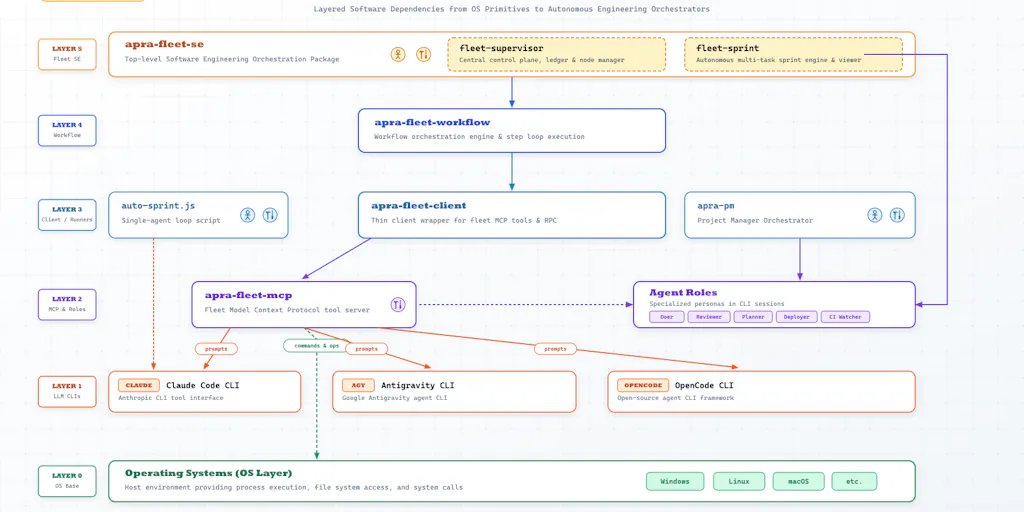
Every cross-border operator I know is drowning in the same paradox: we have more tools than ever, yet the mechanical work of running an e-commerce operation — syncing inventory across Amazon and Shopify, reconciling marketplace payouts, scraping competitor pricing, updating listings across five channels — still eats the hours that should go into strategy. We’ve been sold AI as a copilot that writes emails, but the real bottleneck was never writing. It’s the coordination — getting multiple systems to talk to each other, run unattended, and recover when something breaks at 2 a.m. during a flash sale. That’s why apra-fleet, a control plane for AI agents that runs them across your actual machines and keeps long unattended work alive, caught my attention. This isn’t another chatbot wrapper. It’s an infrastructure play that treats AI agents like a distributed workforce — and for anyone running a multi-channel operation, that’s a fundamentally more interesting proposition than yet another analytics dashboard.
The Problem It Actually Solves: Unattended Work Is the Missing Layer
Here’s the honest truth about how most cross-border sellers use AI today: we treat it like a glorified search bar. We ask ChatGPT to draft a product description, we paste it into Helium 10 to check keywords, we manually copy the result into Amazon Seller Central. The moment we try to chain multiple AI calls together — say, having one model extract competitor prices from a scraped page, another model decide on a repricing strategy, and a third model execute the change — the whole thing falls apart. Why? Because LLM providers have timeouts, rate limits, and context windows that make long-running workflows a nightmare. A task that takes forty minutes of multi-step reasoning will just die halfway through.
The apra-fleet team — the maintainers describe themselves as having “several machines, several provider subscriptions, and no sane way to use them together” — built this because they hit the exact same wall. They wanted premium models for judgment calls and cheap or local models for mechanical work, all running across their actual hardware without someone babysitting the process. That’s a problem every serious operator recognizes. When you’re running a TikTok Shop storefront alongside an Amazon FBA business, you don’t have the luxury of watching a terminal window. You need work to happen while you sleep.
The deeper insight here is what the maker calls “explore with agents, operate with programs.” The idea is that you let an LLM figure out a workflow once — spend tokens on discovery — and then convert that understanding into a deterministic program that runs the mechanical steps for free, calling a model only when actual judgment is required. Their own e2e setup step went from “a few dollars per run to roughly zero.” For a cross-border seller, that cost curve is the entire game. If you’re running daily repricing across 5,000 SKUs and every run costs you token fees, the math breaks. If the first run figures out the pattern and the next 999 runs are nearly free, you’ve just turned a money-losing automation into a margin driver.
How It Differs From Everything Else You’ve Tried
Let me be specific about the incumbent landscape, because this matters for your tooling stack. The obvious comparison is Zapier or Make — workflow automation tools that connect SaaS apps. Those work fine for simple triggers, but they’re fundamentally shallow. They can’t run code on your machines, they can’t manage a fleet of distributed workers, and they certainly can’t have an AI agent file bugs against itself and fix them in the next cycle. The apra-fleet approach is more like a distributed task queue with an AI brain — closer to what Temporal does for deterministic workflows, but with LLM orchestration baked in.
Then there’s the agent framework layer — LangChain, CrewAI, and the rest. Those give you the building blocks for multi-agent systems, but they don’t solve the operational nightmare of running those agents reliably. They assume you’ll handle deployment, monitoring, and recovery yourself. The apra-fleet pitch is that they’ve spent eight months as their own primary users hardening exactly those unglamorous parts: “stall detection, crash recovery, resumable state.” That’s the difference between a demo and a tool you can trust with production work.
The most interesting contrast, though, is with the vertical AI tools that have sprouted across e-commerce — repricers, listing optimizers, review responders. Those are single-purpose. They solve one slice of your operation and don’t talk to each other. Apra-fleet is deliberately domain-agnostic; the workflow engine “doesn’t know what a sprint is.” The team cites two production use cases that have nothing to do with software: tracking cloud spend across a large-scale SaaS deployment and reconciling construction project financials. For a cross-border seller, that generality means the same control plane that runs your pricing intelligence could also run your inventory forecasting, your supplier communication, and your returns analysis — without you having to buy five different point solutions.
Why Amazon Sellers Should Care More Than Shopify Ones
If you’re running a Shopify DTC brand, you have a relatively clean data environment. Your store, your customers, your orders — it’s all in one place, and the Shopify API is well-documented and stable. You can get away with simpler automation because the system boundaries are narrow.
Amazon sellers live in a different world. You’re dealing with Seller Central reports that change format without notice, FBA inbound shipment windows that shift, buy box fluctuations driven by a dozen factors you can’t fully see, and a marketplace that actively discourages off-platform automation. The number of moving parts is staggering, and the cost of a failed unattended run is real money — a missed repricing window during a competitor’s stockout, a late inventory sync that triggers a listing suppression. This is precisely the scenario where a control plane that runs durable programs — not fragile one-shot scripts — earns its keep. The ability to have an agent plan work, dispatch it across machines, have a different provider review each change, and file bugs against itself is the difference between automation that occasionally works and automation that self-corrects.
Where the Math Breaks
Let’s talk about the token economics, because that’s where most AI tooling falls apart in practice. The apra-fleet team’s claim that their e2e setup went from “a few dollars per run to roughly zero” sounds great, but it depends on the workflow being reducible to a deterministic program after initial exploration. That works for processes with a clear success criterion — a setup step either succeeded or it didn’t. But many cross-border operations don’t have that clarity. A pricing decision based on competitor intelligence involves judgment that’s hard to codify into a deterministic program. If you’re calling a premium model for every decision, the cost curve doesn’t flatten the way it does for mechanical work.
The honest reading of what apra-fleet offers is that it’s a framework for achieving that cost curve, not a guarantee. You still need to invest the engineering time to convert your exploratory agent runs into deterministic programs. For a solo seller or a small team without technical chops, that’s a real barrier. The “quick start is genuinely five minutes” claim — npm install -g @apralabs/apra-fleet — assumes you’re comfortable with a command line and can reason about distributed systems. That’s not the typical profile of someone managing a Temu storefront.
What Cross-Border Sellers Can Borrow From This Right Now
You don’t have to adopt apra-fleet tomorrow to benefit from the thinking behind it. The “explore with agents, operate with programs” philosophy is directly transferable to how you build your automation stack, regardless of the tooling. Here’s what I’d take from it:
Separate judgment from mechanics in every workflow you automate. When you’re building a repricing rule, don’t have an LLM make every decision. Have it analyze the competitive landscape once a week and output a pricing algorithm — then let that algorithm run deterministically until the next analysis cycle. The same logic applies to inventory forecasting, ad budget allocation, and supplier negotiation scripts.
Design for unattended recovery, not just unattended execution. The apra-fleet makers emphasize that “a fleet you have to watch is worse than no fleet.” Most e-commerce automation fails at this. Your Klaviyo flows might fire correctly, but what happens when Shopify rate-limits your API calls mid-sync? Does your system retry with backoff, or does it silently die and leave you with a stockout? The operators who win are the ones who build self-healing into their processes.
Use mixed models strategically. The apra-fleet approach of “premium models only where judgment matters, cheap or local models for mechanical work” is a cost discipline most sellers ignore. You don’t need GPT-4 to extract a tracking number from a supplier email. You need it to decide whether a supplier’s delay justifies switching vendors. Route accordingly.
The Multi-Agent Review Pattern Is Underrated
One of the most interesting operational patterns in apra-fleet is having “a different AI provider review each change.” This is a quality-control mechanism that most e-commerce operators haven’t considered. When you’re generating product listings at scale, you’re typically using one model and hoping for the best. But a second model — ideally a different provider with different training data and biases — catching hallucinated product specs or compliance issues before they go live is a cheap insurance policy. For Amazon sellers, where a single listing violation can trigger account suspension, this kind of adversarial review loop is worth more than most premium SaaS subscriptions.
Where My Judgment Says It Falls Short
I’ve been around enough tool launches to know that the gap between a compelling Product Hunt demo and production reliability is wide. The apra-fleet makers are honest about their status: “single autonomous sprints on a fleet you register are solid — that’s our daily driver. The multi-sprint supervisor dashboard is a preview, and some permission setup is still manual.” That’s a refreshingly candid assessment, but it also tells you what’s not ready.
For cross-border sellers, the missing pieces are significant. There’s no mention of integrations with e-commerce platforms, payment processors, or logistics APIs. You’d be building those connectors yourself. The tool is Apache-2.0 licensed and free, which is great for tinkerers, but it means you own the operational burden. There’s no managed cloud version, no support SLA, no promise that the workflow engine won’t change in breaking ways between versions. For a serious operation, that’s a non-starter for core workflows.
The other gap is the observability story. The team mentions tracking cloud spend and reconciling construction financials as production use cases, but the dashboard is clearly oriented toward engineering workflows — sprints, issue trackers, integration suites. Translating that to e-commerce operational metrics — order defect rates, inventory turnover, advertising cost of sales — requires either significant customization or a mental translation layer that most operators won’t bother with.
Finally, there’s the provider dependency risk. Apra-fleet is provider-agnostic, which is good, but it still depends on LLM APIs that can change pricing, rate limits, or capabilities overnight. The “free” tier of the tooling hides the fact that your token spend is the real cost. If you’re running a high-volume operation, that’s a variable cost that scales with your success — and it’s not capped.
What I’d Watch / Test Next
If you’re intrigued but not ready to commit, here’s what I’d do this week:
Run a small, non-critical workflow through apra-fleet — something like nightly price monitoring on a handful of competitor SKUs. The five-minute install claim is real if you’re comfortable with a terminal. Use it to validate whether the “explore with agents, operate with programs” loop actually delivers the cost savings they claim. Track your token spend before and after the workflow stabilizes.
Build a judgment-vs-mechanics audit of your current automation. Take your top five recurring operational tasks — repricing, inventory sync, review monitoring, ad optimization, supplier follow-up — and map which steps require actual judgment and which are mechanical. You’ll likely find that 70–80% of the steps are mechanical and could be deterministic, which is the apra-fleet thesis applied to your own stack.
Test the multi-provider review pattern manually. Pick a high-stakes output — a new product listing for Amazon, a customer-facing email sequence, a supplier contract clause — and have a second AI provider review the first’s work. The cost is pennies, and the error-catching potential is significant. This is the pattern apra-fleet automates, but you can start doing it by hand today.
Watch the project’s GitHub for durability signals. The team’s commitment to Apache-2.0 licensing and open-sourcing their workflow engine internals is a good sign, but watch for sustained commit activity and a growing issue tracker. A tool like this lives or dies on community trust and maintenance discipline.
The broader takeaway is that the next wave of e-commerce tooling won’t be about single-purpose AI features bolted onto existing SaaS. It’ll be about orchestration — getting multiple agents, models, and machines to work as a coordinated system that runs unattended and self-corrects. Apra-fleet is an early signal of that direction, and even if you never adopt it, the operational philosophy behind it is worth stealing. The sellers who figure out how to separate judgment from mechanics and build self-healing workflows will be the ones who scale without scaling their headcount.