The Attention Arbitrage Play: Why Your Product Pages Are Losing Customers to Their Own Impatience
Every cross-border seller I know obsesses over the same vanity metrics: traffic spikes, click-through rates, add-to-cart percentages. We pour money into Helium 10 keyword research, bid wars on Amazon Sponsored Products, and endlessly A/B test Shopify theme variants. But here’s the uncomfortable truth nobody in the DTC space wants to admit: the moment a potential customer lands on your product page, you’re already fighting a losing battle against their thumb. They scroll. They skim. They flick past your carefully crafted bullet points and your “About Us” story like it’s a Terms of Service agreement. And then they’re gone, bouncing to a competitor who didn’t even bother to write a description, just a better price and a faster delivery promise.
The real bottleneck in e-commerce isn’t traffic acquisition anymore — it’s attention retention. We’ve optimized the funnel’s top until it’s a firehose, but the middle is a sieve. This is why I’ve been watching the rise of AI-powered reading assistants with more than casual interest, and why the launch of Framer AI Agents and the iterative development of Skim Recap by yui M represent something significant — not for what they are as consumer toys, but for what they signal about how we must fundamentally rethink content consumption in a global marketplace where your buyer might be reading your listing in their second language, at 2 AM, on a phone with a cracked screen.
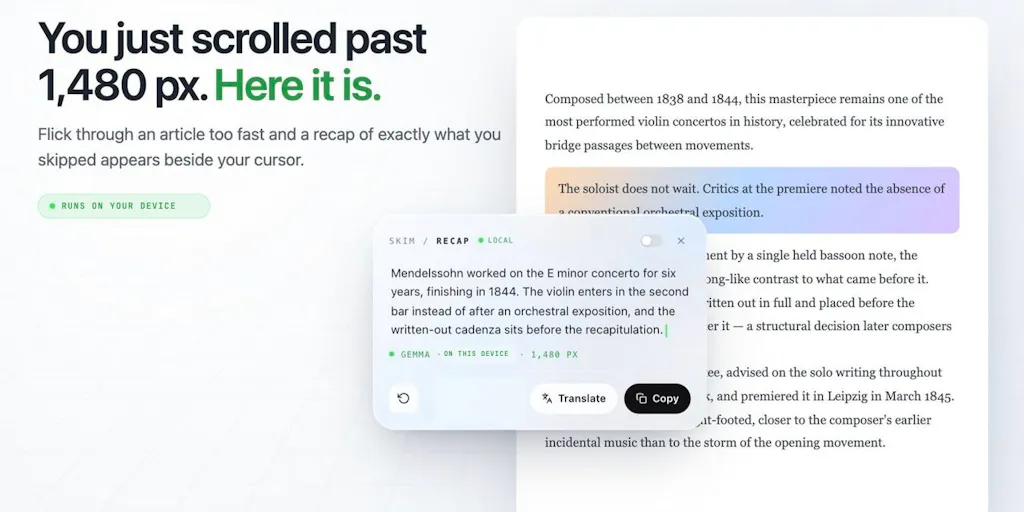
Let’s talk about the actual mechanics of losing a sale. It’s rarely a dramatic failure. It’s death by a thousand skips. The customer scrolls past your “Premium Quality” header, ignores your “Ships from US Warehouse” note, and lands on a review that mentions sizing issues. They don’t read the size chart. They don’t read your return policy. They just leave. What if we could recapture that skipped context in real-time? That’s the core problem Skim Recap is trying to solve, and it’s a problem that should terrify and inspire every brand owner who’s ever watched their analytics dashboard show a 4.2-second average session duration on a page they spent weeks perfecting.
The Context Gap: Why “Faithful” Recaps Are the Future of Localized Listings
The first thing that struck me about Skim Recap’s approach is the philosophical commitment to restraint. The maker explicitly notes that a recap is “deliberately limited to what the passage said.” In an AI landscape where every tool promises to generate entire campaigns from a single prompt, this is almost contrarian. For cross-border operators, this distinction is critical. Most AI writing tools available to sellers — the ones integrated into Shopify or offered as Amazon Seller Central third-party apps — are designed to expand content. They take a feature list and generate 500 words of fluff about “elevating your lifestyle.”
Skim Recap does the opposite. It compresses without hallucinating. It doesn’t invent a benefit that isn’t in the source text. For a seller trying to localize a listing from English to German or Japanese, this is the difference between a translation that adds cultural nuance that doesn’t exist and a translation that faithfully conveys the technical spec. The tool’s use of “the closest heading and the page title” to determine meaning is essentially a primitive form of SEO contextualization. It’s teaching us that the surrounding structure of your content matters more than the content itself.
This is a lesson for how we build product pages. If an AI scraper or a human reader can’t determine what your product is from the H1 and the first paragraph alone, you’re losing the algorithm game. The “Feynman” feature, which allows a user to select a specific word or phrase to get a context-aware explanation, is the most interesting part here. Think about the cross-border buyer who doesn’t know what “GSM” means in a fabric listing, or what “IPX7” signifies in a waterproof electronics listing. They don’t want a full rewrite of the paragraph; they want a definition of that one term that’s stopping their comprehension. Skim Recap’s approach — using the passage, nearby context, and heading to disambiguate “argument” in a logic article versus a function signature — is exactly the kind of semantic precision that localized product descriptions desperately need.
Why Amazon Sellers Should Care More Than Shopify Ones
Shopify store owners control their narrative. They can write long-form storytelling pages, use custom CSS to highlight text, and design the entire journey. Amazon sellers, on the other hand, are trapped in a rigid A+ content template that forces them to compress their value proposition into a few image blocks and a bullet list. The “honest trade-off” of a 2.97 GB model download and substantial local memory requirements — as disclosed in the Skim Recap launch page — seems absurd for a consumer, but it’s a non-starter for a mobile browser. However, the concept of local, private, context-aware summarization is a goldmine for Amazon FBA operators who are tired of paying for SaaS tools that send their proprietary product data to hosted LLM APIs.
For Amazon sellers, the “fast-scroll threshold” is the equivalent of the “above the fold” metric. Amazon’s algorithm tracks dwell time and bounce rate, albeit opaquely. If a potential customer scrolls past your bullet points quickly because they’re generic, the algorithm notices. Skim Recap’s attempt to detect a “fast scroll” and recap “exactly that skipped stretch beside your cursor” is a direct mirror of the user behavior we need to preempt in our listings. We can’t install an extension on the buyer’s browser, but we can structure our content so that even a fast scroller catches the key differentiator. We need to write bullet points that are self-contained, so that skipping one doesn’t lose the plot.
The Local-First Economics of AI Tooling for Global Operations
The most technically significant aspect of Skim Recap is its architecture: everything runs locally with Gemma 4 E4B, LiteRT-LM, and WebGPU. There is “no account or hosted LLM API.” For a cross-border seller running a lean operation, this is a massive signal about where the tooling stack is heading. We’ve become conditioned to the subscription-everything model — paying $99/month for a keyword tool, $59/month for an email platform like Klaviyo, and then another $20/month for an AI writing assistant that requires an API key.
The promise of on-device AI isn’t just about privacy (though that’s a huge win for sellers dealing with proprietary sourcing data or unpublished product roadmaps). It’s about latency and cost predictability. When you’re managing listings across multiple marketplaces — let’s say you’re selling on eBay, Etsy, and TikTok Shop simultaneously — you don’t want to wait for a server in Virginia to process a prompt from your laptop in Shenzhen. Local inference eliminates that lag. The requirement for WebGPU and “substantial local disk/memory requirements” is a barrier, sure, but it’s a barrier that will fall faster than we think. The M-series chips and high-end Android tablets that most serious operators use can handle this.
The “shadow root” implementation — ensuring the card “runs in a shadow root so host-page CSS cannot restyle it” — is a subtle but profound detail for anyone who has ever tried to build a Chrome extension for e-commerce workflows. It’s a technical acknowledgment that the web is a hostile environment. Your beautifully designed tooltip or recap card will get mangled by the host page’s aggressive stylesheets. For sellers, this is a reminder that your own product pages are subject to the same chaos. If you’re embedding review widgets or size chart popups that don’t have proper CSS isolation, they’re going to look broken on mobile devices. The technical rigor here is a lesson in defensive design.
Where the Math Breaks
Let’s be brutally honest about the limitations. The 2.97 GB model download is a non-starter for 90% of the consumer market. For a cross-border seller, this isn’t a tool you hand to your customers; it’s a tool you might use internally for competitive research. You could use it to skim through a competitor’s long-form blog post or their Temu store policies without missing the fine print. But the “Feynman” feature, while brilliant, is only as good as the context it’s given. If you’re analyzing a product spec sheet that uses a proprietary term like “DTC-optimized,” the local model won’t know it. It doesn’t have access to your brand’s internal glossary.
The math also breaks on the “Retry asks for a genuinely different expression” feature. In a cross-border context, a “genuinely different expression” might require cultural adaptation, not just syntactic variation. A local model can’t tell you that a phrase which works in US English is considered aggressive in Japanese. It lacks the cultural corpus. So while the tool is excellent for comprehension, it is still primitive for transcreation. That’s where the human operator still earns their keep. We can use tools like this to speed up our reading, but we cannot yet use them to replace our cultural consultants.
Borrowing the Playbook: Operational Lessons for the DTC Operator
So, what can we actually take from this launch and apply to our businesses this week? It’s not about installing Skim Recap on your laptop (though you might). It’s about adopting the principles of the tool in your content strategy.
First, the principle of the “closest heading”. When you structure your product descriptions, every paragraph should be subordinate to a clear, keyword-rich heading. This isn’t just for SEO; it’s for AI readability. As more consumers use AI assistants to summarize product pages before they buy, your content needs to be structured so that the AI can easily parse the “closest heading” to answer the user’s question. If your H2 says “Sizing” but the paragraph underneath talks about fabric composition, you’re confusing the machine and the human.
Second, the principle of the “faithful recap”. Don’t let your marketing team write hyperbolic descriptions that don’t match the spec sheet. If you claim “Unbreakable” in the title, but the details mention “fragile handling required,” you’re setting up a negative recap. The AI tools that summarize your listing for the buyer will pick up on that contradiction. Write honest, spec-driven copy. Let the benefits be implied by the features.
Third, the principle of local processing. Evaluate your current tooling stack. Are you sending sensitive data — like your Amazon repricing strategy or your supplier contact lists — to a hosted LLM? Consider local-first alternatives for data analysis. The latency and privacy benefits are real. The Skim Recap page explicitly mentions “Gemma 4 E4B, LiteRT-LM, and WebGPU” — these are the building blocks of a new generation of private, fast tools that serious operators should be tracking.
The “Feynman” Method for Customer Support
The most actionable idea here is the “Feynman” concept applied to your FAQ page. The tool’s ability to select a word and get a context-specific explanation is exactly what your customer support team needs. Instead of writing a 500-word FAQ answer, write a concise paragraph and then create a glossary of terms. When a buyer from Spain asks about “certification,” point them to the specific phrase in the description and give them the explanation. This reduces the cognitive load on the buyer. You’re not just giving them an answer; you’re teaching them how to read your product page better. This is the ultimate form of pre-sales education.
What I’d Watch / Test Next
This week, I’m not going to rush out and install a browser extension. I’m going to run a content audit on my top three SKUs using a simple test: Can I summarize the key selling points from the product page alone, without looking at the product itself? If I can’t, my customers can’t either.
Concretely, here’s my plan of action for any seller reading this:
- Test the Feynman logic manually: Take a technical spec from your product (e.g., “Thread count 400”) and write a one-sentence explanation that assumes zero prior knowledge. Put that explanation directly beneath the spec in your listing, not in a hidden FAQ tab.
- Audit your headings: Ensure every H2 and H3 in your Shopify blog posts and product descriptions is a standalone summary of the following paragraph. If you were to delete all the body text, the headings should still tell the complete story of the product.
- Check your CSS isolation: If you’re using third-party review apps or size chart widgets, view your product page on a mobile device with a custom dark-mode reader. If the widget looks broken, it’s hurting your conversion. Take the “shadow root” lesson to heart and demand better isolation from your app vendors.
- Monitor the local AI space: Keep an eye on the development of WebGPU compatibility in mainstream browsers. The moment it’s stable, tools like this become viable for internal research teams. The promise of running a private, offline analysis of a competitor’s entire TikTok Shop catalog without sending a single request to a server is a strategic advantage worth waiting for.
The takeaway isn’t about the tool itself; it’s about the shift in how we must treat content. The skimmer is the new normal. The fast-scroll is the default behavior. Build your pages for the skimmer, structure your data for the machine, and keep your core value proposition in a bullet point that can be read in under two seconds. That’s the game now.


