The documentation tax nobody budgets for — and why cross-border ops teams should care
Every cross-border seller I know runs on a wiki they no longer trust. Somewhere between the first SOP and the fifth marketplace expansion, the playbook that tells a VA how to handle an A-to-z claim, how to file a SAFE-T claim, or how to escalate a TikTok Shop violation quietly diverges from reality. The docs don’t fail loudly. They fail during a peak-season incident, a compliance audit, or a new-hire onboarding — the three moments when you can least afford it. That’s the exact pain WikiFix is pitching into, and it’s worth a serious look even if you’ve never opened Confluence in your life.
What WikiFix actually does — and the honest caveats up front
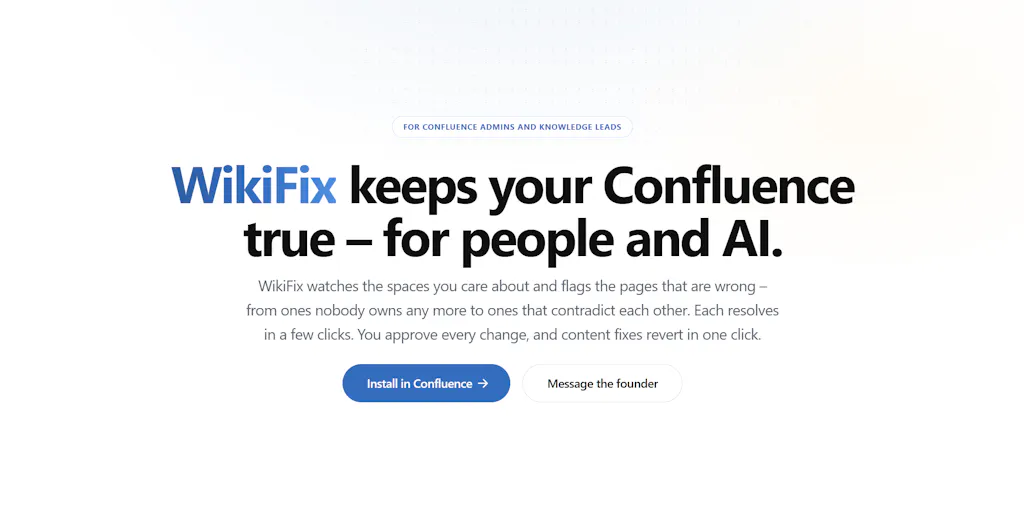
The maker, Rezgar Cadro, frames it plainly: WikiFix monitors your spaces for contradicting claims, duplicate docs, and orphan pages. It surfaces the conflict as a multiple-choice question — “who may sign off an exception for a High or Medium risk?” — with quoted evidence from each page. You pick the right answer, it writes the fix, you approve, and you can undo in one click.
Two things earn my respect here. First, the maker volunteered the failure rate before anyone asked: about 1 in 5 findings are wrong when hand-checked, varying by wiki. Second, there’s a quality gate that scores findings and hides the weakest ones by default, with an option to expand into lower-confidence results for compliance or legal contexts. That’s a mature posture. Most AI doc tools ship as if precision is a solved problem.
The v1 scope is deliberately narrow: it only looks inside Confluence. A standalone version is promised for v2, and the maker is openly soliciting which knowledge base platforms to support next. The public benchmark scans are the most interesting artifact — NASA at 57 conflicts across 732 docs, GitLab at 332 across 4,576, Sourcegraph at 86 across 901, and Kafka at 168 across 1,629. You can browse the examples directly at wikifix.ai/examples.
Why this is a bigger deal for Amazon and TikTok Shop sellers than for Shopify brands
Here’s the asymmetry most tool reviewers miss. A Shopify DTC brand’s “documentation” is mostly marketing calendars and creative briefs — annoying when stale, rarely catastrophic. An Amazon FBA seller’s documentation is operational infrastructure. Think: the SOP for responding to a policy warning, the escalation tree for a hijacked listing, the checklist for a reimbursement claim, the runbook for a suspended account appeal.
When those docs contradict each other, you don’t get a confused marketer. You get a VA following the wrong escalation path at 2 a.m. during a Prime Day outage, or a new account manager filing a POA that references a policy that changed six months ago. The cost of stale docs in cross-border e-commerce is measured in suspended accounts, not awkward meetings.
This is why the “broken runbook during an incident” framing landed so hard with commenters. Gal Dayan put it well: the worst possible time to discover the page you’re trusting is eight months out of date is mid-incident. For sellers running lean ops across time zones, that’s a Tuesday.
How it differs from the tools you’re already paying for
The obvious question: why not just ask Notion AI, Atlassian Rovo, or a general assistant like ChatGPT to clean up your docs?
The maker’s answer is the sharpest part of the launch, and it’s worth repeating because it’s a genuine architectural distinction. Assistants like Rovo start from your question and fetch the few pages likely to answer it. Contradiction detection starts from no question at all — it puts every claim next to every other claim on the same topic and looks for disagreement. That’s a fundamentally different retrieval pattern. You can’t prompt your way to “find everything in my wiki that disagrees with something else in my wiki,” because you don’t know what to ask.
Compare that to the incumbent tooling cross-border teams already stack:
- Confluence itself has page versioning and search, but no semantic conflict detection. It’s a filing cabinet, not an auditor.
- Notion has AI Q&A and database automations, but again, it’s query-driven.
- Guru and Slab do knowledge management with verification workflows, but they rely on humans to flag staleness. WikiFix inverts that — the machine finds candidates, humans adjudicate.
- Helium 10, Jungle Scout, and similar seller tools sit in a completely different lane — listing and keyword intelligence, not internal documentation.
The closest analog isn’t a docs tool at all. It’s the pattern of AI-assisted code review — a bot proposes a diff, a human approves or rejects. WikiFix is applying that loop to prose.
The two-layer safety model is the real feature
One commenter, Mishaal Rashid, zeroed in on what actually makes this usable: most tools flag a problem and hand you a to-do list. WikiFix asks which answer is right and writes the fix. The maker’s reply is the detail that matters operationally — you get two layers of safety: WikiFix’s one-click revert plus Confluence’s own page versioning.
For cross-border teams, that’s the difference between a tool you’ll actually let touch your SOPs and one you’ll disable after a week. If you’ve ever had a well-meaning automation overwrite a compliance doc with no clean rollback, you know why this matters.
What cross-border sellers can borrow from this, even without buying it
You don’t need WikiFix to steal its logic. Here’s what I’d take:
1. Treat your SOPs as a knowledge base with a conflict problem, not a folder. Most sellers have three or four places where the same procedure is documented — a Notion page, a Google Doc, a Slack canvas, a Loom video. Those are your contradiction surface. The NASA and GitLab scan numbers suggest even disciplined teams accumulate dozens to hundreds of conflicts over time.
2. Separate “who decides” from “who edits.” The multiple-choice model is smart because it forces a named owner to adjudicate. In a cross-border org, the person who knows whether a High-risk exception needs a manager sign-off is rarely the person maintaining the wiki. WikiFix’s “send it to the page owner” flow is worth replicating manually if nothing else.
3. Schedule the scan. The maker confirmed scans can run ad-hoc or on a schedule, with weekly or monthly reports landing in your inbox. For a seller with seasonal peaks, I’d run a scan right before Q4 prep and right after any major marketplace policy change. The cost of a stale escalation tree during peak is asymmetric — you want the docs audited when you’re calm, not when you’re firefighting.
4. Watch the “two true statements from different months” problem. This is the sharpest critique in the whole thread, raised by Gal Dayan: when two pages disagree, it isn’t always because one is wrong. Sometimes both were correct at different points in time, and the real failure is that nobody dated the change. WikiFix’s “pick which answer is right” model assumes a single ground truth, which breaks down for versioned behavior — a feature that worked one way before a platform update and another way after.
That critique generalizes far beyond wiki software. If your SOP for handling a TikTok Shop violation was written before a policy change and never updated, it isn’t wrong — it’s expired. The fix isn’t a contradiction resolver, it’s a dating and versioning discipline. I’d want to see WikiFix handle that case explicitly in v2, and I’d want my own docs to carry “last verified” timestamps regardless of whether I ever adopt the tool.
Where the math breaks
Let me be the skeptic for a paragraph. The 1-in-5 error rate is disclosed honestly, but it’s also the ceiling on how much you can automate. If a fifth of findings are wrong, a human still has to review every single one — which means WikiFix saves you the finding time, not the deciding time. For a team with 50 docs and 5 conflicts, that’s a marginal win. For a team with 4,000 docs and 300 conflicts, it’s transformative. The value curve is steeply nonlinear, which means small sellers probably shouldn’t bother and larger ops teams should pilot immediately.
There’s also the Confluence-only constraint. If your team lives in Notion — which is common among DTC brands and smaller Amazon sellers — you’re waiting for v2. The maker is explicit that they’ll “work out what matters most together” with the community, so this is a genuine vote-with-your-comment situation.
What I’d watch / test next
This week, before you decide anything about WikiFix, do a manual version of its core function. Pick your three most operationally critical docs — the account-suspension runbook, the returns/refunds SOP, and the escalation tree — and read them side by side. Look for the same question answered two different ways. I’d bet you find at least one contradiction, and I’d bet it’s in a doc nobody has touched since last peak season.
If you run Confluence, scan a public or low-stakes space first and see how the findings land. If you’re on Notion, leave a comment on the launch asking for support — that’s how v2 scope gets decided. And regardless of platform, start stamping every SOP with a “last verified” date. The dating problem Gal Dayan raised is the one WikiFix can’t fully solve for you, and it’s the one that will bite you first.