The Multiplayer AI Problem Is Now a Cross-Border Operations Problem
If you run a Shopify store, an Amazon FBA brand, or a TikTok Shop operation, you already live inside a multi-agent reality — you just haven’t named it that way. A listing optimizer, a review-response bot, a supplier-email drafter, a Klaviyo flow generator, a TikTok caption spinner: each one is an AI agent doing work in isolation, inside someone’s private tab, and nobody on your team can see what it touched. That invisibility is the exact problem Velozity, a new shared-workspace product from Velozity Labs, is trying to attack. Whether or not you ever sign up, the framing the founders use — “AI is single-player, real work is multiplayer” — is worth stealing for your own ops stack this quarter.
What Velozity Actually Solves (And What It Doesn’t)
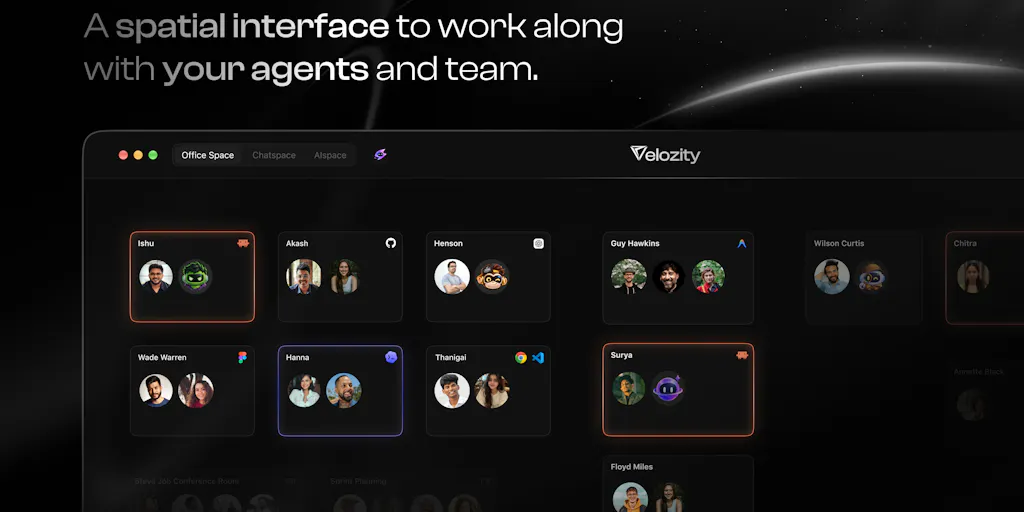
The pitch, as laid out by co-founder Ishu Darshan in the launch thread, is that everyone on a team is paying for their own AI subscription and using it alone. You prompt, copy the answer into chat, explain context to a teammate, get feedback, prompt again. The AI got faster; the team didn’t. Velozity’s answer is a single shared office where people and their agents sit in the same “Space” — live presence, chat, calls, tasks, calendar, notes and files in one place — with agents that read the same mail, files and calls your team does and carry a job through to the end.
Three claims matter to me as an operator:
- Bring your own AI. Agents run on the AI subscription you already pay for (source). That’s a meaningful differentiator against walled-garden agent platforms that want you to buy tokens through them.
- Approval is the boundary, not every step. Nothing is sent, paid or signed without a person approving it — but the agent doesn’t need a human click between every micro-action. Darshan describes a three-step flow: agent drafts → person reads and approves/edits/rejects → only then does it go out, and if the draft changes after approval, it needs re-approval (source).
- It’s the chat, not a layer on top of one. When a commenter asked what chat tools it works with, the founders clarified Velozity doesn’t sit on top of other chat tools — it is the chat — though it does connect with Slack, Microsoft Teams, Discord, Telegram and WhatsApp Business to pull context in (source).
That last point is the honest tension. If you’re a five-person DTC brand living in Slack and Notion, “we are the chat” is a migration ask, not a feature. If you’re a 30-person cross-border team with a Philippines CS pod, a China sourcing agent, and a US growth lead all in different time zones, a single shared Space with presence and calls has real appeal — but only if the connective tissue to your existing tools is strong enough that you don’t end up maintaining two homes for the same conversation.
Why Amazon sellers should care more than Shopify ones
Shopify operators tend to run lean — one founder, a VA, a freelance designer. The “AI is single-player” pain is real but manageable because there’s no team to synchronize. Amazon FBA brand owners are the opposite: you’ve got a PPC manager, a listing/creative person, a supply-chain coordinator, and often an agency on retainer, all touching the same ASINs. The failure mode Velozity describes — an agent drafts something, a human copies it into chat, someone else explains context, the loop restarts — is literally how most Amazon teams run their weekly listing audits and review-response queues today. Multiply that across a 200-SKU catalog and the copy-paste tax is a headcount problem, not a productivity quirk.
The same argument applies with even more force to TikTok Shop operators, where creative iteration cycles are measured in hours and every caption, hook, and product tag is a small approval decision. If you can let an agent draft 40 variants and have one human approve the batch, you’ve compressed a day of work into an hour. That’s the promise. Whether Velozity delivers it is a separate question.
How It Compares to What You’re Probably Already Using
Let me map this against tools cross-border sellers actually have in their stack.
Against Slack + ChatGPT / Claude / Gemini. This is the incumbent setup for 90% of the sellers I talk to. It works. Its weakness is exactly what Velozity is pointing at: no shared memory across agents, no audit trail of what an agent did, no presence layer that tells you “Maria’s agent just sent a supplier email.” If you’ve ever discovered after the fact that a VA’s AI drafted a customer reply that went out with the wrong return policy, you know the pain.
Against Notion AI and ClickUp Brain. These are knowledge-base-first tools that bolted AI on. They’re strong at drafting docs and summarizing wikis; they’re weak at agents that take actions across email, calendar, and code. Velozity’s model — agents that can raise a PR, send a message, book a call, all gated by approval — is closer to what Zapier + an LLM used to promise before Zapier pivoted to its own agent story.
Against Microsoft Copilot and Google Workspace with Gemini. These are the enterprise default and they’re getting genuinely good at the “agent inside your mail and calendar” pattern. Velozity’s differentiator is the shared Space and the bring-your-own-AI model. Copilot wants you on Microsoft’s rails; Velozity explicitly doesn’t care which model you’re paying for. For a cross-border team that’s already standardized on ChatGPT Team for the US pod and something cheaper for the overseas pod, that flexibility is not trivial.
Against Lindy, Relevance AI, and the broader agent-builder category. These let you build agents that act. What most of them lack is the human coordination layer — presence, shared tasks, a visible approval queue. Velozity’s bet is that the coordination layer is the product, and the agents are table stakes.
Where the math breaks
The economics of “bring your own AI” sound great until you do the math on seat count. If Velozity charges per seat on top of the ChatGPT Team or Claude Team subscriptions you’re already paying for, you’re now paying twice for the same underlying capability, plus a workspace tax. The founders say it’s “free to start” (source) but don’t disclose pricing tiers beyond a mention of a Pro plan with a team activity dashboard (source). For a 20-person cross-border team, that’s the number that decides whether this is a tool or a toy.
What Cross-Border Sellers Can Borrow From the Launch
Even if you never open a Velozity Space, there are three operational patterns in this launch worth importing into your own stack this week.
1. Make the approval boundary explicit
The single most useful idea here is that the human-in-the-loop checkpoint should sit at the workspace exit, not at every step. Darshan’s three-step model — agent drafts, person approves/edits/rejects, only then does it send, and any post-approval change re-triggers approval (source) — is a design pattern you can copy into your own AI workflows today. If you’re using Zapier or Make to automate customer service replies, supplier POs, or ad copy pushes, ask yourself: is there a single approval gate before anything leaves your org, or are you approving at every micro-step and burning human attention on trivia?
For Amazon sellers specifically: your review-response workflow should have exactly one approval gate before a response posts, and that gate should be visible to the whole team. Not five gates, not zero.
2. Treat the Space as the permission boundary
The founders’ answer to a sharp question about file access is worth quoting in full because it’s a clean mental model: a file added to a Space belongs to that Space, everyone in the Space can see it, there are no per-file permissions inside a Space, and the Space itself is the boundary (source). Personal data — your connected email, calendar, meeting notes — follows the person, read-only by your own agents, never visible to a teammate’s agent.
Translate that to your own ops: your supplier cost sheets, your PPC bid history, and your customer PII should live in different Spaces with different membership. If your VA’s agent can read your margin data because it’s in the same shared drive as the product photos, that’s a governance bug, not a convenience.
3. Audit trails are the new compliance line
Velozity’s CTO Akash Mandal notes that every agent run is recorded in the Space — who asked, what it did, what changed (source). For cross-border sellers, this matters more than it does for a domestic SaaS team, because you’re operating across jurisdictions with different data-handling expectations. If a German customer asks under GDPR what your AI did with their support ticket, “we don’t know, it was in someone’s ChatGPT history” is not an answer. An audit trail per agent run is table stakes for any team selling into the EU or UK.
4. Don’t ignore the “who’s overloaded” question
One commenter asked whether Velozity shows how work is spread across the team so managers can spot overload. The honest answer from the founders: partly — tasks are assigned by person, admins get a dashboard on Pro, you can ask an agent who has the most open tasks, but automatic overload detection isn’t there yet (source). For a cross-border team with a CS pod in Manila and a sourcing pod in Shenzhen, that’s a real gap. But it’s also a reminder: before you buy any agent platform, ask what visibility it gives you into human workload, not just agent activity. The bottleneck in most cross-border ops isn’t the AI — it’s the one person who has to approve everything.
Where My Judgment Says It Falls Short
I want to be fair to a product that’s clearly early and that the founders themselves describe as “far from finished” (source). But there are four things I’d want answered before recommending it to a seller doing real volume.
First, the migration cost is understated. “It is the chat” is a clean pitch, but it means every conversation, every file, every integration you’ve built in Slack or Teams has to either move or be mirrored. The founders say Velozity connects with Slack, Teams, Discord, Telegram and WhatsApp Business (source) — but “connects with” and “replaces” are very different claims, and the launch thread doesn’t clarify which one is true for the integrations that matter to cross-border teams (WeChat, WhatsApp Business API at scale, Line for Japan/Taiwan).
Second, the cross-border-specific integrations are absent from the conversation. No mention of Shopify admin, Amazon Seller Central, Helium 10, Klaviyo, Gorgias, or any of the tools that actually run a cross-border store. Agents that “work inside your apps” is the claim; the app list is the proof, and the proof isn’t in the thread.
Third, the pricing model is opaque. “Free to start” plus a Pro tier with a team activity dashboard is the only pricing detail disclosed (source). For a tool that asks you to bring your own AI subscription, the marginal cost per seat matters enormously. A 30-person team paying $20/seat/month on top of existing AI subscriptions is $7,200/year before you’ve proven the productivity gain.
Fourth, the “agents can raise a PR” claim is a developer-team feature, not a seller feature. Mandal confirms agents can make changes in a repo, raise a PR, and go through normal review before merge (source). Great for a tech-enabled brand with an in-house dev. Irrelevant for the 80% of cross-border sellers who don’t have a repo. The product’s center of gravity feels like a technical team, and the cross-border seller use case is a happy accident rather than a designed-for segment.
A note on the “multiplayer AI” framing
The phrase is good. It’s also slightly misleading. What Velozity is really selling is shared context plus approval gates — the multiplayer part is the visibility, not the AI itself. Your agents don’t actually collaborate with each other in any deep sense; they share a Space and a file system, and a human approves what leaves. That’s a valuable thing, but it’s a coordination layer, not a multi-agent system. Don’t buy the marketing and expect emergent agent teamwork. Buy it if you want your team’s AI activity to stop being invisible.
What I’d Watch / Test Next
Three concrete things to do this week, in order of effort.
If you’re curious about Velozity itself: open a free office, bring in one agent, and run a single real workflow through it — I’d suggest your review-response queue or your supplier-email drafting, since both have clear approval gates and measurable cycle times. Time how long it takes from “agent drafts” to “message sent” versus your current Slack-plus-ChatGPT loop. If the delta isn’t at least 30%, the migration cost isn’t worth it yet.
If you’re not ready to migrate: steal the pattern. Pick one AI workflow in your ops — ad copy, CS replies, supplier POs — and add a single explicit approval gate before anything leaves your org. Put it in a shared channel, not a DM. Measure how many times a week the gate catches something that would have gone out wrong. That number is your business case for a tool like Velozity later.
If you’re an Amazon or TikTok Shop operator specifically: watch whether Velozity ships native integrations with Seller Central, Shopify, or TikTok Shop Seller Center in the next two quarters. Without those, it’s a general-purpose team workspace that happens to have agents — useful, but not a cross-border ops platform. With them, it becomes something worth a serious evaluation.
The interesting question isn’t whether Velozity wins. It’s whether the “shared Space with approval gates” model becomes the default shape of how cross-border teams run AI in 2026, or whether Slack and Microsoft eat this feature before anyone else gets scale. My bet is on the latter for most sellers — but the founders have named a real problem, and the naming is worth more than the product right now.