The Cross-Border Influencer Problem No One Wants to Admit
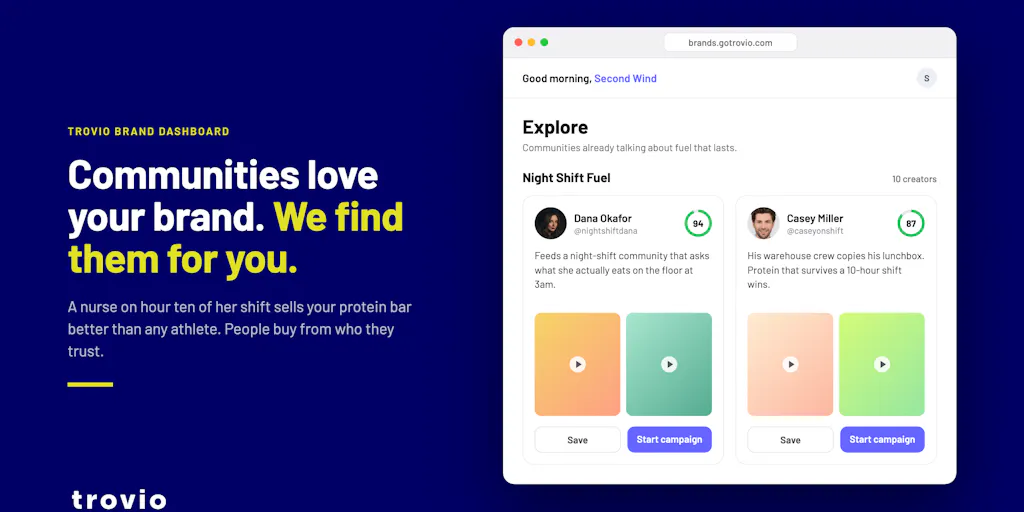
If you manage a cross-border brand—selling from Guangzhou into Los Angeles, or from Shenzhen into London—you already know that influencer marketing feels like a rigged game. You throw money at someone with 500K followers in your category, and your conversion rate sits at 0.04%. Meanwhile, a tiny account nobody in your agency has heard of—someone who reviews budget meal prep kits for broke students—casually drives ten sales from a single TikTok. The gap isn’t about reach or production value. It’s about community trust, a thing that search bars and follower counts cannot surface. That’s why the launch of the Trovio Brand Dashboard from Trovio matters to every cross-border operator who has wasted budget on the wrong creator. They’ve built a matching engine that skips the category label and hooks into the actual community a creator speaks to. For sellers operating in foreign markets—where you cannot read the cultural signals yourself—this kind of discovery is the difference between a campaign that lands and one that feels like an ad.
The Problem: Influencer Discovery for Cross-Border Is Still Stuck in 2018
Every cross-border seller I talk to runs the same playbook. They scrape Amazon Seller Central reviews, search Instagram hashtags, or hire a local agency that promises “vetted talent.” The result? A list of creators who filed themselves under “fashion” or “home decor” and whose audience overlap with your actual buyers is a coin flip. The underlying issue is that search retrieves metadata, not behavior. A creator’s self-assigned category tells you nothing about whether their audience would trust a cross-border brand shipping from overseas. The Trovio Brand Dashboard co-founder Andrew Lukas nails this in the launch thread: “A search bar retrieves creators by the label they filed themselves under, and your customers don’t live in one label.” For a US-based brand, that’s annoying. For a Chinese seller trying to break into the German market, it’s catastrophic. You don’t know which German micro-influencers are actually trusted by people who buy imported fitness gear. You only know who has “fitness” in their bio.
Existing platforms like Grin, Upfluence, and AspireIQ have improved campaign management, but their discovery layers still lean on keyword-based searches and follower thresholds. They don’t model communities. Trovio’s bet is that a creator who talks about “always being in transit” is a better voice for a travel-branded supplement than a travel blogger with 100K followers, because the “transit” community actually buys products for life on the go. That distinction is huge for cross-border sellers who need to find authentic voices in a culture they don’t inhabit.
Why Amazon Sellers Should Care More Than Shopify Ones
If you run a Shopify store, you can attach UTMs, use affiliate links, and pull conversion data into Klaviyo without much friction. Amazon sellers on Amazon face a much harder problem. Amazon’s attribution is opaque—you cannot easily tie a creator’s post to a specific sale unless you use Amazon’s own influencer program or a special tracking link. Trovio’s short-link approach, which bakes attribution into the link itself without a pop-up promo code, is exactly what an Amazon seller needs. The link goes straight to your Amazon listing (or to your storefront), and because the platform tracks conversions, you bypass Amazon’s walled garden. The same logic applies to TikTok Shop sellers: TikTok’s internal attribution is inconsistent, and a third-party link that tracks through to Shopify or an external checkout gives you a second layer of truth. Trovio’s dashboard tracks “conversions, not just reach”—a phrase that should be wallpaper in every Amazon seller’s war room.
What Trovio Actually Does Differently
The core innovation is the matching model. Instead of asking for a category, the dashboard asks for your brand description and surfaces the communities your customers already live in—along with the creators those communities trust. Lukas shared a concrete example: “a streamer who sits eight hours a day is a genuinely strong fit for comfortable activewear.” That’s a match that no keyword search would ever surface. For a cross-border seller, this kind of lateral thinking is invaluable. If you sell ergonomic office chairs to US remote workers, your best creator might be someone who talks about “WFH pain relief,” not “home office furniture.” They live in a pain-point community, not a product category.
The second difference is attribution. Trovio uses “short links” that carry the attribution data in the link itself—no UTM query strings that get stripped when someone copies a link. Creators get their own link, and the brand sees click-through to conversion on their side. Lukas noted that this also allows them to pull “post-side numbers straight from the platform” because creators connect their accounts directly. That solves two cross-border headaches: (1) time-zone delays in reporting, and (3) reliance on self-reported screenshots that often inflate numbers. A creator in Tokyo can post at midnight US time, and by morning you have real data.
The Bot Problem: Trovio’s Approach vs. Reality
Fake followers are a plague, especially on TikTok and Instagram where bot farms thrive. Trovio addresses this by requiring creators to connect their accounts directly—no uploaded media kits. “Accounts flooded with bots are pretty loud in that data,” Lukas said: “big reach, engagement that never follows.” They also screen for paid subscribers: “bot farms don’t pay a monthly subscription to manage a fake audience.” That’s clever, but it assumes all good creators are willing to pay. Many micro-influencers in developing markets (Indonesia, Brazil, Vietnam) may balk at a subscription fee. Cross-border sellers in those regions might find the pool thin. Still, for US- and EU-targeted campaigns, the filter improves quality dramatically.
Where the Math Breaks
Lukas shared a compelling benchmark during the Product Hunt thread: a $50,000 budget on one macro creator yields about 2.6 million views and 1,150 conversions, while the same budget spread across 10 smaller creators yields about 1.9 million views but 4,700 conversions. That’s 4x more sales for fewer eyeballs. The logic is sound—smaller creators have higher engagement rates and more trust. But the math breaks for many cross-border sellers because their budgets rarely start at $50K. A typical test for a DTC brand entering a new market might be $2,000–$5,000. At that level, you might hire 2–3 micro-creators, not 10. The unit economics still favor smaller creators, but the administrative cost of managing 10 creators (even with Trovio’s dashboard) might eat into margin. Trovio claims to take “the logistics off your plate,” but we don’t yet know their pricing. If it’s a flat subscription plus a per-campaign fee, the threshold for viability could be higher.
Another gap: Trovio currently supports Instagram and TikTok as first-class platforms, with YouTube rolling out. That leaves out Twitch, YouTube Shorts, Pinterest, and—critically for cross-border sellers targeting China—Douyin or WeChat. For sellers aiming at Southeast Asia, Shopee and Lazada have their own influencer ecosystems that Trovio doesn’t touch. So while the community-matching thesis is universal, the execution is still Western-centric.
What Cross-Border Sellers Can Borrow Even Without Trovio
You don’t have to wait for an invite to apply Trovio’s logic. Start mapping your target customers to communities rather than categories. Look at Reddit subreddits, Discord servers, and Facebook Groups where your product solves a recurring pain point. Find the active members who also happen to have a public social presence. Those are your best creators. Use a tool like Ahrefs or Similarweb to discover which communities drive referral traffic to your competitors. Then outreach manually or with a lean CRM like Clay. That’s the DIY version of Trovio’s approach. It takes time, but it works.
My Judgment: Where It Falls Short
The community-matching thesis is the right one for 2025. Trovio has built a solid foundation. But I see three weaknesses for cross-border operators:
Language and region filtering. The product doesn’t seem to let you filter creators by the language they speak or the country they’re based in. If you’re a Japanese brand wanting to sell in the US, you need creators who are American (or at least culturally fluent). A community match might surface a creator from the UK who also talks about comfort—but your target audience is in New York. The matching model needs a geographic boundary.
Closed communities are missing. The best cross-border communities for niche products—think WhatsApp groups for diaspora buyers, or Telegram channels for crypto-native shoppers—are completely outside Trovio’s graph. Lukas admitted that “Discord and Telegram native communities aren’t in the graph yet.” For sellers of supplements to Latin American immigrants in the US, or beauty products for African communities in the UK, those closed spaces are where trust lives. Without them, Trovio is still optimizing for the public social graph.
Pricing transparency. The product is in launch mode, and no pricing is disclosed. Cross-border sellers operate on thin margins. If the tool costs $500/month plus a creator commission, it may only be viable for brands doing $50K+/month in influencer spend. Smaller operators will stick with manual outreach and hope for the best.
That said, the conversion tracking and attribution layer are best-in-class. If you’re already spending $10K+ monthly on influencer campaigns, Trovio could pay for itself in one campaign cycle by cutting out creators who don’t convert.
What I’d Watch / Test Next
This week, if you manage a cross-border brand, do three things:
Audit your last five influencer campaigns. List the creators, their category labels, and your actual conversion data. Then try to think of each one as a “community spokesperson” rather than a category expert. Ask yourself: “What community does this creator actually lead? Was it a community of people who buy things like mine, or just people who consume content about my category?” You’ll likely find mismatches.
Run a micro-test with 3–5 creators in one target market, sourced by community logic. Don’t use a search tool. Instead, spend an hour in relevant Facebook Groups, Discord servers, and subreddits. Find the active posters who have 1,000–10,000 followers on Instagram or TikTok. Reach out with a free product and a short-link tracking setup (use Bitly or a custom domain with UTM parameters). Compare results against your last macro-influencer campaign. I’d bet the per-dollar conversion rate is 2–3x higher.
Request early access to Trovio’s dashboard and test it on a small campaign in a market where you have existing data (US or UK, where their social platforms have good coverage). Specifically, test their community-match results against your manual community discovery. If the tool surfaces creators you missed, it’s worth the subscription. If it only finds the same faces you already know, pass until they add more platforms.
The cross-border influencer marketing game is still an inefficient mess. Trovio’s community-first approach is the most promising correction I’ve seen in years—not because it’s perfect, but because it finally moves the needle from “how many followers” to “who actually buys.” Run your own math, test with your own budget, and don’t let the category label blind you to where your customers really live.


