The quiet tax on cross-border operators isn’t tariffs — it’s the translation loop
Every cross-border seller I know runs some version of the same invisible workflow: copy a supplier message, paste it into ChatGPT or Claude, ask for a translation that doesn’t sound like a robot, paste it back, fix the tone, send. Multiply that by supplier WeChat threads, Amazon Buyer-Seller Messaging replies, TikTok Shop comment moderation, Etsy customer notes, and the Shopify support inbox, and you’ve quietly hired yourself as a full-time translation middleware layer. Translate Like Me, a small menu-bar app from Victor Kuznetsov, is a direct attack on that loop — and while it’s a developer-tooling-shaped product, the operating principle behind it is something every DTC and marketplace operator should study.
Here’s the thesis: the next wave of cross-border leverage isn’t another AI writer or another listing optimizer. It’s the removal of context-switching friction from the workflows you already run dozens of times a day. This app is a case study in that, and it’s also a mirror for where most seller-side tooling still gets it wrong.
What problem this actually solves (and why it’s not “translation”)
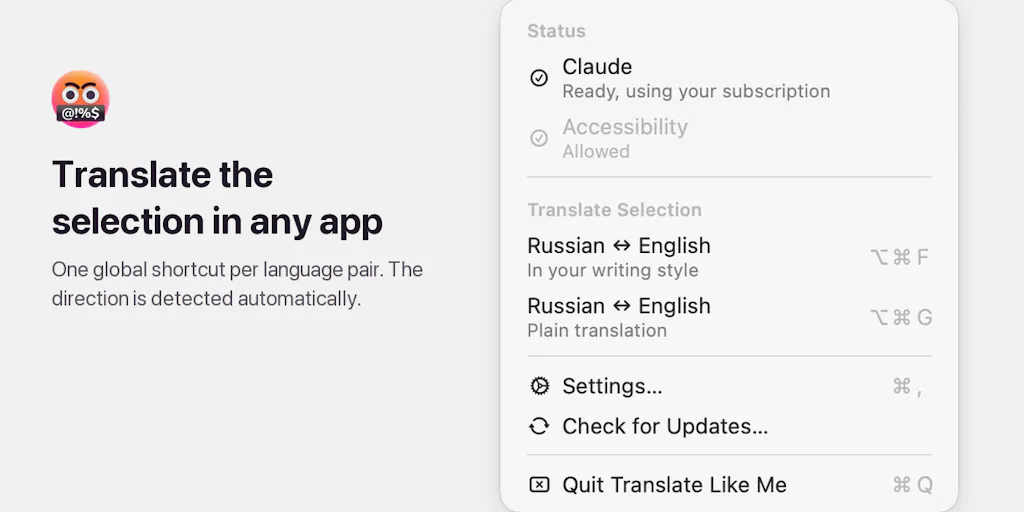
The stated origin story is refreshingly unglamorous: the maker writes in Russian and English daily, got tired of the copy → paste → prompt → paste-back loop, and built a macOS menu bar app that collapses it into one shortcut. Select text in any app, hit the pair’s shortcut (Option+Cmd+F by default), and the selection is replaced in place with the translation. Direction is auto-detected per call — text in the pair’s first language goes to the second, anything else goes to the first.
That’s it. No dashboard, no team workspace, no “AI-powered localization platform.” And that restraint is the point. The product isn’t competing with DeepL or Google Translate on raw translation quality — it’s competing with the act of leaving the app you’re in. For a seller juggling eight tabs, that’s the actual cost center.
Two design decisions stand out for anyone who runs cross-border ops:
- Per-pair writing styles. Each language pair can carry its own style. The maker keeps one Russian/English pair tuned to his own voice for personal messages, and a second plain pair for other people’s text. That’s a genuinely useful mental model: your tone for outbound brand comms should not be the same as your tone for translating a supplier’s spec sheet.
- It rides the subscription you already pay for. The app calls official CLIs —
claude -p,codex exec,grok -p— as subprocesses. API keys work too for Claude and OpenAI. No server, no analytics. Swift, Apache 2.0, signed and notarized, updates via Sparkle, installable with Homebrew.
The performance claim is the most interesting number in the whole launch: for Claude, turning off tools, MCP servers, and session history took a call from 10k+ input tokens and 5–8 seconds down to about 150 tokens and 2.4 seconds on Sonnet. That’s roughly a 98% reduction in token overhead for a task that doesn’t need any of it.
Why Amazon sellers should care more than Shopify ones
Shopify operators live in a browser and a handful of SaaS dashboards. Amazon sellers live in a weird archipelago of surfaces: Amazon Seller Central, Buyer-Seller Messaging, supplier WhatsApp/WeChat, freight forwarder email threads, Helium 10 for research, and increasingly TikTok Shop Seller Center for short-form demand capture. Every one of those is a place where a Russian, Chinese, or Spanish sentence lands in your lap and needs a reply that sounds human within the hour.
The friction of “open a new tab, open ChatGPT, paste, prompt, copy, return, paste” is small per instance and enormous per week. A menu-bar shortcut that replaces text in place is worth more to an Amazon operator with a Chinese supplier relationship than to a Shopify merchant selling domestically. If you’re running Amazon FBA with overseas manufacturing, this is closer to a daily-driver tool than most of the “AI listing optimizer” SaaS you’re paying for.
Where the math breaks
The token-efficiency win is real, but the app is macOS-only, single-user, and local. There’s no shared glossary across a team, no audit trail, no way to enforce that your VA uses the same brand-voice pair you tuned. For a solo operator, that’s fine. For a five-person cross-border team, you’re back to everyone maintaining their own private style configs — which is exactly the fragmentation that Lokalise and Crowdin exist to prevent, at a very different price point and complexity level.
How it differs from the incumbents you’re probably comparing it to
Let’s place it honestly against three categories of tools a cross-border seller might reach for.
Against browser-based AI chat. ChatGPT, Claude, and Gemini are the default. They’re better at long-context reasoning, they handle documents, and they’re free or cheap. What they can’t do is replace selected text in the app you’re already in without you leaving it. Translate Like Me is not a better translator; it’s a better interruption model. If your translation volume is five messages a day, stay in the browser. If it’s fifty, the shortcut pays for itself in cognitive load alone.
Against dedicated translation SaaS. DeepL Pro, Smartling, and Phrase target localization teams managing glossaries, translation memory, and multi-locale release cycles. They’re the right answer when you’re localizing a product catalog into six languages with brand consistency requirements. They’re the wrong answer when you just need to answer a Guangzhou supplier’s WeChat message in your own voice in under ten seconds. Different job, different tool.
Against OS-level translation. macOS and Windows both ship built-in translation. It’s free, it’s everywhere, and it’s mediocre at tone. The gap Translate Like Me exploits is that “translate this” and “translate this the way I would say it” are different problems, and only the second one matters when you’re negotiating MOQs or handling a return request from a German buyer.
Why the CLI-as-backend choice matters beyond this app
The architectural detail worth stealing: the app doesn’t call a translation API. It shells out to the official CLIs of the AI providers you already subscribe to. That means it inherits your existing plan, your model access, and your rate limits — no separate API billing, no key management if you’re on a Claude or ChatGPT subscription. API keys are supported as a fallback for Claude and OpenAI.
For sellers building internal tooling, this is a pattern to copy. The cheapest, fastest way to add AI to an internal workflow in 2025 is often not “integrate the API” but “wrap the CLI your team already pays for.” It sidesteps procurement, billing, and the classic trap of an ops manager burning $400 on API calls because a script looped.
What cross-border sellers should borrow from this
Strip away the specifics and there are four transferable lessons for anyone running cross-border operations.
1. Kill the tab-switch, not the task. Most seller-side AI tooling tries to replace a workflow. The higher-leverage move is often to remove one step from a workflow you already run. A Shopify support macro that pre-fills a translated reply, a Slack shortcut that drafts a supplier follow-up, a Chrome extension that summarizes a competitor’s listing in place — these are small, boring, and disproportionately valuable.
2. Style is a per-context variable, not a global setting. The pair-with-style model is the right abstraction. Your brand voice for customer-facing replies should differ from your voice for supplier negotiations, which should differ from your voice for internal SOPs. Most sellers set one “brand tone” prompt and wonder why everything reads flat. Segment by audience, not by language.
3. Token hygiene is a real cost line. The 10k → 150 token reduction is a reminder that most “AI slowness” is context bloat, not model speed. If you’re running any internal AI tooling — listing generation, review summarization, ad copy variants — audit what you’re stuffing into the prompt that the model doesn’t need. Session history and tool definitions are usually the culprits. The payoff is latency, cost, and often quality.
4. Local-first, no-server tools are underrated for ops. No analytics, no server, no data leaving the machine. For sellers handling supplier pricing, customer PII, or unreleased product info, that’s not paranoia — it’s basic hygiene. Worth noting when you’re evaluating the next SaaS that wants your Seller Central credentials.
A note on the licensing and distribution choices
Apache 2.0, signed, notarized, Homebrew-installable via brew install --cask wiltodelta/tap/translate-like-me. For a solo maker shipping a utility, this is the correct stack. It also means a technically-inclined ops lead could fork it, swap in a Chinese/English pair tuned to their supplier vocabulary, and deploy it internally without a procurement cycle. That’s a real option for mid-size sellers who’ve outgrown manual translation but aren’t ready for a localization platform contract.
Where my judgment says it falls short
I like the product’s discipline, but three things give me pause for the cross-border use case specifically.
No team layer. If you run a support team or a VA pod, per-user style configs are a bug, not a feature. You want a shared glossary — brand terms, SKU names, compliance phrases — that everyone inherits. Not disclosed whether this is on the roadmap.
No mobile or Windows. Cross-border operators are frequently on their phones handling TikTok Shop comments, Etsy convos, and eBay messages. A macOS menu bar app doesn’t reach that surface. The maker is explicitly asking what users want next, so this may evolve — but as it stands, it’s a desktop power-user tool.
The AI-provider dependency is a feature and a fragility. Leaning on claude -p, codex exec, and grok -p means you’re exposed to whatever those CLIs do next — deprecations, auth changes, pricing shifts. It’s a thin wrapper on someone else’s roadmap. For a personal tool, fine. For a business-critical workflow, you’d want a fallback path.
The real gap: it doesn’t understand commerce. A generic translation tool doesn’t know that “dispute” in an Amazon context means an A-to-z claim, that “FBA” should never be translated, or that “MOQ” is jargon your supplier already uses. The highest-value version of this product for cross-border sellers would carry a commerce glossary by default. That’s the wedge a seller-side fork could own.
The comparison I’d actually make
If you’re a cross-border operator deciding where this fits: it’s not a Shopify Translate & Adapt replacement, and it’s not competing with Weglot for storefront localization. It’s competing with the 40 seconds you waste every time you leave Seller Central to translate a message. That’s a much smaller market and a much more honest one.
What I’d watch / test next
Three concrete things to do this week if this resonates.
First, audit your own translation loop. For two days, count how many times you copy text out of a seller tool, translate it elsewhere, and paste it back. If it’s more than twenty, install the app via brew install --cask wiltodelta/tap/translate-like-me and see if the shortcut changes your behavior. If it’s fewer than ten, skip it — you don’t have the problem.
Second, steal the token-hygiene lesson for your existing AI tooling. Pull up whatever internal prompt you’re running for listing generation or review summarization and check your input token count. If you’re north of 5k per call for a task that doesn’t need it, strip tools, history, and boilerplate. The latency and cost improvements are usually immediate.
Third, watch for a commerce-glossary fork. The most valuable version of this category for cross-border sellers is a translation layer that already knows your vertical’s jargon — FBA, MOQ, A-to-z, DDP, HS codes, TikTok Shop’s specific moderation vocabulary. If nobody builds it, a technically-capable ops lead at a mid-size seller should. The maker is explicitly asking for feature direction on the launch page, so if you want shared glossaries or a Windows build, say so there rather than waiting.
The bigger takeaway: the cross-border tooling stack is overdue for a wave of small, local, single-purpose utilities that shave seconds off high-frequency workflows. Translate Like Me is one. The category is wide open.