Why a Fidget Toy for Your Mac Is Actually a Masterclass in Cross-Border Product Strategy
Every cross-border seller I know is chasing the same phantom: a product that solves a problem people didn’t know they had, priced as a one-time purchase, with zero ongoing support burden and a built-in viral hook. We spend thousands on product research tools, pore over Helium 10 data, and stalk TikTok Shop trends — and then a solo developer ships a ball that hangs off your menu bar and gets more organic enthusiasm in a day than most of our SKUs see in a quarter. That gap isn’t an accident. It’s a lesson in positioning, scope discipline, and the economics of delight that most of us have forgotten. Let me show you what Tether — a $4.99 fidget toy for your macOS desktop — teaches us about selling physical goods across borders.
The Problem Isn’t the Product — It’s the Attention Economy
Here’s the uncomfortable truth: the problem Tether solves isn’t fidgeting. It’s the guilt of fidgeting. We’ve all been on a Zoom call where we’re supposed to be engaged, and instead we’re peeling labels off water bottles, clicking pens, or — worst of all — checking a second screen. The developer, Alex, admits he built it because he was “looking for something to keep my hands busy during long work meetings. Pens, cables, the corner of a notebook, the usual.” That’s not a niche problem. That’s a universal condition for anyone who works in a distributed team — which, post-2020, is most of the knowledge economy.
For cross-border sellers, this is the first lesson: the best products don’t solve a functional gap; they solve an emotional one. Your Amazon listing for a “silicone desk toy” competes against 10,000 identical listings. But a product that says “this keeps your hands busy so your ears stay free” — that’s a story. That’s positioning. And it’s why Tether’s launch page reads less like a spec sheet and more like a confession.
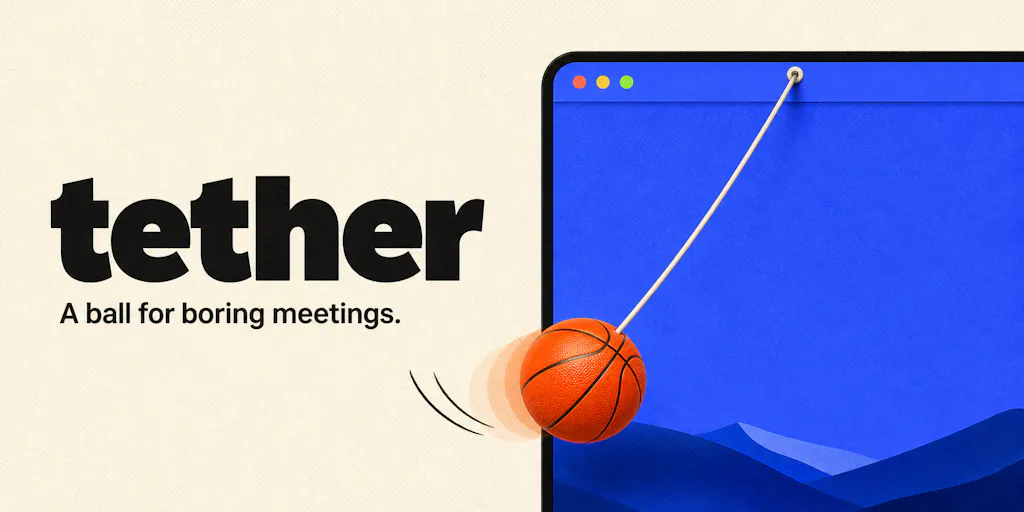
The second lesson is about scope. Alex didn’t build a full productivity suite. He built one ball, with seven variants, and a single killer interaction: “Drag it, fling it, slingshot it. The tether stretches and snaps back.” That’s it. No account, no subscription, no telemetry. The entire product is a one-time purchase on the Mac App Store, built for macOS 14 and later. For a cross-border operator, this is the difference between a hero SKU and a catalog of also-rans. You don’t need 50 SKUs. You need one product that does one thing so well that people tell their colleagues about it.
Why Amazon sellers should care more than Shopify ones
Shopify DTC brands have the luxury of storytelling. They control the landing page, the email flows, the unboxing experience. Amazon sellers don’t. We get a title, five bullets, and a main image. So when I see a product like Tether succeed on pure narrative, I pay attention — because it tells me that the product itself has to carry the story when the listing can’t.
On Amazon, Tether would be a disaster as a physical product. It’s a digital toy. But the positioning translates perfectly. “Hands busy, ears free” is a bullet point that would crush on a listing for a fidget cube, a stress ball, or even a phone stand. The lesson for Amazon sellers is brutal: if your product doesn’t have a one-sentence emotional hook, you’re competing on price. And competing on price is a race to the bottom that only Amazon wins.
The Physics of Delight: What Tether Gets Right That Your Product Doesn’t
Let’s talk about the actual mechanics, because there’s a reason this thing got 22 comments in a day while most Product Hunt launches get crickets. The physics engine is the product. “Real physics against your real windows. The ball lands on their top edges, rolls along them, and reacts when you move them.” That’s not a feature list; that’s a promise of emergent behavior. The ball doesn’t just sit there — it interacts with your actual work environment. You can “cut the rope and it comes loose across the desktop, bouncing off whatever is in the way.”
For a cross-border seller, this is the difference between a product that’s used and a product that’s played with. Your kitchen gadget might work, but does it delight? Does it make someone want to show it to a colleague? Tether’s comment section is full of people doing exactly that — one user, Avinash Bussa, says “I literally have one hanging next to my desk in my home office. Didn’t thought I would ever need it for screen. That’s crazy :D” — and the maker’s response is perfect: “The physical one might have better bounce, but mine has never rolled under the desk mid-call.”
That exchange is your entire social proof strategy in two lines. The product is better than the physical alternative because it solves a specific pain point (losing the ball under the desk) that the physical version can’t. For cross-border sellers, this is a call to audit your product against the “better than the alternative” test. If your product isn’t better than the generic version in a way you can articulate in one sentence, you don’t have a product — you have inventory.
Where the math breaks
Here’s where I have to put on my operator hat and do the math that the maker didn’t have to do. Tether is a one-time purchase on the Mac App Store. Let’s say it’s $4.99 (Apple’s typical price point for this kind of utility). The Mac App Store takes a 30% cut, so the maker nets ~$3.50 per unit. To make a living wage — say $70,000/year — you need 20,000 sales. That’s not impossible, but it’s a lot for a fidget toy.
Compare that to a physical product. A fidget cube costs $0.50 to manufacture in Shenzhen, sells for $15 on Amazon, and nets $6-7 after PPC, FBA fees, and returns. You only need 10,000 units to hit the same revenue. And here’s the kicker: a physical product has repeatability. You can make a version 2.0, a glow-in-the-dark version, a travel version. Tether is a finished product. There’s no accessory ecosystem, no replenishment, no consumable.
This is the trap of digital products: they’re cheap to make but expensive to scale. Physical products are expensive to make but scale beautifully. For cross-border sellers, the lesson is not to copy Tether’s business model — it’s to copy Tether’s positioning and apply it to a physical good that can be iterated. A “bounce” that sells once is a novelty. A “bounce” that sells 10,000 times is a brand.
What Cross-Border Sellers Can Actually Borrow From a Mac Fidget Toy
Let’s get practical. Tether is a toy, but the strategy underneath it is transferable to any cross-border operation. Here are three specific things you can steal this week:
1. The “one-key hide” as a UX principle. Tether has a feature that hides the ball “the instant somebody says your name.” That’s not a feature; that’s empathy. The maker knew that the user’s boss or partner might walk in, and the last thing you want is to be caught playing with a ball during a serious meeting. This is the same principle as a discreet shipping box, a no-logo return label, or a “silent mode” on a gadget. For cross-border sellers, think about the context in which your product is used. If your customer is embarrassed to be seen with your product, you’ve failed. If you can design for that embarrassment — make it discreet, make it guilt-free — you’ve built loyalty.
2. The “seven balls, each with its own weight, grip and bounce” as a variant strategy. Alex didn’t build seven products. He built one product with seven skins that change the feel. This is the same logic as offering your best-selling widget in matte black, rose gold, and “ocean blue.” Variants aren’t just about color — they’re about identity. On Amazon, this is how you own the buy box for “fidget ball” instead of letting a competitor undercut you on the same SKU. On Shopify, this is how you increase AOV without building a new product.
3. The “no account, no subscription, no telemetry” as a trust signal. In an era where every SaaS wants your email and every app wants your location, Tether’s privacy stance is a differentiator. “Nothing leaves your Mac.” For cross-border sellers, this translates to transparency about data and logistics. Do you tell your customers exactly when their package will arrive, or do you make them guess? Do you offer a no-questions-asked return policy, or do you hide your returns page? Trust is a feature. Price it accordingly.
Why Shopify DTC brands should be watching this more closely than Amazon sellers
I said Amazon sellers should care, but Shopify DTC brands should be obsessed. Tether is a pure DTC play: a solo developer, a Product Hunt launch, a direct-to-consumer sale on the Mac App Store. There’s no marketplace, no algorithm, no buy box. The product succeeds or fails entirely on its ability to generate organic enthusiasm.
For DTC operators, this is the template for a successful launch. Tether didn’t need a $10,000 influencer budget or a TikTok ad campaign. It needed a compelling story, a responsive maker, and a product that people want to show off. The comment section is full of people doing the marketing for free — Lisa from Softorino asks if it’s quiet enough for a call, Irene Chan says she has ADHD and “usually need[s] something to tinker with,” and Nika from minimalist phone says “Good launch on Monday when we have Sprint.”
That’s your target market telling you exactly who they are: distributed workers, ADHD folks, sprint-planning survivors. If you’re a DTC brand, you should be mining Product Hunt comment sections like this for your customer avatars. The people who comment on a fidget toy are the same people who buy weighted blankets, noise-canceling headphones, and ergonomic keyboards. They’re your audience.
Where Tether Falls Short — and What You Shouldn’t Copy
I’ve been generous, so let me be honest about the flaws. First, the platform limitation: “Not at the moment. Just Mac for now! Sorry.” — that’s a direct quote from the maker when asked about PC support. For a cross-border seller, this is a cardinal sin. Your market is global. If you launch on one platform, you’re leaving money on the table. Tether is macOS 14+ only, which means it excludes Windows users (the majority of the enterprise market) and anyone on an older Mac.
Second, the monetization ceiling. A one-time purchase with no subscription, no consumable, and no expansion pack is a dead end. The maker could have added a “premium ball pack” or a “team license” for companies. Instead, it’s a single SKU with a finite market. For cross-border sellers, this is the difference between a product and a line. Your first product should be the hook; your second product should be the profit.
Third, the lack of a “wow” moment that translates to a physical product. Tether is a simulation. It’s fun, but it’s not tactile. The maker even jokes about it: “The physical one might have better bounce.” For a cross-border seller, this is a reminder that your product has to work in the real world, with real hands, real surfaces, and real expectations. A digital toy can be perfectly tuned; a physical product has tolerances, defects, and returns. Don’t let a pretty demo fool you into thinking manufacturing is easy.
What I’d Watch / Test Next
If I were running a cross-border operation, here’s what I’d do this week based on this launch:
1. Audit your product listing for a “one-sentence emotional hook.” Write down what your product does in ten words. If it doesn’t make someone feel something — relief, delight, status — rewrite it. Tether’s hook is “hands busy, ears free.” What’s yours?
2. Test a “discreet mode” feature. If your product is used in a public or professional setting, find a way to make it less embarrassing. This could be packaging, a silent mode, or a design choice. Tether’s “one key hides it” is the kind of feature that wins reviews.
3. Study the comment section of a Product Hunt launch for your niche. Don’t just skim the praise — look for the questions. Alexander Knysh asks “Is there a way to download this on PC?” — that’s a demand signal for a platform you’re not serving. Jacob Swiss says “Clearly I’m going with the basketball” — that’s a preference signal for a variant. Use these comments to build your roadmap.
4. Reconsider your pricing model. Tether is a one-time purchase. If you’re selling a physical product, ask yourself: can I add a subscription component (consumables, refills, accessories) or a “premium” tier? The maker of Tether is leaving money on the table by not offering a “team pack” or a “pro physics engine.” Don’t make the same mistake.
5. Build a product that’s better than the physical alternative. Tether’s killer feature is that it never rolls under the desk. What’s your product’s equivalent? If you can’t name it, you’re selling a commodity. And commodities are won on price — a race you can’t win against Temu or SHEIN.
The takeaway isn’t that you should build a Mac fidget toy. It’s that the principles behind it — emotional positioning, scope discipline, trust signals, and a relentless focus on the user’s context — are the same principles that separate a $50,000/year Amazon account from a $500,000/year brand. Tether is a toy. But the strategy behind it is serious business.