The $2.99 lesson: what a novelty Mac typing app teaches cross-border sellers about micro-pricing, demo-first funnels, and the “pet” retention loop
Most cross-border operators I know are obsessed with the wrong launch. They’ll spend a quarter modeling a Temu price war or a TikTok Shop affiliate ladder, then miss the actual transferable playbook sitting on Product Hunt: a solo maker charging $4.99 once for a Mac menu-bar app that plays mechanical-keyboard sounds, discounting it to $2.99 with a launch code, and — most interestingly — bolting a tamagotchi-style “keycap pet” onto the transaction so the product has a reason to stay installed. None of that is e-commerce in the strict sense. All of it is directly borrowable by anyone running a Shopify store, an Amazon FBA brand, or a DTC subscription. The interesting questions here aren’t “is this cute” — they’re about one-time pricing versus LTV, demo-as-landing-page, and whether a mascot can do the retention work that most sellers try to buy with Klaviyo flows. That’s why I read the Teclo launch closely, and why I think it’s worth 2,000 words of your time.
What Teclo actually is, stripped of the launch-day sugar
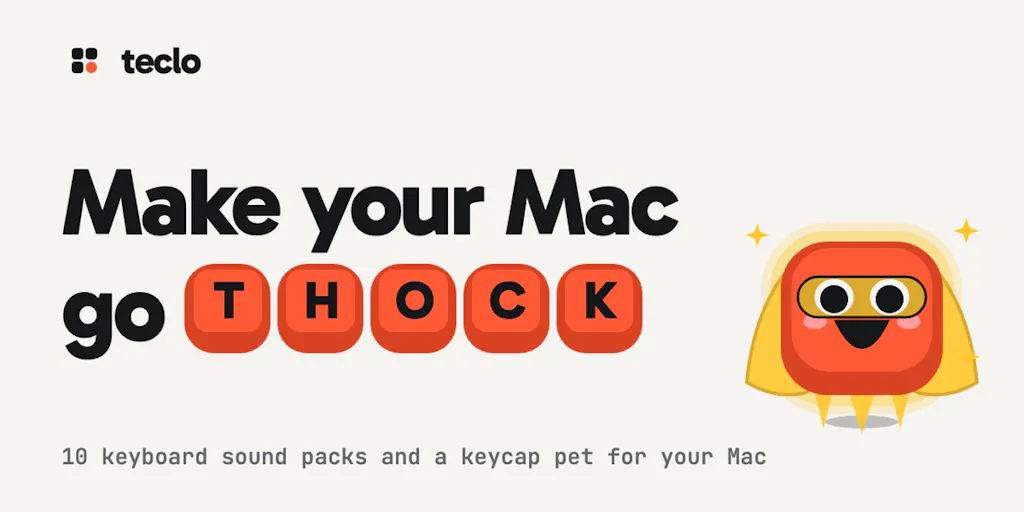
Teclo is a macOS utility made by Andrei (Perseu) that lives in the menu bar and plays a synthesized sound for every key press and release, in any app. It ships with sound packs — the maker says all packs are generated by Teclo’s own code rather than recorded samples, with six modeled on mechanical keyboards (everything from lubed linears on foam to a buckling spring) plus Rain, Typewriter, Pixel, and Laser. The pricing is the part every operator should underline: $4.99 once, a lifetime license, 7-day free trial, and a launch-day code (PHUNT) that drops it to $2.99 until October 30, covering up to three Macs. The maker also claims the app reacts to key presses only and never logs or sends what you type — a privacy claim worth noting because it’s the kind of line that, in a cross-border context, is either a trust asset or a compliance liability depending on how you substantiate it.
Then there’s the retention hook: a small keycap pet that falls asleep when you stop typing, cheers up as you type, and “powers up” if you hold a fast pace. That’s the whole product. No cloud, no account, no subscription. A one-time purchase with a mascot.
Why this belongs in a cross-border essay at all
Because the mechanics of this launch — micro-price, lifetime license, launch-code discount, interactive demo, mascot-driven habit — are the same mechanics that decide whether a $19 gadget on Shopify converts, whether an Amazon FBA brand can justify a replenishment email, and whether a Temu-style low-ASP seller ever escapes the race to the bottom. The product category is irrelevant. The pricing architecture and the demo funnel are not.
The problem it solves is smaller than the launch implies — and that’s the point
Let’s be honest about the job to be done. Teclo doesn’t solve a business problem. It solves a sensory mismatch: the maker’s own framing is that he likes the sound of a mechanical keyboard but types on a MacBook all day. That’s it. It’s a $5 solution to a $5 annoyance, and the launch page doesn’t pretend otherwise.
For a cross-border operator, the lesson isn’t “sell typing sounds.” It’s that the most defensible micro-products are the ones that fix a specific, repeatable, low-stakes irritation for a person who is already at their desk for eight hours. The addressable audience is narrow (Mac users who care about keyboard feel), but the frequency of use is enormous (every keystroke, all day). Narrow-and-frequent beats broad-and-occasional almost every time in low-ASP e-commerce. Compare it to the graveyard of generic “desk accessories” on Amazon — cable organizers, wrist rests, monitor stands — where the buyer uses the thing twice a week and never thinks about the brand again. Teclo’s buyer is exposed to the product hundreds of times a day. That’s a retention surface most physical-goods sellers would kill for, and it costs the maker nothing to maintain.
The second problem it quietly solves is discovery friction. A sound-effects app is hard to sell in a screenshot. So the maker built a live demo — the update post says your keycap pet runs over the keyboard and you can tap any key to hear a pack. One commenter, Nika, said she spent 30 seconds pressing keys on the site just to hear the sounds. That’s the entire conversion engine: let the buyer experience the product before the download, not after. For physical-goods sellers, the analog is a 3D/AR viewer, a sample video, or a “hear it / feel it / see it in your room” module — anything that collapses the gap between listing and sensory reality.
How it stacks up against the incumbents you’d actually compare it to
If you’re evaluating Teclo as a category, the honest comparison set isn’t other typing-sound apps — it’s the broader “make your Mac feel like something” utility market and, more usefully for us, the pricing models those tools use.
- Mechanical keyboards themselves (Keychron is the obvious reference — one commenter literally asked for Keychron sounds). A real board costs $80–$200 and solves the problem physically. Teclo’s pitch is that you get 80% of the sensory payoff for $5 without buying hardware. That’s the classic “software eats a hardware purchase” wedge, and it’s the same wedge that lets a $9 digital planner undercut a $40 paper planner on Etsy.
- Subscription utility apps — think Setapp or the endless menu-bar utilities on the Mac App Store that charge $2–$5/month. Teclo deliberately goes the other way: one-time, lifetime, three machines. That’s a positioning choice, not a rounding error, and it’s the one I’d argue with most (more below).
- Recorded-sample sound apps — the maker’s differentiator is that all 16 packs are synthesized in code rather than sampled. Whether a buyer can hear the difference is debatable; whether the maker can ship new packs cheaply is not. Synthesized assets are a content pipeline, not a licensing cost.
- The “pet” genre — tamagotchi-style companions like Finch or the various focus-pet apps. Teclo borrows the emotional loop without the subscription. That’s a genuinely interesting hybrid: habit-formation mechanics attached to a one-time purchase.
Where Teclo differs from all of them is that it refuses to monetize the relationship. No upsell, no pack DLC, no subscription. For a consumer that’s refreshing. For an operator studying it, that’s the first red flag.
Why Amazon sellers should care more than Shopify ones
Shopify operators already live in a world of apps, trials, and one-click installs — Teclo’s demo-to-download funnel is familiar territory. Amazon FBA sellers, by contrast, are structurally starved of sensory demos: you get six images, a video slot, and A+ content, and that’s it. The Teclo lesson for FBA is the launch-code mechanic: a time-boxed discount (here, $4.99 → $2.99 through October 30) that creates urgency without permanently devaluing the product. That maps almost one-to-one onto Amazon coupons and Prime Exclusive Discounts, and it’s a cleaner urgency play than a permanent “was $19.99, now $12.99” strikethrough that trains buyers to wait. The other FBA-relevant takeaway is the three-machine license — a soft “family plan” that raises perceived value without raising price. Bundling two units for a modest discount does the same job on a physical listing.
What cross-border sellers can actually borrow from this launch
Four things, in order of how quickly you can test them.
1. The demo-as-landing-page pattern
Teclo’s update post leads with the live demo, not the download button. The comment thread confirms it worked — people played with it before they thought about buying. If your product has any sensory dimension (sound, texture, fit, scent, motion), your PDP should let the buyer experience it before the add-to-cart. For a Shopify store, that’s an embedded video or interactive module above the fold; for Amazon, it’s the video slot plus a QR-to-demo insert in the box. The metric to watch is time-on-page-to-add-to-cart, not raw bounce.
2. Micro-pricing with a lifetime anchor
$4.99 lifetime is a psychological anchor, not a business model. The maker is essentially selling a permanent license at the price of a coffee, then discounting it 40% on launch day. For cross-border sellers, the borrowable version is a low-ASP hero SKU priced as an impulse buy, with a launch-window coupon that makes the first purchase feel like a deal. The trap is treating that price as sustainable — see the next section.
3. A mascot as a retention surface
The keycap pet is doing the work that most DTC brands try to buy with Klaviyo welcome flows and points programs. It gives the user a reason to open the app daily, and it gives the maker a content hook (new packs, new pet states) without a paid acquisition budget. Physical-goods analog: a character or ritual baked into the unboxing and the replenishment reminder. If your product has a “daily use” cadence, a mascot or ritual is cheaper than a loyalty program and harder to copy.
4. Synthesized content as a supply chain
Because the sound packs are generated in code, the maker shipped six new packs (Boulder, Cricket, Cushion, Marimba, Terminal, Bubble) within a day of launch, bringing the total to 16. That’s a content pipeline with near-zero marginal cost. Cross-border sellers with digital add-ons — presets, templates, recipes, playlists, firmware features — should be building the same pipeline. The launch-day velocity is the tell: 16 packs in 24 hours is a supply chain advantage disguised as a feature list.
Where my judgment says it falls short
I like the launch. I don’t like the business model, and I’d push back on three things.
The math breaks at lifetime pricing
$4.99 once, discounted to $2.99, for up to three Macs, with a 7-day free trial and no recurring revenue. Run the arithmetic: even at a generous 1,000 lifetime buyers, that’s under $5,000 gross, before payment processing, before the cost of building 16 sound packs, before support. The maker’s own update suggests the launch is going well by Product Hunt standards, but Product Hunt spikes decay in 72 hours. Without a subscription, a pack DLC, or a pro tier, there’s no mechanism to convert launch-day attention into ongoing revenue. For cross-border operators, the lesson is inverted: one-time pricing is a great acquisition tactic and a terrible retention strategy. If you’re going to sell a lifetime license, you need a second monetization surface — accessories, a pro tier, a bundle — or you’re running a hobby with a checkout page.
The privacy claim needs substantiation
“It never logs or sends what you type” is exactly the right claim to make for a keylogger-adjacent product, and exactly the claim that gets scrutinized hardest. In the EU and UK, that’s a GDPR-adjacent trust statement; on the Mac App Store, it’s a review risk. The launch page asserts it but doesn’t show the mechanism (sandboxing, no network entitlement, open-source audit). For a cross-border seller shipping any connected device — a smart pet feeder, a Bluetooth tracker, a baby monitor — the parallel is direct: if your product touches user data, your trust claim needs a proof page, not a sentence. That’s a gap I’d flag in any due-diligence review.
The pet is a retention hook without a retention model
The keycap pet is charming, and it’s the most interesting thing in the launch. But it’s attached to a product with no ongoing revenue, which means the maker is investing in engagement he can’t monetize. That’s fine for a passion project and instructive for operators: engagement mechanics only pay off if there’s a monetization surface behind them. A DTC brand with a subscription or a replenishment cadence can afford to build a mascot. A one-time-purchase seller cannot, unless the mascot drives referrals or upsells. Teclo’s pet is a feature, not a funnel — yet.
What I’d watch / test next
Three concrete things to do this week, depending on which side of the launch you sit on.
If you sell physical goods: pick your lowest-ASP hero SKU and run a 7-day launch-window coupon at 40% off, paired with a sensory demo module (video or interactive) above the fold on your PDP. Track time-on-page-to-add-to-cart and coupon redemption rate against a control. That’s the Teclo funnel, translated to Shopify or an Amazon coupon.
If you sell digital add-ons or consumables: audit whether you have a content pipeline that can ship new SKUs at near-zero marginal cost. If not, build one — presets, templates, recipes, firmware updates. Teclo shipped six packs in a day; you should be able to ship one a week.
If you’re evaluating a lifetime-license model: model the LTV before you commit. If the answer is “one purchase, no second surface,” don’t build the mascot — build the bundle instead. And if you make any trust claim about user data, write the proof page before the launch page.
The launch itself I’d watch for one more signal: whether the maker adds a paid pack tier or a pro version in the next 30 days. If he does, the $2.99 launch was customer acquisition, and the real business starts after October 30. If he doesn’t, Teclo is a well-executed novelty — and the most useful thing about it is the pricing lesson, not the product.