The personalization flywheel is moving from ads to artifacts — and cross-border sellers should be paying attention
Every cross-border operator I know is fighting the same war on two fronts: customer acquisition costs that keep climbing on Meta and TikTok, and retention curves that flatten out the moment the unboxing dopamine wears off. We’ve spent a decade optimizing the transaction — the ad, the listing, the checkout, the last-mile — and almost nothing optimizing the artifact that survives the transaction. That’s why Storytailor’s relaunch caught my eye, even though it has nothing to do with selling physical goods. It’s a children’s storytelling product, not a commerce tool. But the mechanic underneath it — turning a customer’s own input into a personalized, repeatable, shareable output — is the exact mechanic that DTC brands, print-on-demand operators, and marketplace private-label sellers have been trying to bolt onto their funnels for years. If you sell anything with a name, a photo, or a story attached to it, this launch is worth an hour of your week.
What Storytailor actually is, and why the mechanic matters more than the category
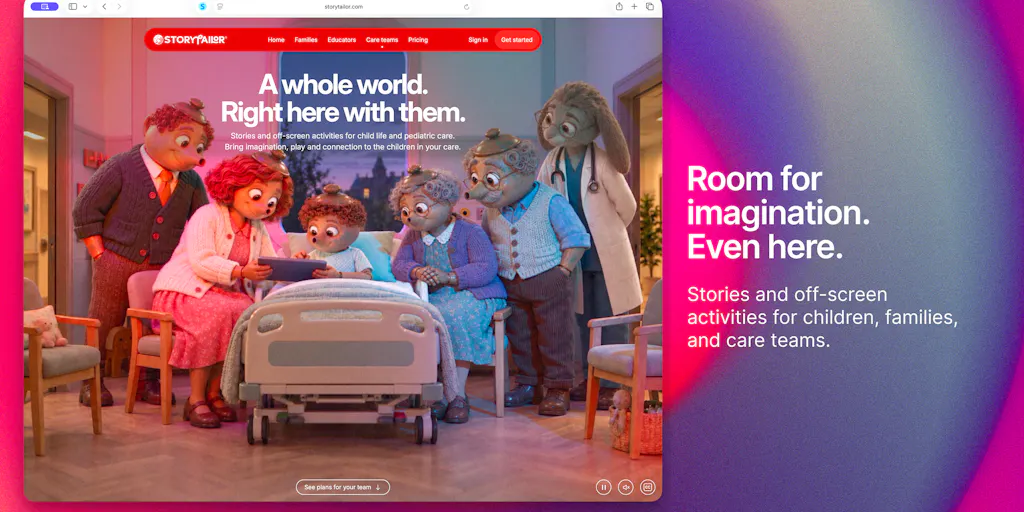
Storytailor is a personalized children’s storytelling product built by Storytailor Inc., and the relaunch was led by maker JQ Sirls, who describes rebuilding it so that “children’s ideas [have] somewhere to go.” The core loop, per the maker’s own launch comment: a grown-up uploads a child’s drawing, the system turns that drawing into a character, and that character returns in new illustrated stories. Families can read or listen together, explore something called “Wonder Words™,” and continue with off-screen activities. Educators get lesson plans. The grown-up signs in; the child doesn’t need their own credentials. There’s a Storytailor ID per child, managed by the adult, that keeps characters, stories, and preferences together. The first two stories are free.
If you’re an Amazon FBA seller reading this and wondering why I’m spending words on a kids’ app, stay with me. The reason this matters isn’t the children’s book vertical — it’s that Storytailor is a clean, well-documented example of a persistent personalization loop: one piece of customer-supplied input (a drawing) becomes a durable asset (a character) that gets reused across multiple outputs (stories). That’s the same architecture behind the highest-retention DTC brands I’ve watched over the last three years, and it’s the architecture almost nobody in cross-border e-commerce has actually built.
The three-part loop, stripped of the kid-friendly framing
Break Storytailor down to its skeleton and you get:
- Ingest a customer artifact. Not a preference, not a survey answer — an artifact the customer made. A drawing. In e-commerce terms: a photo, a name, a pet, a handwriting sample, a voice clip, a floor plan, a recipe.
- Convert it into a reusable entity. Storytailor calls it a character. You’d call it a customer profile object. The point is that it persists, and it’s owned by the customer, not by the session.
- Re-serve it in new contexts. New stories, new adventures, new formats. Each new output is a new reason to come back, and each one is personalized to a degree that a generic catalog can’t touch.
The reason this is hard for most sellers isn’t technical. It’s organizational. Personalization at scale requires you to store customer-supplied artifacts somewhere, govern them, and then build a repeat-use surface on top. Most Shopify stores have a customer account page and a wishlist and call it a day. Most Amazon Seller Central sellers have literally zero customer-owned surface area — the platform owns the relationship, and you rent access to it through ads and Brand Registry. That asymmetry is the whole game.
How it differs from the incumbents you’re probably already comparing it to
The obvious comparison set for Storytailor is the personalized children’s book category — Wonderbly (formerly Lost My Name), which built a real business on name-personalized books; Lovevery, which runs a stage-based subscription for early childhood; and the long tail of Etsy sellers doing custom illustrations. There’s also Moonpig on the greeting-card side and Shutterfly on the photo-goods side. The category is not new, and the “personalized book” pitch is at least fifteen years old.
What’s different here is the input. Wonderbly asks you to type a name and pick a hair color. Storytailor asks you to upload a drawing the child made. That’s a much higher-fidelity signal, and it produces a much stickier asset — because the child recognizes their own creation, not a template with their name slotted in. The maker’s framing is explicit: “We want children to see themselves without every adventure having to be about what makes them different.” That’s a positioning choice, and it’s a smart one, because it sidesteps the awkwardness of identity-based personalization while still delivering the emotional payload.
The second difference is the multi-output loop. Wonderbly sells you a book. Storytailor sells you a character that generates books. That’s a subscription-shaped business wearing a one-off product’s clothing, and it’s the same shift I’ve watched happen in Printify-style print-on-demand, where the winning operators aren’t selling one mug — they’re selling a design system the customer keeps coming back to.
Why Amazon sellers should care more than Shopify ones
Here’s the uncomfortable part. If you sell on Amazon, you have almost no mechanism to build a persistent personalized loop. You can’t store customer artifacts. You can’t email them without jumping through Amazon’s Buyer-Seller Messaging hoops. You can’t run a subscription without Subscribe & Save, which is a blunt instrument. Your entire personalization surface is the listing itself, and the listing is shared with every competitor.
Shopify sellers, by contrast, own the customer record, the email list, the Klaviyo flow, the Meta pixel, and the post-purchase sequence. They can build a Storytailor-style loop. They just usually don’t, because it requires a product that’s designed for repeat personalization rather than a one-and-done SKU. If you’re an Amazon-first seller, the takeaway isn’t “build a Storytailor clone.” It’s “stop pretending the platform will let you build one, and start treating the DTC channel as the place where the personalization loop lives.”
What cross-border sellers can actually borrow from this
I’ve been watching personalized-goods operators for years, and the ones who survive the ad-cost treadmill all converge on the same playbook. Storytailor’s launch is a clean reference implementation. Here’s what I’d steal.
1. Make the customer’s input the product, not the customization
Most “personalized” products are a base SKU plus a name field. That’s not personalization; that’s a form. The Storytailor move is to make the customer’s artifact — the drawing — the thing the product is built around. For a print-on-demand seller, that’s the difference between “add your name to this mug” and “upload your kid’s drawing and we’ll turn it into a mug, a puzzle, a notebook, and a set of stickers.” The second one has a reason to exist beyond the name field.
2. Persist the artifact, don’t just consume it
Storytailor keeps the character. That’s the moat. If you’re a DTC operator, the equivalent is keeping the customer’s uploaded photo, design, or text on file so that the next purchase is one click, not one re-upload. This is table stakes in Canva and Etsy custom shops, and it’s almost entirely absent in cross-border DTC. Every re-upload is a drop-off point. Every stored artifact is a re-engagement hook.
3. Build the second purchase into the first
The first two stories are free. That’s a classic freemium hook, and it’s the right one for a product whose value compounds with use. In e-commerce terms: the first personalized item should be priced to acquire, and the second and third should be where the margin lives. The mistake most sellers make is pricing the first item for margin and then wondering why nobody comes back.
4. Treat safety and trust as a feature, not a compliance cost
The maker links to a trust page in response to a comment about child safety, and the “grown-up signs in, child doesn’t need credentials” design is a deliberate trust choice. Cross-border sellers handling customer photos, children’s names, or any PII should be reading that as a signal: trust infrastructure is a conversion asset, not a legal footnote. If you’re selling into the EU, GDPR compliance is table stakes; if you’re selling kids’ products into the US, COPPA is the line you don’t cross. Storytailor’s design choices are a useful template for how to make that visible to the customer.
Where the math breaks
I want to be honest about the limits of this analogy. Storytailor is a digital product with near-zero marginal cost per story. Physical personalized goods have real COGS, real fulfillment latency, and real return rates — and personalized goods are notoriously hard to return, which is both a margin advantage and a customer-service liability. The loop works beautifully in software. In hardware, it works only if the artifact-to-product pipeline is cheap enough to run at low volume. That’s why Printify and Printful matter more than most sellers admit: they’re the infrastructure that makes the Storytailor loop economically viable for physical goods. If your per-unit personalization cost is above roughly 30% of the sale price, the loop doesn’t compound — it just adds friction.
Where my judgment says Storytailor falls short
I don’t want to write a puff piece, so here’s the honest read.
The onboarding is rough. A reviewer flagged that the signup flow doesn’t clearly tell you what’s wrong when your input fails validation — specifically, a birthday field that expects MM/DD/YYYY and silently rejects a two-digit year. The maker acknowledged it and says it’s been updated, but the underlying issue — unclear error states in a flow that’s supposed to be friendly to non-technical parents — is exactly the kind of thing that kills conversion in the first ninety seconds. If you’re borrowing the onboarding pattern, borrow the fix, not the original.
The “Wonder Words™” and “off-screen activities” features are under-explained. The launch copy mentions them, but there’s no detail on what they actually are, how they’re generated, or whether they’re part of the free tier. For a product whose pitch is “children’s ideas have somewhere to go,” the pedagogical layer is doing a lot of work — and right now it’s mostly a bullet point.
The pricing beyond “first two stories free” is not disclosed. That’s fine for a launch, but it matters for the analogy. If the paid tier is a subscription, the loop compounds. If it’s per-story, it doesn’t. I can’t tell from the source, and I’d want to before I cited this as a model.
The competitive moat is thinner than it looks. Wonderbly has brand recognition and distribution. Moonpig has a massive gifting footprint. An AI-native competitor with better illustration quality could replicate the core loop in a quarter. Storytailor’s defensibility is the character graph — the accumulated library of a family’s characters and stories — which is real, but only if retention holds.
The cross-border angle nobody’s talking about
Here’s the part I find genuinely interesting. Storytailor’s product is inherently multilingual-friendly — a child’s drawing doesn’t have a language, and an illustrated story can be localized at near-zero marginal cost. That’s a structural advantage for cross-border operators who’ve been stuck with English-first creative and expensive localization pipelines. If you’re selling into TikTok Shop in the UK, Germany, or Southeast Asia, the ability to generate personalized creative in the customer’s language — from a customer-supplied artifact — is a real unlock. It’s also a real risk: AI-generated children’s content in multiple languages is a regulatory minefield, and the trust page is doing more work than the launch copy admits.
What I’d watch / test next
Three concrete things I’d do this week if I ran a personalized-goods brand.
First, audit your post-purchase flow for artifact capture. Find the one place where a customer could upload something — a photo, a drawing, a name, a story — and add it. Not as a customization field, but as a stored asset tied to their account. Even if you never use it for a second product, the act of capturing it changes how you think about the customer relationship.
Second, model the second-purchase math. If your first item is priced for margin, you’re probably losing the loop. Run the numbers on a first-item acquisition price and a second-item margin price, and see whether the LTV math actually works. If it doesn’t, the personalization loop isn’t your problem — your unit economics are.
Third, pressure-test your trust posture. If you’re handling customer photos or children’s data, read Storytailor’s trust page and compare it to yours. If yours is a paragraph in the footer and theirs is a designed surface, that’s a conversion gap, not a legal one.
The broader thesis: personalization is moving from a checkout feature to a retention architecture, and the operators who win the next three years will be the ones who treat customer-supplied artifacts as assets rather than form fields. Storytailor is a children’s product, but the mechanic is the message. Watch the mechanic, not the category.