Why a FaceTime Agent Matters More Than Another Chatbot
Every cross-border operator I know is drowning in the same paradox: customer support costs are climbing, response-time SLAs are shrinking, and the moment a buyer hits a visual problem — a cable that doesn’t fit, a screen showing an error, a product assembly step gone wrong — the entire AI chatbot stack collapses. Your bot can apologize in four languages, but it cannot see that the customer plugged the USB-C into the Ethernet port. That gap is where refunds happen, where return rates climb, and where your Amazon listing’s “defective” flag gets triggered. So when I saw Chert — a tool that puts an AI agent on FaceTime with vision — my first thought wasn’t “cool demo.” It was “this is the missing layer between a FAQ bot and a human support rep.”
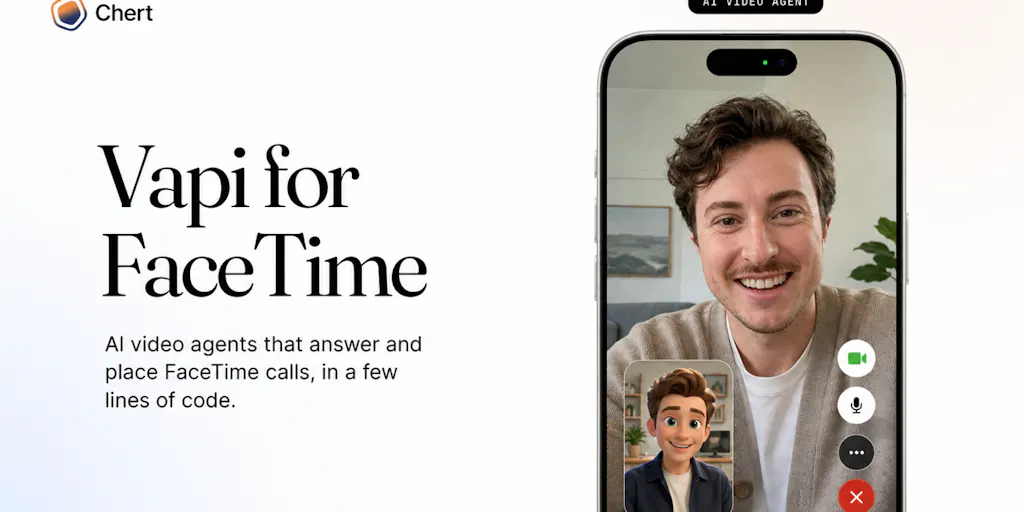
The pitch is deceptively simple: deploy an AI agent that answers and places FaceTime calls, sees what the user shows the camera, and responds in real time. The founder, Gary Gao, frames it as “Vapi for FaceTime” — a reference to the voice-agent infrastructure layer. But for anyone running a DTC brand or an Amazon FBA operation, the more useful frame is this: it’s the first practical bridge between the chat interface and the physical reality of your product.
The Blind Voice Agent Problem
Let me be blunt: most voice AI on the market today is theater. It sounds human, it deflects politely, and it fails the moment the customer’s problem becomes spatial. The founder’s own framing is worth quoting: “every voice agent shipping today is blind. It can only handle what a customer can describe, so the second a problem is visual (e.g. ‘which cable goes where?’, ‘what’s this error on my screen?’), a human has to jump in.”
That’s not a niche complaint. Think about the top return reasons for cross-border e-commerce: “item didn’t fit,” “item defective,” “item not as described.” A significant portion of those are actually setup failures — the product is fine, the customer can’t figure it out, and they don’t have the vocabulary to explain what they’re seeing. A blind chatbot can’t diagnose that. A video-capable agent can.
The distinction matters because it changes the economics of support. Right now, the escalation path is: chatbot fails → email ticket → human reads the description → human asks for a photo → customer sends a blurry photo → human guesses. That’s a 48-hour cycle at best, and a return label at worst. Chert’s approach collapses that to a single interaction where the agent sees the problem in real time. For a seller with a 3% return rate on a $50 product, cutting even half of those returns pays for a lot of infrastructure.
What Chert Actually Does — and How It’s Different
The mechanics are straightforward. You write “a few lines of code” to deploy an agent that can both answer and place FaceTime calls. It uses the camera to see what the user shows it, and it responds in real time. The demo number is live — you can FaceTime +1 310 279 2297 to test it yourself, and the docs are at https://www.trychert.com/facetime.
Now, the comparison game. The obvious incumbents are the voice-agent platforms: Vapi, Bland.ai, and the broader Retell AI ecosystem. Those are phone-based, audio-only. They’re great for appointment reminders and simple order-status queries. They’re useless for “which cable goes where.”
The other comparison is the video-support tools like Cobrowse.io or Surfly — but those are human-to-human, screen-sharing tools. They don’t have an AI layer that can interpret what it sees and act on it. Chert’s bet is that the AI layer is the differentiator: it’s not just a video call, it’s a video call with a reasoning engine attached.
The third, and most interesting, comparison is the GPT-4o class of multimodal models. Those can see images and video, but they’re not natively wired into a communication channel. You’d have to build the telephony, the call routing, the camera access, and the real-time response loop yourself. Chert is packaging that — and the FaceTime integration is the clever part. FaceTime is pre-installed on every iPhone, it’s trusted, and it doesn’t require the user to download a new app or create a new account. That’s a massive friction reduction for the customer.
Why Amazon Sellers Should Care More Than Shopify Ones
Here’s where I’ll get opinionated. If you’re running a Shopify store, you have a direct relationship with the customer. You can embed a video-support widget on your product page or in your post-purchase flow. The user journey is yours to control.
But if you’re an Amazon Seller Central operator, you’re playing a different game. You don’t own the customer relationship. You can’t put a widget on the product page. Your support options are constrained by Amazon’s messaging system, which is text-based and clunky. The only place you have any agency is in the product insert — the little card that goes in the box. Imagine that card saying: “Need help? FaceTime this number and an AI assistant will walk you through setup.” That’s a channel Amazon can’t take away from you, and it’s a way to intercept a return before the customer clicks the “Return” button. For FBA sellers, where return fees and “defective” flags hit your account health, this is potentially a bigger deal than for any DTC brand.
The caveat, of course, is that FaceTime is Apple-only. That’s a real constraint in the cross-border world, where the dominant OS in many markets is Android. The founder acknowledges this in the comments, noting plans to expand to WhatsApp messaging and video calling. That’s the right direction — WhatsApp is the default communication app for most of Latin America, Southeast Asia, and parts of Europe. But it’s not here yet, so the current use case skews toward US and Western European customers on iPhones.
The Use Cases That Actually Matter for Cross-Border
The Product Hunt comments surface a few use cases, and I want to push them further through an e-commerce lens.
Remote support and field service. This is the obvious one. If you sell anything that requires assembly — furniture, exercise equipment, electronics, even complex subscription boxes — the “which cable goes where” problem is your return-rate killer. A video agent that can see the customer’s setup and guide them through it in real time is a direct substitute for a human support call. The founder cites this explicitly: “remote support that can actually see the problem.”
Telehealth intake. This is less directly relevant to e-commerce, but it signals the platform’s depth. If Chert can handle regulated video interactions, it can handle the less-regulated world of product support. The privacy question — raised by a commenter and answered with “we encrypt user information so that it is never exposed” — is a yellow flag that needs scrutiny, but the intent is there.
Guided onboarding. This is the one I think is underrated for DTC brands. Think about a smart-home device, a security camera, or a Wi-Fi mesh system. The unboxing and setup experience determines whether you get a 5-star review or a “this is garbage, it didn’t work” 1-star. A video agent that walks the customer through the setup, seeing what they’re doing, could dramatically improve your first-review score distribution. That’s not just support — that’s a product feature.
KYC and identity verification. A commenter asked about this, and the founder’s response is interesting: “visual identity verification could actually be more robust than a lot of the current identity verification infrastructures over text, email, or calls today.” For cross-border sellers dealing with high-fraud regions or high-value items, this could be a fraud-prevention tool. But I’d be cautious — this is a regulated space, and “we encrypt user information” is not the same as “we are SOC 2 Type II certified and GDPR-compliant.” That’s a “wait and see” item.
Where the Math Breaks
Let’s talk about the economics, because that’s where the shine wears off. Chert is positioned as an infrastructure layer — “Vapi for FaceTime.” That means you, the seller, are paying for API usage. The pricing is not disclosed on the launch page, which is a red flag for anyone who’s been burned by AI vendor pricing before. Voice and video AI is expensive to run — the compute costs for real-time video inference are an order of magnitude higher than text-based chatbots.
Here’s the math problem: if a text-based support interaction costs you $0.01 in AI tokens, and a video interaction costs you $0.50 to $1.00, you need to be very sure that video interaction is preventing a return worth at least $50. For a low-ASP product — say, a $15 gadget — the economics don’t work. The video agent would cost more than the product’s margin. For a high-ASP product — a $200 smart home device, a $500 exercise machine — the math starts to make sense. The break-even is somewhere in the $50-$100 product range, and that’s the segment I’d target first.
The second math problem is the Apple-only constraint. If you’re selling primarily to US consumers, that’s maybe 50-60% of your customer base on iPhone. If you’re selling globally, that number drops to 20-30% in many markets. You’re building a support channel for a minority of your customers. That’s fine as a premium support tier, but it’s not a replacement for your existing chat and email infrastructure.
What Cross-Border Sellers Can Borrow (Even If You Never Use Chert)
Here’s the part I want you to take with you, regardless of whether you sign up for Chert’s API or not.
The “blind agent” framing is a diagnostic tool. Go through your return reasons and support tickets. Which ones are text-describable? Which ones are visual? If a customer says “it doesn’t work,” how many of those are actually “I can’t figure out how to plug it in”? If that number is significant, you need a visual support channel — whether that’s Chert, a human video-call service, or just a better product insert with QR codes linking to video guides.
The pre-installed channel insight is huge. FaceTime works because it’s already there. The lesson for your brand is: don’t make customers download a new app or create a new account to get support. The friction of “download our app to get help” is often higher than the friction of “just return the product.” If you’re building a support flow, put it in a channel the customer already has — SMS, WhatsApp, or a web-based video link that doesn’t require an app.
The “show me the problem” principle. Even if you’re using a human support team, the principle stands: the fastest path to resolution is seeing the problem. If you’re not already asking customers for photos or video in your first support response, you’re wasting time. The AI layer just makes this scalable — but the operational insight is the same.
Where I’m Skeptical
I want to be clear about the risks, because the Product Hunt launch energy is uniformly positive and that’s always a warning sign.
Privacy and compliance. The founder’s answer to the privacy question — “we encrypt user information so that it is never exposed” — is the kind of answer that sounds good in a comment thread but doesn’t survive contact with a compliance officer. For regulated use cases like KYC or telehealth, you need more than encryption. You need data residency guarantees, audit logs, and clear retention policies. If you’re a cross-border seller dealing with GDPR or CCPA requirements, you need to ask harder questions before you route customer video through a third-party API.
Latency and reliability. One commenter said the latency was “better than I expected,” which is faint praise. Real-time video AI is compute-intensive. On a congested network — which is the norm in many emerging markets — the experience could degrade significantly. A video agent that lags is worse than a text bot that’s instant.
The WhatsApp gap. The founder says WhatsApp support is “in the future.” For cross-border sellers, that future can’t come soon enough. FaceTime is a US/Apple-centric channel, as a commenter pointed out. The global default is WhatsApp. Until Chert ships that integration, its relevance to the cross-border market is limited to a specific, higher-income customer segment.
What I’d Watch / Test Next
Here’s what I’d do this week if I were running a DTC brand or an Amazon FBA operation.
1. Run a “visual problem” audit on your return data. Pull your last 100 support tickets and return reasons. Categorize them: how many were text-describable vs. visual? If you find more than 20% are visual, you have a case for a video support channel.
2. Test the demo yourself. The number is +1 310 279 2297. FaceTime it, show it a broken product or a confusing setup, and evaluate the response. Don’t just read the reviews — feel the latency, test the edge cases. This is the fastest way to know if the tech is ready for your customers.
3. Build a “video-first” support flow for your highest-ASP products. Pick your top 10% of SKUs by price. Create a support path that asks for a video or photo on the first response. You can do this with a human team or with a tool like Loom for async video, or Chert for real-time. Measure the impact on return rates and refund requests. I’d bet you see a measurable improvement.
4. Watch the WhatsApp announcement. If Chert ships WhatsApp video calling, the cross-border use case becomes dramatically more interesting. For now, treat it as a US-market experiment with global potential.
5. Don’t rip out your existing stack. Klaviyo flows, Zendesk tickets, and Helium 10 tools aren’t going anywhere. Chert is an addition, not a replacement. Use it where it has a clear edge: visual problem-solving for high-ASP products.
The bottom line: Chert is solving a real problem that every cross-border seller has felt but few have articulated — the blindness of the AI support stack. The execution is early, the channel is limited, and the economics are unproven. But the direction is right, and the “show me the problem” principle is one you can adopt today, whether or not you ever write a line of code against their API. The sellers who win in the next two years will be the ones who figure out how to make AI see their products in the hands of customers. Chert is one of the first tools that makes that possible — and that’s worth a test call, even if you’re skeptical.