The $9.99 subscription that should scare every DTC brand owner
Cross-border sellers spend their days optimizing conversion funnels, ad spend, and fulfillment SLAs — but the hardest retention problem in e-commerce isn’t logistics or CAC. It’s emotional. The moment a customer is anxious, overwhelmed, or stuck in a spiral, they churn, they leave a one-star review, or they open a chargeback. Stella, a new emotional-wellness AI from Stella Labs that launched on Product Hunt this week, is a useful mirror for that problem. Not because you should bolt a therapy chatbot onto your Shopify store — but because the way it packages access, pricing, and trust is a masterclass in reducing the friction that kills repeat purchase. And it’s a warning shot: the consumer AI subscription playbook is coming for your customer’s attention budget.
What Stella actually solves (and what it deliberately doesn’t)
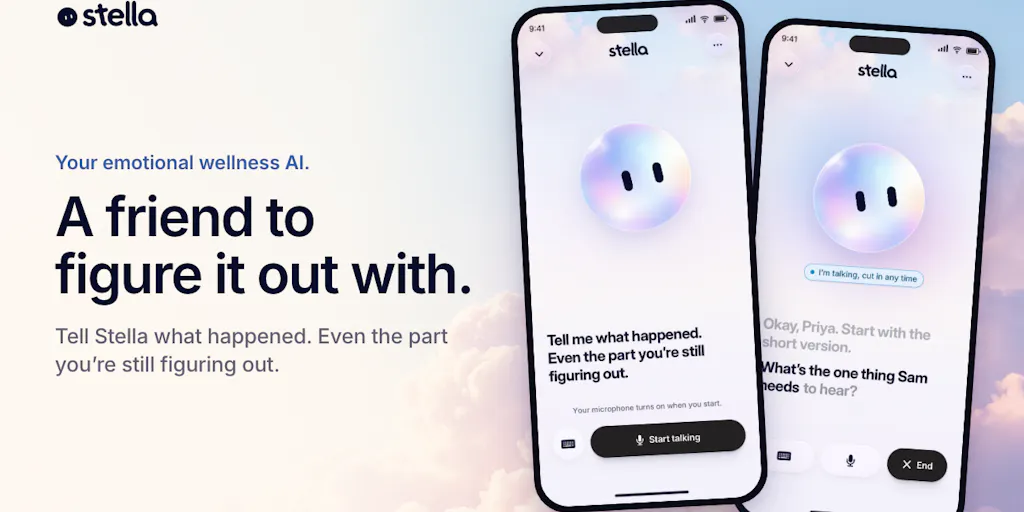
Stella is, in the maker’s own framing, “your emotional wellness AI, a friend to figure it out with.” You tell her what happened — by voice or text in the iPhone app, or by plain text in iMessage — and she helps you reframe, find words for a hard conversation, or pick one small next step. The founder, Max Drut, is explicit that this is not therapy and not a substitute for professional care. That disclaimer is doing a lot of work, and it’s the first thing any operator should study.
The problem it solves is not “mental health.” It’s the 2 a.m. moment: the parking-lot spiral before a meeting, the thing that feels “too small” to bring to a friend who’s already been “that friend” too many times. Stella’s wedge is the low-stakes first step — no intake form, no appointment, no insurance. That’s the same wedge that separates a browse-and-bounce visitor from a first-time buyer on your store.
Why this matters more to Amazon sellers than Shopify ones
Here’s the uncomfortable truth: Amazon’s review system is an emotional-pressure cooker. A frustrated buyer with a defective unit and no easy path to resolution doesn’t just churn — they write a review that poisons your conversion for months. Shopify DTC brands can at least intercept with a Klaviyo flow or a chat widget. Amazon sellers operate inside Seller Central where the only lever is the buyer-seller messaging window and the returns process. An AI that de-escalates a frustrated customer before they hit “leave a review” is worth more to an FBA brand than to a Shopify store with a mature retention stack. Stella’s iMessage-first entry point is the tell: it meets people where the anxiety actually lives, not where your support ticket queue wants them.
How it differs from the incumbents — and where the comparison gets uncomfortable
The obvious comparison set is Woebot, Wysa, and the consumer-facing layer of Talkspace or BetterHelp. Woebot and Wysa are CBT-flavored, app-first, and clinically branded. BetterHelp is a marketplace for human therapists with a matching funnel. Stella sits in a different lane: it’s positioned as a friend, not a clinician, and it deliberately collapses the install barrier with iMessage. That’s the genuinely novel move — texting an AI from a website with no download, per the maker’s own framing, “asks a few questions, including what happened in your own words, then writes your first text for you.”
The pricing is the second differentiator, and it’s aggressive: free to download, subscription required to keep using it, at $9.99 a month or $59.99 a year in the US. That’s roughly a third of a single BetterHelp session and well under Woebot’s enterprise-flavored positioning. For a cross-border operator, that number should trigger a very specific reflex: this is the same psychological price band as a Calm subscription or a mid-tier Spotify plan. It’s priced to be an impulse, not a decision.
Where the math breaks
$9.99/month is a brutal unit-economics environment if you’re paying for inference. Voice input, iMessage delivery, and a persistent conversational memory all carry real per-user compute cost, and the maker hasn’t disclosed burn, CAC, or retention — all “not disclosed” in the launch materials. A $59.99 annual plan implies a ~50% discount for prepayment, which is standard SaaS, but for an AI product with variable inference costs, annual prepay is also a cash-flow bridge. I’d want to see month-2 and month-6 retention before believing this is a business rather than a beautiful demo. The same skepticism applies to any AI tooling you’re evaluating for your own stack right now: the demo is not the P&L.
What cross-border sellers can borrow from Stella’s launch
Four transferable moves, in descending order of how fast you can steal them.
1. The iMessage/no-install wedge. Stella’s smartest growth decision is offering a path that requires zero app-store friction. Your DTC equivalent is the “text us” or WhatsApp entry point that doesn’t force a download or a login. If you’re running TikTok Shop or Temu, your buyer is already in a messaging-native context. Meet them there instead of forcing a email-capture modal.
2. The named-for-a-person trust device. Stella is named after the founder’s mother, and the about page leans into it. That’s not sentimentality — it’s a trust shortcut. DTC brands that put a real founder face and a real origin story on the product page consistently outperform anonymous catalog pages on Shopify conversion. This is the cheapest CRO lever most operators ignore.
3. The “not therapy” disclaimer as a positioning asset. Stella tells you exactly what it isn’t. That honesty reduces refund risk and sets expectations. Your product pages should do the same: state the one thing your product is not for. It cuts returns and it builds the kind of trust that survives a Trustpilot scroll.
4. The annual-prepay cash bridge. $59.99/year vs. $9.99/month is a 50% discount that pulls a year of cash forward. Subscription-box operators on Recharge or Bold should be testing steeper annual incentives than they currently do — especially in categories with high month-1 churn.
Why Etsy and eBay sellers should care less than they think
If you’re a handmade Etsy seller or a eBay reseller, Stella’s lessons are mostly irrelevant. Your buyer relationship is transactional and search-driven; there’s no subscription surface to defend. The one exception is post-purchase anxiety on high-ticket items — a $400 vintage watch or a custom commission — where a proactive “here’s exactly what happens next” message does more for your review score than any chatbot. Don’t over-index on AI wellness; do steal the expectation-setting discipline.
Where my judgment says Stella falls short
Three concerns, stated plainly.
First, the trust question the maker himself raises — “would you start by texting an AI from a website, or does an app feel more trustworthy for something this personal?” — is unresolved. My read: iMessage is a brilliant acquisition channel and a questionable retention channel. People clear their texts; they don’t clear their home screen. The app is where habit lives.
Second, the “friend” positioning is a liability at scale. A friend who is always available and never has needs is a fantasy, and users will eventually feel the asymmetry. Woebot and Wysa avoid this by being unambiguously tools. Stella’s warmth is her differentiator and her ceiling.
Third, the pricing has no visible moat. At $9.99, ChatGPT Plus at $20 and Claude at $20 are the real competitors — and they’re general-purpose. Stella’s bet is that emotional specificity beats general capability. That’s a defensible bet, but it’s a bet, not a fact.
What I’d watch / test next
This week, three concrete moves. (1) If you run a subscription box or consumable, test a 40–50% annual-prepay discount against your current month-to-month offer and measure the 90-day LTV delta, not just the conversion lift. (2) Add a one-line “what this product is not for” statement to your top three product pages and watch return rate for 30 days. (3) If you sell on Amazon, audit your buyer-seller messaging for de-escalation language — the Stella lesson is that the first message after a problem determines whether you get a review or a return. And keep an eye on Stella’s Product Hunt page for retention signals; if a $9.99 emotional AI holds users past month three, the subscription playbook for every consumer category just got a new benchmark.