The Jira Tabs You Keep Open Are a Fulfillment Problem
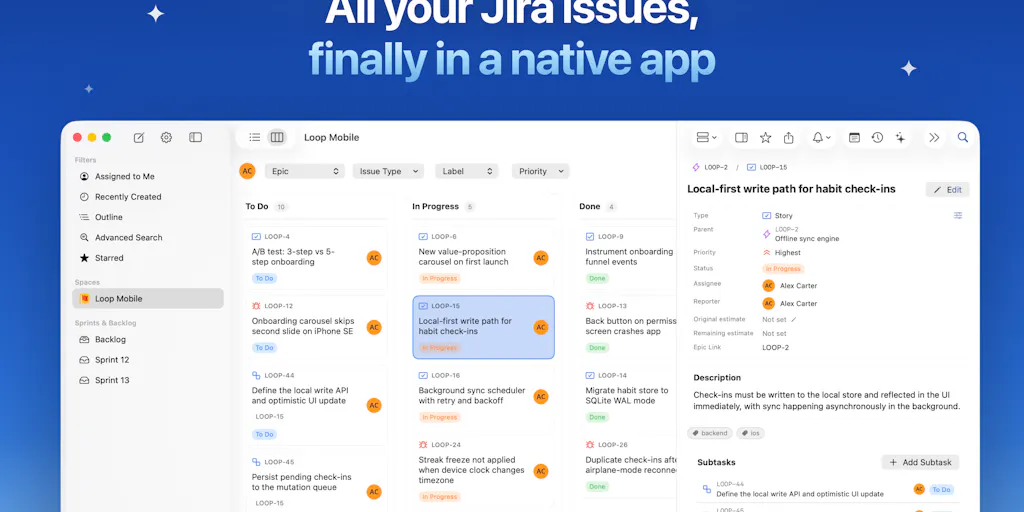
Cross-border operators rarely lose money on strategy. They lose it on latency — the twelve minutes between a supplier question and a decision, the two days a listing sits suppressed because nobody noticed the case in Seller Central, the sprint review where the ops lead admits the returns-reduction ticket never moved. Every one of those gaps is a tooling gap, not a talent gap. So when a small indie team ships a native, keyboard-driven Jira client and explicitly says it was built because “everyday Jira work on a Mac shouldn’t mean hunting through browser tabs,” I pay attention — not because I run Jira sprints for fun, but because the same pattern shows up in every marketplace back office I touch. Starlie, built by Artem Belkov and a small maker team, is worth dissecting for what it reveals about how thin clients, local data, and AI handoffs are about to reshape the operator’s daily stack.
What Starlie Actually Solves (And What It Doesn’t)
The pitch is narrow and honest: a fast, native, keyboard-driven Jira client for Mac focused on daily workflow. The feature list is short — a native Kanban board for running sprints, ticket updates, ⌘K jump-to-issue with full JQL search, and the ability to open an issue directly in Claude or Codex with its context and local project attached. It works with both Jira Cloud and self-hosted Jira. The privacy posture is the interesting part: Jira data is stored only on the device and in the Atlassian account, with no usage data collection and no analytics or tracking in the app. There’s a seven-day free trial.
Now translate that to e-commerce. If you run a DTC brand on Shopify and a marketplace business on Amazon Seller Central, your internal work doesn’t live in Jira — it lives in a sprawl of tools that each pretend to be the source of truth. Supplier QC issues live in email. Listing changes live in a spreadsheet. Creative briefs live in Notion. Ad experiments live in a Slack thread that dies in 48 hours. The teams that scale past $5M GMV are the ones who force all of that into one ticket system, usually Jira or Linear, and then spend their days fighting the interface. Starlie is a bet that the interface, not the workflow, is the bottleneck.
Why Amazon sellers should care more than Shopify ones
Shopify operators tend to be generalists running lean teams — a founder, a marketer, a ops person, maybe an agency. They can survive on Notion and a shared inbox. Amazon FBA brand owners can’t. The moment you’re managing multiple ASINs across marketplaces, you’re juggling case logs, inventory reconciliation, reimbursement claims, A+ content revisions, and ad structure changes that all have deadlines and dependencies. That’s project management whether you call it that or not. A native client that lets an ops lead hit ⌘K, pull up the reimbursement ticket, and hand the context straight to an AI agent is a meaningfully different workflow than alt-tabbing between a browser and a ChatGPT window and re-pasting the same ASIN data for the fifth time. The AI handoff is the feature Amazon sellers should be watching, not the Kanban board.
Where the math breaks
The trial is seven days and pricing isn’t disclosed on the launch page. That’s a problem for operator evaluation, because the real cost of a Jira client isn’t the subscription — it’s the migration and the muscle memory. If you’re on a five-person ops team, you’re asking everyone to relearn a daily tool for a speed gain that’s hard to quantify. The math only works if the ⌘K-plus-AI-handoff loop saves each person more than the subscription cost per month in recovered minutes, and nobody has published that number. Treat the trial as a two-week experiment with a stopwatch, not a permanent switch.
The Boring Infrastructure Lesson: Local-First Is a Feature
Here’s the part most cross-border operators will skim past and shouldn’t. Starlie’s privacy design — data stored only on the device and in the Atlassian account, no analytics, no tracking — is the same architecture that’s quietly winning in the e-commerce tooling stack. Think about what you actually paste into third-party SaaS tools every day: supplier cost sheets, margin data, customer PII from Klaviyo exports, ad account structures. Every one of those is a compliance liability the moment it leaves your machine and lands in a vendor’s analytics pipeline.
The tooling vendors that understand this are the ones building local-first or bring-your-own-key architectures. The ones that don’t are the ones you’ll be ripping out in eighteen months when a marketplace audit or a GDPR request forces the issue. Starlie is a small signal that indie developers have internalized this — a one-person team shipping a privacy-by-design client for a niche workflow is a leading indicator of where the rest of the stack is heading. If you’re evaluating any new SaaS this quarter, from a Helium 10 add-on to a returns automation tool, “where does my data live and who can see it” should be the second question you ask, right after “what does it cost.”
The AI handoff is the real product
The most underrated line in the entire launch is the one about opening an issue directly in Claude or Codex “with its context and local project attached.” That’s not a Jira feature. That’s a template for how every operational tool is going to work in the next 24 months. The winning pattern is: your system of record holds the structured context, and your AI agent holds the reasoning. The tool’s job is to hand off cleanly, not to become the AI itself.
For cross-border sellers, this maps directly onto the workflows that eat the most hours. A supplier dispute ticket with the PO number, the QC photos, and the WhatsApp thread attached, handed to an agent that drafts the escalation email in Mandarin. A listing suppression ticket with the policy violation text and the historical appeal language attached, handed to an agent that drafts the appeal. The bottleneck has never been the AI’s capability. It’s been the friction of assembling context. Any tool that removes that friction — even a Jira client — is worth studying as a pattern.
What Cross-Border Sellers Should Borrow From This Launch
You don’t need Starlie. You probably don’t even use Jira. But the launch contains four transferable moves that apply to any operator building or buying their internal stack.
One: pick one system of record and force everything into it. The reason Starlie’s ⌘K search works is that every issue lives in Jira with structured fields. If your supplier issues live in email and your listing issues live in a spreadsheet and your ad issues live in a Slack channel, no client can save you. Consolidation is the prerequisite, not the product.
Two: treat keyboard-driven interfaces as a real productivity lever, not a gimmick. ⌘K jump-to-anything is the single highest-ROI UI pattern of the last decade. If you’re buying any tool in 2026 — a WMS, a PIM, a helpdesk — put “does it have a command palette” on your evaluation checklist. It sounds trivial. It isn’t. The difference between a three-second action and a fifteen-second action, multiplied by two hundred actions a day across a team, is a headcount.
Three: demand local-first or BYO-key architectures from your vendors. The Starlie team’s decision to collect no usage data and ship no analytics is a competitive advantage they’re giving away for free. When you’re negotiating with a SaaS vendor — a TikTok Shop analytics tool, a Temu repricing service, an Etsy SEO tool — ask whether they offer a self-hosted or local-processing option. The ones that do are the ones that will survive the next round of privacy regulation without a fire drill.
Four: build the AI handoff into your own SOPs, even without a product. You don’t need Starlie to steal the pattern. Create a standard template for every recurring ticket type — supplier dispute, listing appeal, reimbursement claim — that includes the exact fields an AI agent needs to draft the response. Then your team’s job becomes “fill the template, hit generate, review, send.” That’s the same workflow Starlie is selling, minus the subscription.
What I’d watch / test next
Three concrete things to do this week. First, if you’re a Mac-based ops lead already living in Jira, install Starlie and run the seven-day trial with a stopwatch — measure the time from “I need to update this ticket” to “ticket updated” against your browser baseline. If it doesn’t beat the browser by thirty percent, don’t buy it, but do steal the ⌘K pattern for whatever tool you do use. Second, audit your top five recurring ticket types and write a context template for each one — the fields an AI agent would need to draft a response. This costs you an afternoon and pays back immediately, regardless of what tools you run. Third, if you’re evaluating any new SaaS this quarter, add two questions to your standard eval: “where does my data live” and “does it have a command palette.” Both are leading indicators of whether the vendor is building for 2026 or 2019. The Starlie team hasn’t disclosed pricing and hasn’t shipped offline mode yet — those are the two things to watch before committing a team to it. But the architecture and the AI handoff pattern are worth copying today, whether or not you ever open the app.