The “nobody owns this” problem is the real bottleneck in cross-border ops
Every cross-border seller I talk to has the same structural gap: the work that grows the business is the work nobody owns. Not the ads, not the listings, not the support macros — those have owners and dashboards. I mean the connective tissue: sourcing a shortlist of overseas partners, drafting the first-touch email to a potential 3PL, checking whether a new market’s import duty math actually works, scraping competitor review language for a product angle. On a five-person team, that work gets done at 11pm or not at all. So when I saw SquadRoom launch on Product Hunt — pitched by Kartike Bansal of SpeedVitals as “a team of AI employees” with one owner per task and a human approval gate — I read it less as a shiny new agent toy and more as a direct answer to the staffing ceiling that caps most DTC and FBA operators. The interesting question isn’t whether it works. It’s whether the approval model survives contact with a real seller’s inbox.
What SquadRoom actually is, stripped of the launch-day gloss
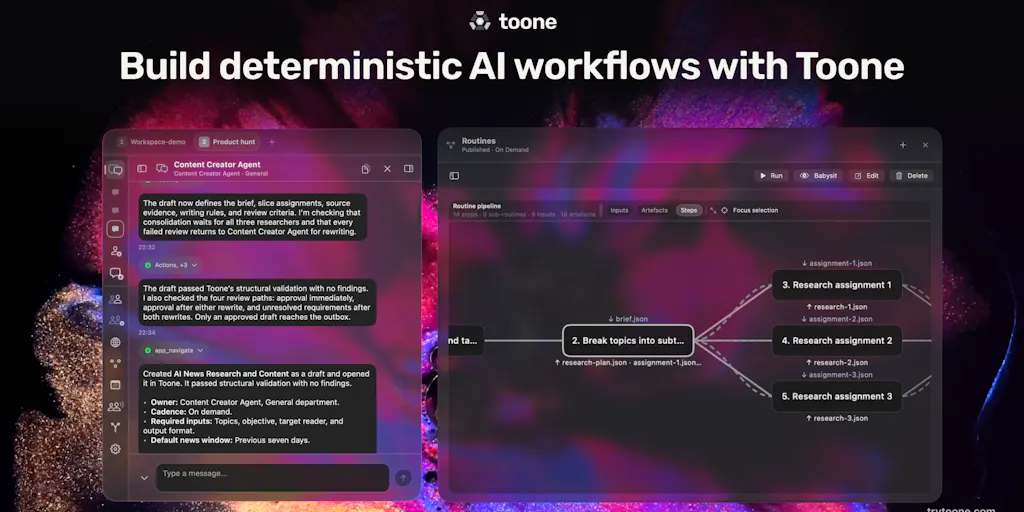
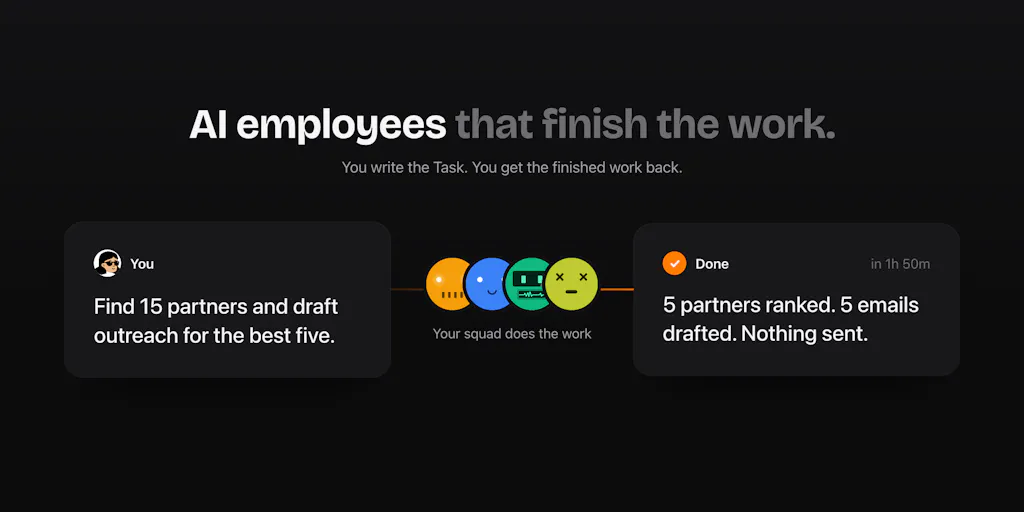
The pitch is deliberately unglamorous: you tell a lead agent what you need in plain words, it plans the work, and hands each piece to a specialist — research, partnerships, ops, content, or any role you define. The specialists execute with real tools, and you get back finished work plus a report of every step and source. It’s built on Hermes Agent by Nous Research, and early access is $49/month for the whole squad, with a live demo on the homepage that requires no signup.
Two design choices matter more than the feature list. First, one owner per task — the maker’s stated reason is that “work doesn’t get lost between agents,” which is a direct shot at the multi-agent orchestration mess where three agents touch a task and none is accountable. Second, nothing is sent, posted, or paid without your OK, and you bring your own AI key with no markup. That last point is worth pausing on for anyone running cross-border P&L: token markup is a silent tax on every AI tool in your stack, and “bring your own key” shifts that cost line back to you where you can actually see it.
Why Amazon sellers should care more than Shopify ones
Here’s my honest read on who this fits. A Shopify DTC brand with a content-led acquisition model has a fairly linear work queue: research, write, publish, measure. An Amazon FBA seller’s queue is a hydra — supplier vetting, listing localization across marketplaces, review-mining for product iteration, competitor price monitoring, and the constant “should we launch in this country” analysis. The second profile is where a task-delegating agent earns its $49. A Shopify operator can get most of the way with a Klax-style automation stack plus a freelancer. An Amazon seller juggling Seller Central reports across five locales has no clean equivalent — the work is too heterogeneous for a single tool, which is exactly the gap a “squad” model claims to fill.
Where the math breaks
Be skeptical of the “$49 for the whole squad” framing. It’s early-access pricing, and it excludes your own AI API spend, which is the variable that actually scales with usage. If you’re running heavy research tasks — scraping Reddit, LinkedIn, competitor sites — your token bill can quietly exceed the subscription. The right way to model this is cost-per-finished-task, not cost-per-seat. Run one real job, count the tokens, and compare against what a VA or freelancer would charge for the same output. For a partner-research task that a VA bills at two hours, the agent probably wins. For a task that needs judgment calls across ten ambiguous inputs, it probably doesn’t.
The approval-queue problem is the whole ballgame
The most useful thread in the entire launch page is the exchange between Dounia Boughalem and Vasco Ferreira, who both zero in on the same trap: “nothing goes out without my OK” sounds great until the approval queue grows faster than you can read it, at which point you’ve just built a new inbox. Ferreira’s follow-up is even sharper — he says he hasn’t found a tool yet that “manages to strike a balance” between validation and the time wasted on it.
This is the exact failure mode that killed the first wave of “AI SDR” tools in 2024. The agent generates 200 personalized emails, you approve them one by one, and by email 40 you’re rubber-stamping without reading — which means the human-in-the-loop safety net has become theater. Bansal’s answer to this is the part I’d actually test: agents only stop when a decision genuinely needs you, they batch up to three questions into one ask with the finding behind each, they check what you’ve already told them before asking again, and only the waiting task pauses while everything else keeps moving. There’s also an optional morning brief listing what’s waiting with a recommended answer for each.
That’s a thoughtful set of mitigations, but notice what he admits: no bulk approve, and no “stop asking me about this kind of thing.” Those two missing features are exactly what separates a tool that scales past 20 tasks a week from one that doesn’t. A cross-border seller running supplier outreach across three sourcing regions doesn’t want to approve each email; they want to approve a policy — “any supplier with a verified Alibaba trade history and a MOQ under 500 units, send the standard intro.” Until that exists, the approval model is a ceiling, not a floor.
The one-owner detail is more valuable than it sounds
Oleksii Sekundant of SonOf flagged “one owner per task” as the standout detail, and I agree — but for a different reason than he gives. In a cross-border operation, the failure mode isn’t that work gets lost between agents; it’s that work gets lost between humans and time zones. Your sourcing VA in Shenzhen, your ads freelancer in Manila, your returns processor in the US — handoffs across those boundaries are where things die. If an agent system can enforce “this task has exactly one accountable owner and a visible step log,” that’s a governance primitive that maps directly onto how a distributed seller team should already be operating. It’s a small thing that’s actually a management philosophy.
The content use case is real, with a caveat
Kashish Kumawat reports a month of hands-on use and a concrete result: given a blog task, the agent read existing posts first, scraped LinkedIn, Reddit, and Twitter for research, ran keyword analysis, and returned a draft that “reads exactly like something I would have written” — a job that normally takes one to two days, delivered by end of day. That’s a credible, specific testimonial, and it’s the kind of task where an agent with access to your own published voice has a real edge over a generic ChatGPT prompt.
The caveat is publishing. Bansal confirms direct WordPress publishing isn’t built in yet — drafts land in SquadRoom Docs and you copy them over. He does offer a workaround: connect a custom MCP server (Integrations → Custom → Add custom MCP), and WordPress.com’s own MCP server can write posts as drafts; self-hosted WordPress needs the official MCP Adapter plugin plus a login plugin. For a seller running a content-led storefront, that’s a real integration gap — but the “you hit publish, not the agent” stance is the right one for brand safety, and I’d rather have a tool that’s slow to auto-publish than one that’s fast to embarrass me.
What cross-border operators can borrow from this, regardless of whether you buy it
Even if you never sign up, the launch surfaces three patterns worth stealing for your own stack.
1. Design your approval gates around decisions, not actions. The reason approval queues fail is that they ask you to approve outputs instead of policies. If you’re building any human-in-the-loop workflow — supplier outreach, ad copy, listing edits — define the decision rule first (“approve any supplier meeting criteria X”), then let the system execute against it. Bansal’s batch-of-three-questions-with-a-recommendation pattern is a good template for how an agent should ask.
2. Bring-your-own-key is the right cost architecture. Any AI tool that hides token cost inside a flat subscription is charging you a markup you can’t audit. For a cross-border seller with unpredictable AI usage — heavy research months, light others — BYO-key plus a flat orchestration fee is the honest model. When you evaluate Jasper, Copy.ai, or any of the vertical AI tools in your stack, ask what the token markup is. Most won’t tell you.
3. One owner per task is a governance primitive, not a feature. Whether you’re running agents or humans, the rule that every task has exactly one accountable owner and a visible step log is the cheapest way to stop cross-timezone work from dying. Write it into your SOPs this week, tool or no tool.
Where my judgment says it falls short
Three honest concerns. First, the “specialist” framing is marketing. A research agent, a partnerships agent, and a content agent are the same underlying model with different system prompts and tool access. That’s fine — it’s a useful abstraction — but don’t pay a premium for the illusion of a team when you’re buying orchestration. Second, the missing bulk-approve and “stop asking” features are load-bearing gaps, not nice-to-haves. Bansal himself calls them out as not-yet-built, which is refreshingly candid, but it means the tool’s ceiling is defined by your tolerance for clicking. Third, cross-border specifics are absent. Nothing in the launch addresses multi-currency, multi-language output quality, or regional compliance — the things that actually break AI tools for sellers operating across markets. That’s not a knock on a v1, but it’s the gap I’d watch before committing a real workflow to it.
The comparison I’d actually make
The honest competitive set isn’t Zapier or Make — those are deterministic automations, not reasoning agents. It’s the emerging “AI employee” category: Lindy, Relevance AI, and the agent modes inside HubSpot and Salesforce. SquadRoom’s differentiator is the approval discipline and the BYO-key economics, not the agent capability itself. If you’re already deep in HubSpot, the native agent may be good enough. If you’re a lean cross-border operator with no CRM gravity, a standalone $49 orchestration layer is a reasonable bet — provided you test it against one real, painful task first.
What I’d watch / test next
This week, before you spend a dollar: pick the single highest-friction task in your operation that has no owner — for most cross-border sellers that’s partner or supplier research, or market-entry math for a new country. Run it through the free demo and count three things: how many approval prompts you get, how many tokens you burn on your own key, and whether the finished output plus source log is something you’d actually act on. If the approval count is under five for a task that used to eat a day, it’s worth the $49. If it’s fifteen, you’ve just built a new inbox and you should wait for bulk-approve. Then set a calendar reminder to re-evaluate in 90 days — the roadmap items Bansal named (direct WordPress publishing, and implicitly the approval-batching improvements) are the ones that determine whether this becomes infrastructure or a novelty. Cross-border ops don’t need more AI. They need AI that respects the one resource you can’t buy back: your attention.