The Real Cross-Border Bottleneck Isn’t Traffic — It’s Repeatable Ops
Every cross-border seller I know is drowning in the same quiet problem: not customer acquisition, but the sheer volume of recurring, semi-judgmental work that sits between a product idea and a shipped order. Sourcing follow-ups, listing localization, review triage across six marketplaces, supplier chasing on WhatsApp, ad-copy variants for each locale. These aren’t hard tasks. They’re just relentless. So when a tool like Toone — a macOS app for building AI workflow automations in natural language — shows up on Product Hunt, I don’t read it as a novelty. I read it as a signal about where operator tooling is heading, and whether it’s worth wiring into your stack.
What Toone Actually Is, Stripped of Launch-Day Hype
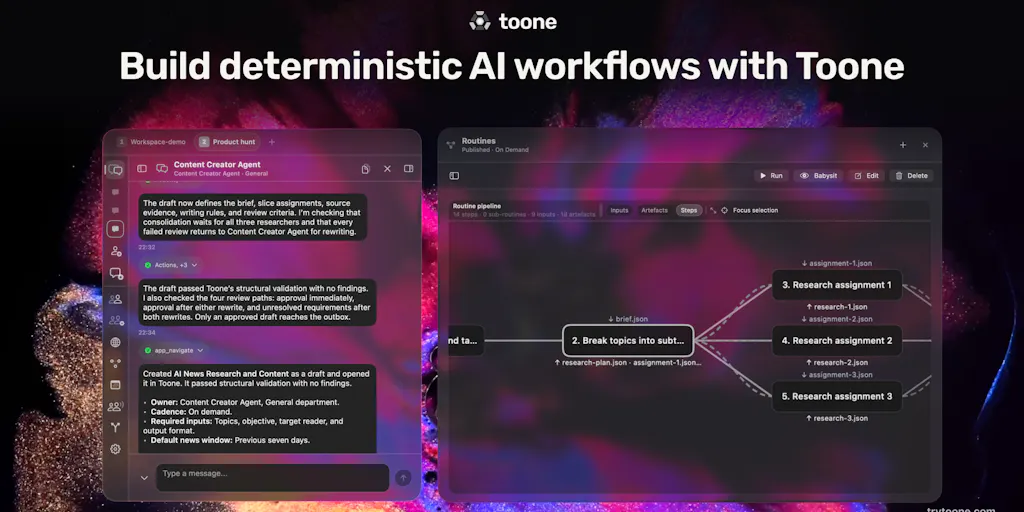
Let me be blunt about what the source material tells us, because there’s less here than the 106 upvotes suggest. Toone is a macOS desktop app, built by Matheus Paranhos, designed to let you compose “complex AI workflow automations and routines with natural language.” That’s the entire pitch. The maker’s own framing is refreshingly honest: he kept rebuilding the same automations every time a project changed, and got tired of “spending more and more time customising the automations that were supposed to save me time.”
The stated design goals are worth noting for anyone who’s been burned by brittle automation: more control over execution, more predictable runs, and visibility into what’s happening “before trusting them with production work.” That last phrase is the tell. This is a tool built by someone who has actually shipped automations and watched them fail in production, not a demo-ware wrapper.
A few concrete facts from the launch thread:
- It’s a macOS app, which immediately excludes a large chunk of ops teams running Windows in Shenzhen, Guangzhou, and Yiwu warehouses.
- The maker says he plans to keep Toone free, with a “routine/automations marketplace” as the core business model.
- Free early access is being offered, and the maker explicitly asked for people to share “one small routine” and report where it falls short.
- The next Product Hunt launch is scheduled for September 18, following a prior launch on March 25th, 2026.
- There are no reviews yet on the Product Hunt page.
That’s the factual surface. Everything else in the thread is maker-community banter — congrats, “looks clean,” “excited to try.” Useful as sentiment, useless as evidence.
Why the “Free + Marketplace” Model Should Make You Nervous
The pricing answer is the most strategically interesting thing in the entire thread. When Brent Vardy asked directly whether Toone would be one-off, subscription, or pay-as-you-go, the maker replied that the app stays free and the marketplace of routines is the business. Read that twice. It means the app is a distribution channel for selling pre-built workflows — which is fine, but it also means the incentive structure is to make marketplace routines the polished path and custom builds the second-class citizen. For a cross-border team with very specific, very weird workflows (multi-currency reconciliation, customs documentation, marketplace-specific compliance checks), you’re likely to be the person building your own routines and never paying a cent. Which raises the obvious question: how long does a free tier stay generous when the revenue comes from elsewhere? Not disclosed, and I’d want that answered before I build my ops on top of it.
How It Compares to What You’re Probably Already Running
Here’s where I have to be honest about the competitive landscape, because “AI workflow automation” is a brutally crowded category and Toone is not entering an empty room.
The closest incumbent in spirit is Zapier, which most cross-border sellers already use for the boring connective tissue — new Shopify order triggers a Slack message, a form submission creates a supplier email. Zapier’s weakness is exactly Toone’s stated strength: complex, multi-step, judgment-requiring workflows get expensive and brittle fast in Zapier’s trigger-action model. The second incumbent is Make, which handles branching logic better but still forces you into a visual node graph that non-technical ops staff find intimidating.
Then there’s the LLM-native tier. n8n is the self-hosted favorite for teams who want control and don’t mind a learning curve. And at the consumer end, ChatGPT itself — which the maker explicitly references, positioning Toone as a way to create “consistent workflows alongside the ChatGPT desktop.” That’s a revealing comparison. Toone isn’t trying to replace ChatGPT. It’s trying to be the layer that makes ChatGPT’s output repeatable, which is the actual gap for anyone running a store.
Why Amazon Sellers Should Care More Than Shopify Ones
This is the part most launch coverage will miss. A Shopify DTC brand’s ops surface is relatively narrow — orders, fulfillment, email flows, a handful of ad platforms. A serious Amazon FBA operation, by contrast, is a hydra: Amazon Seller Central for inventory and listings, Helium 10 or Jungle Scout for research, Klaviyo or Omnisend for retention, separate dashboards for TikTok Shop, Temu, and SHEIN if you’re multi-homing. The recurring tasks multiply accordingly: weekly rank tracking, competitor price monitoring, review-response drafting in five languages, PPC bid adjustments, reimbursement claims. If Toone can genuinely chain those into durable routines with “visibility to understand what’s actually happening,” the ROI for an Amazon seller is an order of magnitude higher than for a Shopify-only brand. The catch is that most of those platforms have hostile APIs or none at all, and the launch material says nothing about integrations. That silence matters.
What Cross-Border Operators Should Borrow From This
Even if you never install Toone, the launch thread contains three transferable lessons for anyone building internal ops.
First: build routines, not one-off prompts. The maker’s core insight — that he was “reworking prompts, rearranging steps, or building the whole thing again from scratch” every time needs changed — is the exact failure mode I see in seller teams. Someone writes a brilliant prompt for generating localized listing copy, uses it once, and it dies in a Notion doc. The discipline of turning that into a named, reusable, inspectable routine is worth adopting regardless of tooling.
Second: start small and compose. The maker’s own advice in the thread is to “start simple and be composing your workflows, instead of creating a big one.” This is correct and underrated. The sellers who fail at automation are the ones who try to automate the entire PPC management stack in week one. The ones who succeed automate one painful weekly task, verify it for a month, then chain the next.
Third: demand visibility before production trust. The phrase “before trusting them with production work” is the single most useful line in the source. Any automation that touches live listings, live bids, or live customer communication needs a dry-run mode and an audit log. If a tool can’t show you what it would have done, don’t let it do anything.
Where the Math Breaks
Let me do the unglamorous arithmetic. The maker justifies the tool by saying people on “$100-$200” AI plans will find it worth it, citing SEO content generation and LinkedIn outreach as the killer use cases. For a cross-border seller, that framing is slightly off-target. Your expensive recurring tasks aren’t SEO and LinkedIn — they’re marketplace-specific and multi-lingual. A routine that drafts English listing copy is worth maybe an hour a week. A routine that correctly handles VAT-inclusive pricing across EU marketplaces, or reconciles Amazon settlement reports against your 3PL invoices, is worth a part-time hire. Toone’s value proposition scales with the specificity and stakes of the workflow, not the generic ones the maker highlighted. That’s not a flaw in the product; it’s a mismatch in the marketing that operators should mentally correct for.
Where My Judgment Says It Falls Short
Three real concerns, stated plainly.
Platform lock-in. macOS-only is a genuine constraint for cross-border teams, where ops staff frequently run Windows and where the “one person, one laptop” model breaks down the moment you hire. A workflow tool that only runs on one person’s Mac is a single point of failure, not infrastructure.
Zero integration evidence. The launch page and thread contain no mention of Shopify, Amazon, Klaviyo, or any commerce platform. “Natural language workflow automation” is only useful if it can actually touch your systems. Until integrations are documented, treat this as a personal-productivity tool, not an ops backbone.
The marketplace incentive. As I flagged above, a free app funded by a routine marketplace has an inherent tension with power users who build everything themselves. I’d want a written commitment on free-tier limits before migrating anything critical. The maker’s responsiveness in the thread is genuinely good — he answered pricing, accuracy, and use-case questions directly — but responsiveness isn’t a roadmap.
A Note on the Accuracy Question
Adana Marukhyan asked the sharpest technical question in the thread: does accuracy hold up when workflows get long and complicated? The maker’s answer — that “boundaries are well defined so the agents know exactly the steps to take” — is the right design philosophy but not proof. Every workflow tool claims consistency at launch. The real test is what happens at step fourteen when an API returns a malformed response. Until there are independent reviews (and remember, there are currently none on the page), that claim is unverified.
What I’d Watch / Test Next
This week, before you spend a single hour on Toone or anything like it, do this: pick the one recurring task on your team that (a) happens at least weekly, (b) has a clear “correct” output you can verify yourself, and © currently eats 30+ minutes of a human’s time. Write down its inputs and its definition of done. That artifact is worth more than any tool evaluation — it’s the spec every automation lives or dies by. Then, if you’re on macOS, join the free early access and test only that one routine, watching specifically for how it handles a malformed input. If you’re on Windows, watch the September 18 launch for any sign of cross-platform support or documented integrations with Shopify, Amazon, or your 3PL — and if those don’t materialize, keep your routines in whatever tool already touches your systems. The category is real and the direction is right. The specific product is still unproven, and in cross-border ops, unproven is just another word for “don’t put it near live listings yet.”