The App Store Localization Tax Is Eating Your Margin — And Nobody’s Automating It Right
Every cross-border operator I know has a version of the same war story: you crack a new market, sales spike, and then you realize you owe that spike to a listing you hand-translated six weeks ago — screenshots, subtitles, metadata, the whole stack — and you’ve never once been able to keep it in sync since. For Shopify and Amazon sellers, localization is a content problem. For anyone shipping a mobile app alongside their DTC brand — loyalty apps, companion apps, marketplace apps — localization is a release pipeline problem, and it’s gated behind Apple’s App Store Connect, which is a genuinely hostile interface for anyone who isn’t a native iOS developer. That’s the context I read Ship Happens against when it hit Product Hunt on July 26, 2025 — not as a cute indie tool, but as a signal about where the localization stack is heading for cross-border sellers who increasingly ship apps as part of their brand.
What Ship Happens Actually Solves
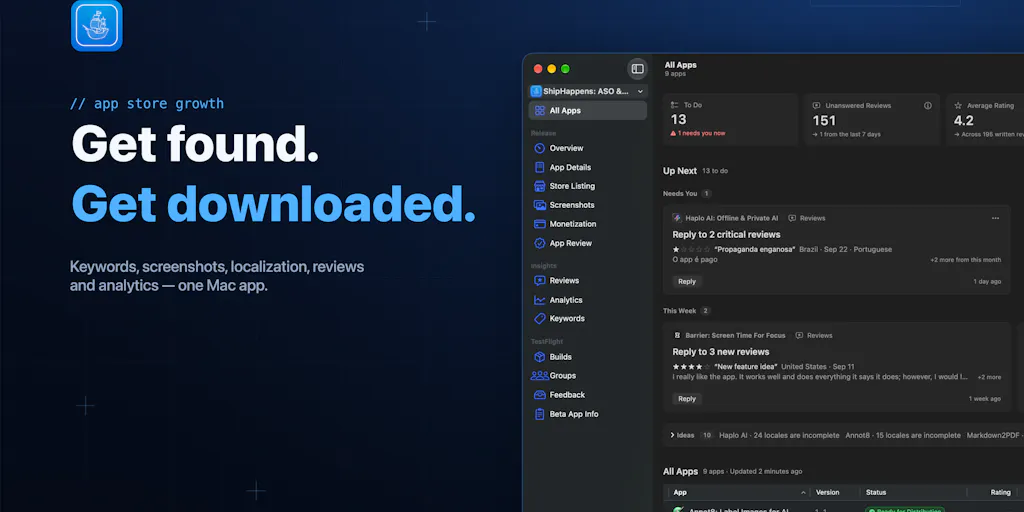
Strip away the launch-page framing and the product does one thing: it takes the tedious, error-prone work of getting localized screenshots and metadata into App Store Connect and automates it. The pitch is “create, translate, & upload screenshots/metadata for apps” — which sounds narrow until you’ve actually done it. App Store Connect localization is a slog of per-locale screenshot sets, per-locale keyword fields, per-locale promotional text, and a review process that punishes inconsistency across locales. Most teams either pay an agency per market or hand the job to a PM who quietly resents every minute of it.
The interesting part isn’t the translation. It’s the upload. Translation is a solved-ish commodity in 2025 — you can pipe strings through DeepL, GPT-4-class models, or a human LSP and get decent output. What’s not solved is the last mile: getting those translated assets into Apple’s system without a human clicking through 40 locales, and keeping them in sync when your English source copy changes. That’s the pain Ship Happens is selling against, and it’s a real one. If you’re a cross-border seller running a brand app across, say, the US, DE, JP, and BR storefronts, you feel this every time marketing rewrites a value prop.
Why Amazon sellers should care more than Shopify ones
Here’s a take that’ll annoy some people: if you’re a pure Shopify DTC operator, Ship Happens is probably irrelevant to you. Your localization lives in Shopify Markets and your theme’s translation files, and the tooling there — while imperfect — is at least designed for merchants. But if you’re an Amazon FBA brand owner who also ships a companion app, or a marketplace seller whose app is your retention layer, you’re stuck between two localization worlds: Amazon’s listing localization (handled through Amazon Seller Central and increasingly through AI-assisted listing tools) and Apple’s app localization (handled through App Store Connect, which Amazon does not touch). Ship Happens lives in the second world. That’s a smaller world, but for app-carrying brands it’s the one that leaks revenue silently.
How It Stacks Up Against the Incumbents
The honest comparison set here isn’t other Product Hunt launches — it’s the established localization stack that cross-border teams already pay for. Three names come to mind immediately:
- Lokalise — the developer-favorite TMS. Strong API, strong CI/CD integrations, but it’s built for engineering teams managing string catalogs, not for a brand operator who wants to push screenshots into App Store Connect on a Tuesday.
- Crowdin — similar story. Excellent for app and web strings, weaker on the store-listing asset side.
- Transifex — same category, same gap.
All three are translation management systems. None of them are store submission systems. That’s the wedge Ship Happens is claiming: it’s not competing with Lokalise on translation quality or workflow depth — it’s competing on the fact that after you’ve translated, someone still has to upload, and that someone is usually a human doing copy-paste into a web form that was designed in 2014. If Ship Happens genuinely closes that loop, it’s less a TMS competitor and more a missing integration layer that sits on top of whatever translation source you already use.
That’s a defensible position. It’s also a fragile one, because Apple could ship a better bulk-upload API tomorrow and evaporate half the value. More on that below.
Where the math breaks
Let me do the unglamorous operator math. Say you localize into 10 locales for your brand app. Each locale needs roughly 5–8 screenshots, a title, subtitle, keyword field, description, and promotional text. If a human is doing this manually at, say, 45 minutes per locale per update cycle, that’s ~7.5 hours per release. At a blended $60/hour loaded cost, you’re burning ~$450 per localization cycle — and you probably update quarterly, so call it $1,800/year, plus the agency translation fees on top. A tool that cuts the upload step by 80% saves you maybe $1,400/year in labor. That’s real but not transformational for a mid-size seller. Where it does pay off is when you’re updating listings more frequently than quarterly — seasonal drops, promo cycles, A/B testing screenshots — because then the per-cycle savings compound fast. If you’re a set-and-forget brand, the ROI is thin. If you’re iterating, it’s obvious.
What Cross-Border Sellers Can Actually Borrow From This
Even if you never touch App Store Connect, there are three transferable lessons in how Ship Happens is positioned:
1. The last-mile upload is where the money is. Every cross-border operator I know has a translation source and a translation sink, and the gap between them is manual. Whether it’s Amazon listing localization, TikTok Shop product copy across regions, or Temu and SHEIN seller portals, the bottleneck is never “can we translate this” — it’s “who’s going to paste it in.” If you’re evaluating any localization vendor in 2025, ask them specifically about the submission step, not the translation step. That’s where the hidden labor lives.
2. Narrow beats broad for indie tooling. Ship Happens isn’t trying to be a full TMS. It’s picking one painful, well-defined job and doing it. That’s the same playbook that made tools like Helium 10 win Amazon sellers — start with one killer workflow (keyword research) and expand. If you’re a seller building internal tooling, resist the urge to build the whole stack. Automate the one step your team hates most.
3. Launch timing matters for tooling adoption. A July 2025 launch means this tool is arriving exactly as AI translation quality has crossed the “good enough for store listings” threshold for most major locales. Two years ago, a tool like this would’ve been dead on arrival because the translation output wasn’t trustworthy. Now the translation is cheap and the orchestration is the value. That’s a shift every cross-border seller should be pricing into their vendor decisions.
The Klaviyo lesson, applied to app localization
Here’s an analogy worth sitting with. Klaviyo didn’t win email marketing by having the best send infrastructure — it won by owning the flow layer above the send, the part where merchants actually do the work. Ship Happens is making the same bet in a much smaller pond: own the flow layer above App Store Connect, and let someone else own the translation engine underneath. Whether that pond is big enough to sustain a company is the open question, but the strategic shape is sound.
Where My Judgment Says It Falls Short
I’ll be blunt about the risks, because operators deserve the skeptical read, not the launch-day hype.
The dependency risk is severe. Ship Happens is built on top of Apple’s App Store Connect. Apple controls the API, the review process, and the pace of change. If Apple decides to ship native bulk localization tooling — and given the AI arms race, that’s not far-fetched — the core value proposition weakens overnight. Any tool whose entire moat is “we automate a first-party interface” is renting its business from the platform owner. That’s not fatal, but it caps the upside and should cap how much you’re willing to pay.
The review count tells you nothing yet. The launch page shows 301 reviews, which sounds impressive until you remember that Product Hunt review counts are notoriously gameable and don’t reflect production reliability. What I’d want to see — and what the source doesn’t disclose — is pricing, supported locales, whether it handles screenshot generation (not just upload), and how it handles App Store review rejections caused by localization errors. Those are the questions that determine whether this is a real tool or a demo.
It doesn’t touch the platforms most cross-border sellers live on. Amazon, Shopify, TikTok Shop, Etsy, eBay — none of these are in scope. If your localization pain is on those platforms, Ship Happens doesn’t help you today. It’s an iOS-app-localization tool, full stop. Don’t let the launch-page language about “apps” make you think it covers your marketplace listings.
The translation quality question is unresolved. The product page says it translates, but not how. Is it using a generic LLM, a specialized MT engine, or human-in-the-loop? For high-stakes store listings where a bad keyword translation can tank your search ranking in a market, that distinction matters enormously. “Not disclosed” is the honest answer, and it’s a gap.
The pricing question nobody’s answering
Pricing isn’t disclosed on the launch page, and that’s the single biggest unknown for an operator trying to decide whether to trial it. For a tool with this narrow a scope, pricing has to be aggressive — think per-locale or per-release, not per-seat SaaS. If it’s priced like a full TMS, the ROI math I ran above collapses. If it’s priced like a utility, it’s a no-brainer for app-carrying brands. Watch the pricing page before you commit.
What I’d Watch / Test Next
Three concrete things I’d do this week if I ran a cross-border brand with an app:
Audit your own localization labor. Before evaluating any tool, actually measure how many hours per month your team spends on store-listing localization across Amazon, Shopify, and any app storefronts. Most operators underestimate this by 2–3x. You can’t evaluate ROI without the baseline.
Trial Ship Happens on one locale, not ten. Pick your highest-value non-English market, run one full localization cycle through the tool, and compare the output against your current manual process — both on time and on App Store review outcomes. If it survives one review cycle cleanly, scale it. If it triggers rejections, you’ve learned something cheap.
Pressure-test the platform-dependency question. Ask the team directly: what happens when Apple changes its API? Do they have a roadmap beyond App Store Connect — Google Play, Amazon Appstore, maybe marketplace listings? A tool with a single-platform dependency is a tool you adopt tactically, not strategically. Don’t build your localization workflow around it until you see a second platform on the roadmap.
The broader takeaway for cross-border operators: localization is quietly becoming an orchestration problem, not a translation problem. The winners over the next 18 months won’t be the tools with the best MT engine — they’ll be the ones that own the last mile between “we have the translated content” and “it’s live in every market.” Ship Happens is a small, early bet on that thesis. Whether it wins or not, the thesis is right, and it’s worth watching who else shows up to compete on it.