The Clip Economy Is Eating Product Content — and S-Roll Is a Small Signal of a Bigger Shift
Cross-border sellers live and die by video throughput. A single Amazon listing now wants a 30-second hero clip, a TikTok Shop wants three hook variants, a Shopify PDP wants a looped UGC cut, and a Temu or SHEIN feed wants verticals in three aspect ratios. The bottleneck is almost never shooting — it’s finding the 11 seconds inside 90 minutes of raw footage that actually converts. So when a maker ships a tool that turns “find the KO clip” into a natural-language prompt, I pay attention, even if the product isn’t built for us yet. S-Roll, launched by Saliency, is worth dissecting — not because it will run your listing videos tomorrow, but because it points at where the editing stack is heading.
What S-Roll Actually Does (and Why It’s Not Just Another Clipper)
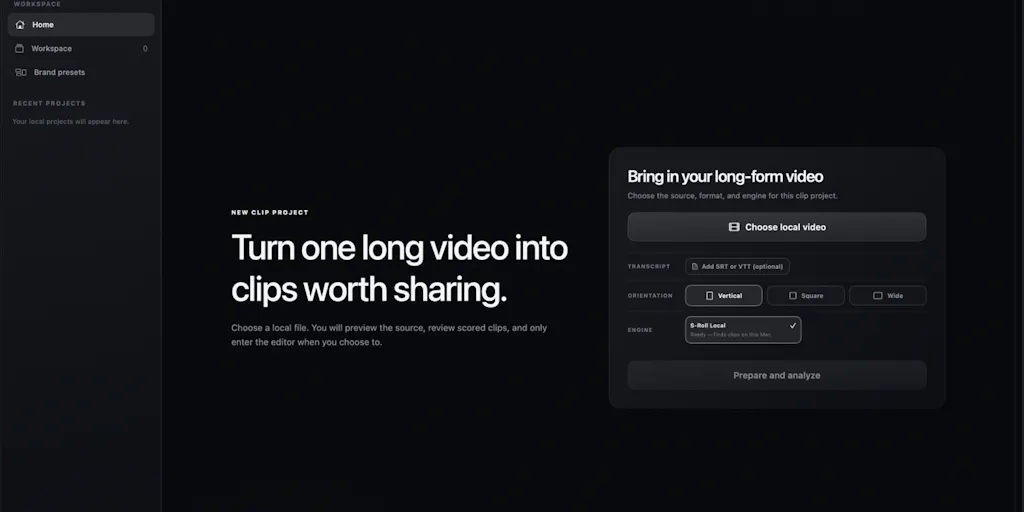
The pitch from maker Ritik Bompilwar is deceptively simple: open a long video, type what you’re looking for, and the agent finds the moment, cuts the clip, tracks the subject, reframes the shot, generates captions, and prepares an export — all locally on Apple silicon, with videos, transcripts, and chats staying on the user’s Mac. It’s free on the Mac App Store with no watermarks, and the maker frames it as step one toward “an operating system for video understanding.”
That last phrase is the tell. This isn’t a timeline editor with AI bolted on. It’s an agentic harness — the model is one component, the orchestration around it is the product. For anyone who has watched the last two years of AI tooling, that’s the correct architectural bet. The winners in 2025 aren’t the ones with the best single model; they’re the ones with the best loop around a commodity model.
The incumbents S-Roll is quietly pointing at
When a commenter named Justin Rockmore asked for three reasons to switch from OpusClip, the maker’s answer was blunt: unlimited usage with no 150-minute cap, completely free with no subscription, no watermark, and data that never leaves your PC. Read that list again — it’s not a feature list, it’s a pricing and privacy manifesto aimed squarely at the SaaS clipper category that includes OpusClip, Descript, CapCut, and Veed. Every one of those tools monetizes minutes, seats, or exports. S-Roll’s wedge is: same core job, zero marginal cost, zero cloud.
For a cross-border operator, that wedge matters more than it looks. Minutes-based pricing is brutal when you’re iterating on 40 SKUs across four markets and half your clips get thrown away. And cloud upload of unreleased product footage is a genuine legal headache in categories like supplements, electronics, and beauty, where NDAs and pre-launch embargoes are standard.
Where the Math Breaks for Cross-Border Sellers
Here’s my honest read: S-Roll is not a cross-border tool today. It’s a Mac-only, Apple-silicon-only local app. Your Shenzhen sourcing agent isn’t running it. Your Manila VA editing on a $400 Windows laptop isn’t running it. Your agency in Lahore isn’t running it. The entire offshore editing layer that most Amazon FBA and TikTok Shop sellers depend on is Windows-first and browser-first — which means the tool’s biggest structural advantage (local processing) is also its biggest distribution ceiling.
There’s also a format gap the maker was upfront about. When asked about import limits, Bompilwar confirmed S-Roll supports all formats except MKV and WebM, with no limit on length or file size. No length cap is genuinely impressive — most cloud tools throttle you at 30 to 60 minutes precisely because GPU time is expensive. But MKV and WebM exclusion is a real friction point for anyone pulling raw screen recordings, OBS captures, or web-sourced reference footage, which is exactly the kind of material sellers use for competitor teardowns and ad-spy research.
Why Amazon sellers should care more than Shopify ones
Shopify merchants mostly work with finished creative from agencies or UGC creators — they need variants, not discovery. Amazon sellers are the opposite. Their raw material is a mess: 20-minute supplier walkthrough videos, 45-minute factory tours, hour-long customer review compilations, and 90-minute livestream replays from TikTok Shop. The job isn’t “make this pretty,” it’s “find the moment where the factory manager explains the waterproofing, because that’s the A+ content clip.” That’s the exact workflow S-Roll’s prompt-to-clip model is built for. A Shopify DTC brand will get marginal value; an Amazon private-label operator with 200 SKUs and a hoard of unedited sourcing footage would get transformative value — if it ran on their team’s machines.
What Cross-Border Operators Should Actually Borrow From This
Even if you never install S-Roll, three things from this launch are worth stealing for your own stack this quarter.
First, prompt-to-timestamp is becoming the default interface for video. If your editing workflow still starts with a human scrubbing a timeline, you’re paying for labor that will be free in 18 months. Start tagging your raw footage library now — even with crude folder structures like /2024-11/factory-tour/waterproof-demo/ — so that when agentic clippers mature, you have a searchable substrate. The tool is not the moat; the library is.
Second, local-first is a real competitive advantage in regulated categories. If you sell supplements, cosmetics, children’s products, or anything with a pre-launch embargo, cloud-uploading footage to OpusClip or Descript is a compliance risk you’re probably not tracking. The maker’s insistence that data never leaves the PC and works offline after sign-in is a preview of the buyer conversation you’ll be having with your legal team in 2026.
Third, watch the “harness” framing. Saliency is explicitly positioning toward owning both models and the agentic layer around them. That’s the same playbook Shopify ran with Sidekick, Klaviyo is running with its AI features, and Helium 10 is chasing with its own assistant layer. The lesson for sellers: don’t lock your data into a single harness. Keep your raw assets in a neutral store — S3, Google Drive, or a DAM — so you can swap the agent on top without re-uploading your entire content history.
My Judgment: Promising Wedge, Wrong Beachhead (For Now)
I like the architecture. I like the pricing stance. I’m skeptical of the go-to-market. A Mac-only, Apple-silicon-only, local-first app is a beautiful artifact for indie creators and podcasters, but it’s aimed at exactly the demographic least likely to have the video volume problem that justifies the tool. The people who need unlimited clip generation are the ones running 500 SKUs across Amazon, TikTok Shop, Temu, and eBay — and they’re on Windows, or they’re outsourcing to Windows.
The honest question is whether Saliency can port the harness to Windows and Linux, or whether “local on Apple silicon” is a philosophical commitment that caps the addressable market at maybe 15% of professional video editors. If it’s the former, this becomes a serious OpusClip competitor within a year. If it’s the latter, it stays a beloved niche tool — which is fine, but not the “operating system for video understanding” the maker is promising.
The unspoken risk: model commoditization
One more thing. The maker’s long-term thesis is that Saliency will “own both the models and the agentic harness.” That’s a defensible strategy, but the model layer is commoditizing fast — OpenAI, Anthropic, Google, and a dozen open-weight labs are all shipping video understanding that gets cheaper every quarter. The harness is where the durable value lives, and that’s a product-design and workflow problem, not a research problem. Which means Saliency’s real competitors aren’t OpusClip — they’re whoever ships the best prompt-to-export workflow on the platform your team already uses. That could be Adobe inside Premiere, Canva inside its editor, or a scrappy startup nobody’s heard of yet.
What I’d Watch / Test Next
This week, three concrete moves. One: audit your raw video library and count how many hours of unedited footage you’re sitting on that has never been clipped. If the number is over 20, you have a discovery problem worth solving, and you should trial S-Roll on one Mac in your team — even just to feel what prompt-to-clip actually feels like. Two: pressure-test your current clipper’s data policy. If you’re uploading pre-launch product footage to a cloud tool, get that in writing from your legal counsel before your next campaign. Three: start a neutral asset store — a simple S3 bucket or shared Drive with a consistent folder taxonomy — so that when the agentic harness war shakes out, you can swap tools without re-uploading five years of footage. The clip economy is real, the tooling is still immature, and the operators who win the next 18 months will be the ones who keep their raw material portable while the interface layer churns underneath them.