Why a Code-Quality Scanner Matters More Than Your Next Ad Budget
Let’s be honest about something that keeps cross-border sellers up at night: the gap between what your storefront promises and what your backend actually delivers. You can pour thousands into Meta ads, perfect your Amazon PPC bidding, and optimize your TikTok Shop creatives until the cows come home. But if the application layer beneath your Shopify theme or your custom headless storefront is accruing “technical debt” — a polite term for the digital equivalent of a slow leak in your warehouse roof — every dollar you spend on acquisition is ultimately subsidizing a future catastrophe. I’ve seen DTC brands hit a scaling wall not because their product-market fit was off, but because their codebase had become a swamp of design tokens that don’t exist, accessibility patterns that were quietly dropped, and business logic bleeding into the presentation layer. The build doesn’t break today. It becomes someone’s problem three sprints later, right when you’re trying to launch on a new marketplace.
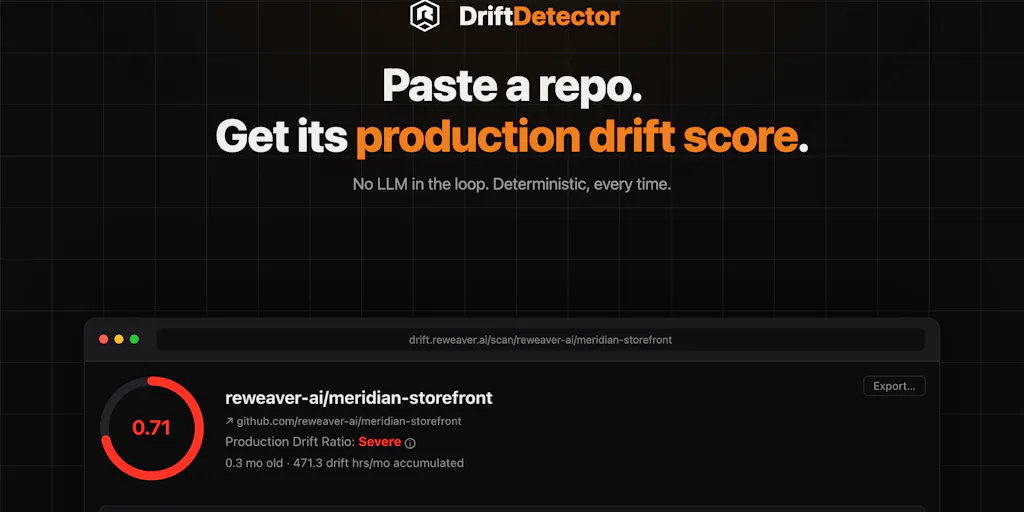
This is why the launch of DriftDetector from ReWeaver AI caught my attention. It’s not a flashy new ad tool or a logistics tracker. It’s a code-quality scanner that promises to measure the drift between what your team intended to ship and what actually got merged. For the cross-border operator who is increasingly reliant on outsourced dev teams, freelancers, or AI coding assistants, this tool speaks to a very real, very painful problem: you are paying for code you cannot see, and you cannot audit the quality of what you’re getting. This isn’t just a developer tool; it’s a vendor management and risk mitigation play for the modern e-commerce executive.
The Problem: You Can’t Audit a Guess
Jonathan Gordon, the hunter behind the project, nails the core issue in his launch narrative. He uses AI coding assistants daily, but he noticed they are “great at the happy path. What kept tripping me up was everything they leave behind.” He went looking at the code and found the usual suspects: design tokens that don’t exist in the design system, accessibility patterns dropped, business logic leaking into the presentation layer, and tests that pass the day they are written but protect nothing after. This resonates deeply with my experience in the e-commerce space. We’ve all been there—hiring a “rockstar” developer on Upwork or a dev agency in Eastern Europe who delivers a working feature, but the underlying code is a house of cards.
The existing solutions on the market, which he correctly identifies, are fundamentally flawed. Most tools “answer this by pointing a second LLM at the diff and asking it to guess what the first one missed.” This is the AI-on-AI audit trap. You are using a probabilistic model to check the work of another probabilistic model. The output is a guess, and as Gordon puts it, “You can’t audit a guess, and you’re paying per token to get one.” This is where the comparison to incumbents like SonarQube or CodeClimate becomes interesting. Those tools are rule-based and deterministic, but they require significant configuration and often struggle to understand the intent of a change. DriftDetector’s value proposition is that it “measures instead.” It claims to be deterministic—”Scan the same commit twice, you get the same answer.” That is a massive differentiator. In a world where we are increasingly trusting AI to write our code, we need a deterministic yardstick to measure the output, not just another opinion.
Why Amazon Sellers Should Care More Than Shopify Ones
You might think this is a Shopify problem, given the platform’s heavy reliance on custom Liquid templates and third-party apps. But I’d argue Amazon FBA sellers should care even more. Your Amazon presence is largely constrained by Seller Central’s rigid UI, but your off-Amazon brand site, your landing pages for PPC traffic, and your internal tools for inventory management are all custom code. More importantly, the stakes are different. On Shopify, a bug might cost you a conversion. On Amazon, a poorly coded integration with a fulfillment API or a pricing tool can lead to a suspension or a TOS violation. The “drift” Gordon talks about—business logic leaking into the presentation layer—is exactly how a seller accidentally displays a price that violates Amazon’s parity rules or mishandles a customer’s PII. The deterministic nature of DriftDetector’s scans makes it a potential safety net for compliance-heavy operations, not just a code-quality nicety.
How DriftDetector Works: The History Is the Feature
The most compelling part of the launch isn’t just the scan; it’s the history. Gordon explains that “the history isn’t a chart of a single scan. Every point on it is a real scan of that commit, and you can zoom into any stretch to have that period re-scanned in detail.” This is a sophisticated approach. It means you can trace the exact moment drift entered the codebase. You can “find the week the drift actually entered, then open that commit on GitHub straight from the table.” This forensic capability is gold for a cross-border operator managing multiple time zones and teams.
Imagine you have a developer in India and another in Brazil working on the same codebase. A feature ships, and six weeks later, you notice a performance degradation on your checkout page. With DriftDetector, you don’t have to argue about who broke it. You zoom into the history, see the spike in drift metrics, and click straight to the GitHub commit. You have objective evidence to present in your next team meeting. It removes the emotion and the blame game from code review. It turns “I think your code is messy” into “the drift score increased by 40% on this specific commit.” For a remote-first, cross-border team, that kind of objective feedback loop is invaluable.
The call to action is also refreshingly frictionless. Gordon invites users to “Go run it on something you’ve shipped. Takes seconds, no account, link’s at the top.” This is a smart go-to-market strategy. In an era where every tool demands a demo and a sales call, offering a no-account, instant scan is a bold move. It respects the operator’s time. It allows a skeptical CTO or a busy e-commerce owner to validate the tool on their own codebase before committing to a conversation. The challenge to “post your score here, because I want to see who has the cleanest and the messiest codebase on Product Hunt today” is a clever community-building tactic that leverages our innate competitiveness.
Where the Math Breaks
Let’s talk about the “effort estimate” feature, which Gordon asks about: “How close does the effort estimate land to your team’s real sprint velocity?” This is where I see the potential for friction. Any tool that attempts to estimate engineering effort is walking a tightrope. If the estimate is too high, your developers will ignore it. If it’s too low, they’ll use it as a weapon against project managers. The danger is that DriftDetector might try to quantify something that is inherently qualitative. The drift score is a metric—it’s a number. But converting that number into “this will take 2.5 days to fix” is a leap of faith. The math can break down when you factor in team familiarity with the codebase, the complexity of the refactor, and the risk of introducing new bugs while fixing old ones. I’m skeptical of the accuracy here, but I’m intrigued by the ambition. If they can nail the estimation, they’ve built a project management tool, not just a code scanner.
What Cross-Border Sellers Can Borrow From This
Even if you don’t have a technical bone in your body, there are three immediate takeaways from this launch that you can apply to your e-commerce operation this week.
First, adopt a deterministic mindset for vendor management. The principle of “you can’t audit a guess” applies to your marketing agencies, your freight forwarders, and your 3PLs. Are you getting reports that are reproducible? If you ask your agency for a breakdown of ad spend twice, do you get the same answer? If you ask your logistics partner for an inventory count, can they verify it with a deterministic scan, or is it an estimate? Start demanding deterministic, verifiable data from your partners. If they can’t provide it, that’s a red flag that you’re paying for guesses.
Second, build a history, not just a status report. Gordon’s point about the history being a series of real scans is a lesson in performance management. Don’t just review your Q3 numbers in October. Track your metrics weekly, bi-weekly, or monthly. The goal is to identify when a trend shifted, not just that it shifted. If your conversion rate dropped, is it because of a change you made to your pricing page on Tuesday? Or was it the new ad creative you launched on Friday? By tracking your e-commerce metrics with the same forensic detail, you can pinpoint the exact “commit” that caused the drift in your business performance.
Third, challenge your tools to be account-less and instant. The frictionless scan is a lesson for the entire SaaS stack you use. If a tool requires a 30-minute demo and a procurement process, it better be a core part of your infrastructure. For everything else, it should be like DriftDetector—instant, self-serve, and low-commitment. This is the standard you should hold your Klaviyo audits, your Helium 10 checks, and your Shopify app reviews to. If you can’t get a value read-out in seconds, it’s probably not worth the integration time.
My Judgment: The Shortfalls and the Blind Spots
No tool is a silver bullet, and DriftDetector has its limitations. The biggest one is the scope of the “packs” it offers. Gordon asks for feedback on “compliance or architectural packs” that are missing. For a cross-border seller, the compliance packs are the critical piece. I’d want to see specific packs for GDPR compliance, PCI-DSS for payment handling, and perhaps even Amazon’s SP-API best practices. If DriftDetector can codify these compliance rules into deterministic scans, it becomes an essential audit tool for any seller dealing with international regulations. Without them, it’s just a generic code linter with a nice history UI.
Another blind spot is the human element. The tool measures code, not the developer. A low drift score can lead to overconfidence. A developer might write code that passes the scanner but is still architecturally unsound or difficult to maintain. The absence of “drift” doesn’t mean the presence of “good design.” It just means the code adheres to a certain set of rules. I would caution operators against using this as the sole metric for developer performance reviews. It should be a diagnostic tool, not a weapon.
Finally, the “no account, takes seconds” approach is great for a top-of-funnel hook, but it raises questions about the depth of the analysis. A quick scan of a public repo is very different from a deep, continuous integration with your private codebase. The real value will be in the paid, integrated version that sits inside your CI/CD pipeline. The launch is a brilliant teaser, but I’m waiting to see how the full product handles authentication, permissions, and the scale of a large monorepo that many e-commerce companies end up with.
What I’d Watch / Test Next
Here are the concrete steps I’d take this week if I were running a cross-border e-commerce operation.
Run a Scan on Your Public-Facing Repos. If you have any open-source projects or public code snippets, run them through DriftDetector immediately. Just to see what the score looks like. It takes seconds, and it will give you a baseline for understanding the tool’s output.
Test the “History” Feature on a Past Project. Don’t just scan your latest commit. Go back to a project that had a major refactor or a hotfix that went wrong. Use the history feature to see if you can pinpoint the exact moment the “drift” entered. This will tell you more about the tool’s forensic power than a snapshot ever will.
Ask Your Dev Lead About Compliance Packs. Share the Product Hunt page with your technical lead or your outsourced dev agency. Ask them directly: “If we were to use this, what compliance or architectural packs would we need for our stack?” This is a smart way to gauge both their understanding of your current codebase’s weaknesses and their willingness to adopt new tooling. Their answer will tell you more about your team’s maturity than the tool itself.
Review Your Own “Drift” Metrics. Take a look at your last quarter’s performance. Identify one metric that drifted downward (e.g., email open rates, average order value, or return rate). Now, try to pinpoint the week it changed and correlate it with a specific change you made to your site, your ads, or your pricing. This exercise in forensic analysis, inspired by DriftDetector, will make you a sharper operator regardless of the tools you use.
The tool is a promising addition to the e-commerce operator’s arsenal. It won’t fix your code for you, but it will tell you when it’s broken and where to look. In a world of increasing complexity and distributed teams, that objective, deterministic insight is a competitive advantage worth testing.


