Why a Research Tool Built for Peruvian Scientists Actually Matters for Your Amazon P&L
Here’s the uncomfortable truth about cross-border e-commerce in 2025: the brands that win aren’t the ones with the best products—they’re the ones that turn messy, scattered workflows into a single, auditable system. You’re juggling Helium 10 for keyword research, a dozen Chrome tabs for competitor spying, a Frankenstein spreadsheet for P&L, and a Slack channel where your VA drops screenshots of supplier chats. Every handoff loses context. Every context loss costs margin. So when I see a tool like Ressearch AI — built by Skyfall Innovations in Peru, of all places — designed to keep scientific researchers from losing momentum between papers, Python scripts, and manuscript drafts, I don’t see a niche academic toy. I see a blueprint for how every serious DTC operator and Amazon FBA brand owner should be thinking about their own tooling stack. The problem it solves isn’t scientific—it’s operational. And that’s why you should care.
The Real Problem: It’s Not the Tools, It’s the Handoffs
Let me paint a picture that has nothing to do with genomics and everything to do with your Q4 planning. You’re a mid-sized Amazon seller with 40 SKUs. Your product researcher finds a gap in the market—let’s say it’s a silicone baby feeder that doesn’t leak. She exports the data from Jungle Scout. She emails it to your supplier sourcing guy. He negotiates with three factories in Shenzhen and sends back quotes in a WeChat screenshot. Your logistics manager turns that into a freight quote using a template from 2022. Your ad guy plugs the final COGS into a PPC forecast that lives on his personal Google Drive. Then you sit in a meeting trying to figure out why the projected ROI looks different from last quarter’s actuals.
Nobody made a catastrophic error. Every step was “fine.” But the sum of those handoffs is a product launch that’s two weeks late and 4% less profitable than the spreadsheet promised. This is exactly what the founder of Ressearch AI, Irwing Smith Saldaña Ugaz, describes in his launch post: researchers have great questions and valuable data, but lose momentum jumping between papers, search engines, Python/R code, statistical tools, and Word. Each handoff loses context, adds friction, and makes the final work harder to review and reproduce.
Now, I’m not suggesting you run your Amazon business inside a scientific research platform. But the architecture of the solution is exactly what your ops stack is missing. Ressearch AI doesn’t try to replace the researcher’s judgment. It keeps the researcher in control while making every step easier to inspect, reuse, and reproduce. It preserves sources, assumptions, code, decisions, and results—all exportable to GitHub or local. That’s the difference between a business that runs on tribal knowledge and one that runs on institutional memory.
What Ressearch AI Actually Does (and What It Teaches Us)
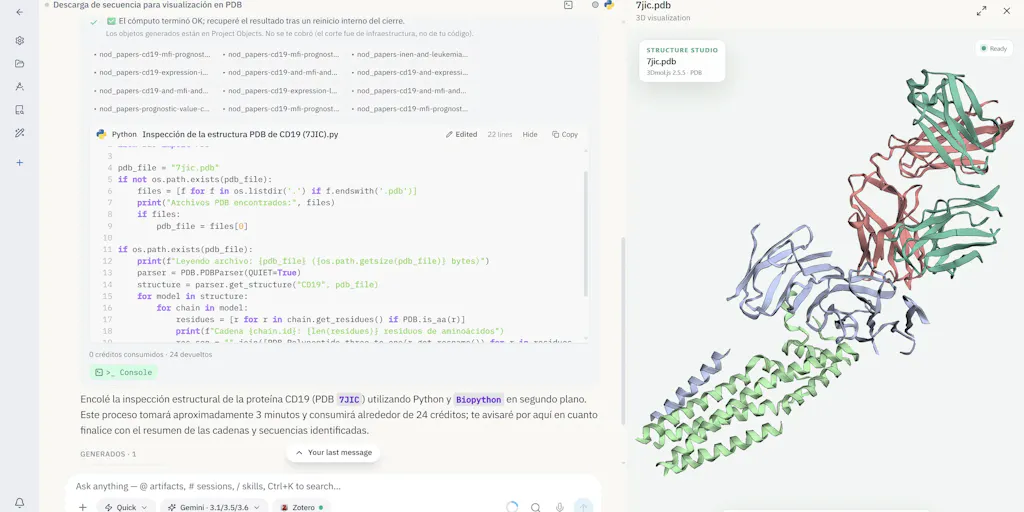
The product itself is a workflow continuity layer for scientific research. You start with a research question, paper, or dataset, and work with specialized scientific agents that can search and connect literature from 30+ scientific sources, plan and run Python or R analyses in isolated cloud sandboxes, create traceable figures and tables, draft scientific writing grounded in project evidence, and preserve the entire audit trail. It’s available in English, Spanish, Portuguese, French, and German, with a free plan plus 25 minutes of free Pro access.
Here’s what I find genuinely interesting for our world: the emphasis on traceability and reproducibility. In science, you can’t just say “the data supports my hypothesis.” You have to show the code, the assumptions, the version of the dataset. In e-commerce, we’re finally being dragged into the same standard. Amazon’s account health requirements, the new Temu supplier compliance demands, and the Etsy seller standards all want to see your work. When you get a suspension notice, you don’t need a better excuse—you need a reproducible trail of where your product came from, how you priced it, and why your listing says what it says.
Why Amazon Sellers Should Care More Than Shopify Ones
If you’re a Shopify DTC operator, you can get away with chaos longer. Your store is your own; you set the rules; the only auditor is your accountant at year-end. But Amazon Seller Central is a different beast. Every listing, every price change, every supplier invoice is potentially a piece of evidence in a future appeal. The sellers who survive the “we need to verify your supply chain” emails are the ones who have a clean, auditable thread from manufacturer to customer. Ressearch AI’s obsession with preserving sources, assumptions, and decisions is exactly the discipline that Amazon sellers need to build into their own operations—whether they use this tool or not.
I’m not saying you should buy a scientific research tool to run your Amazon business. That would be absurd. But the *principle*—that every decision should be traceable to a source, every analysis reproducible, every result inspectable—is the single biggest gap I see in mid-sized seller operations. Most of you have better data than the average scientist. You have sales velocity, conversion rates, ad spend, return rates. But it’s scattered across Klaviyo, Seller Central, your freight forwarder’s portal, and a Google Sheet that’s been mangled by five different fingers. You can’t reproduce your own results from last quarter, let alone prove them to an Amazon investigator.
How This Compares to the Incumbents (and What We Can Borrow)
Let’s be honest about the competitive landscape. In the scientific workflow space, you’re looking at Zotero for reference management, Jupyter for notebooks, Overleaf for LaTeX writing, and a dozen point solutions for stats. The friction isn’t that any one of these is bad—it’s that they don’t talk to each other. The same is true in e-commerce. Helium 10 is great for keyword research. Sellics is decent for reviews and insights. Jungle Scout has its loyalists for product discovery. But your workflow — the actual path from “I wonder if this product will sell” to “it’s on a container ship and my PPC campaign is live” — is held together with duct tape and WhatsApp messages.
What Ressearch AI offers that the incumbents don’t is the unified audit trail. It’s not just a better reference manager or a better code editor. It’s the connective tissue. The founder’s three questions to the Product Hunt community — what real task would you use this for, which tool would it need to replace, and what outcome would justify $19.90/month — are exactly the questions you should be asking about every tool in your stack. If you can’t answer those three questions for your current toolset, you’re paying for clutter, not capability.
Where the Math Breaks
Now let me poke at the pricing, because that’s where my skepticism kicks in. At $19.90/month, Ressearch AI is priced for individual graduate students, not for labs or teams. The founder explicitly asks what outcome it would need to deliver in the first month to keep a user subscribed. That’s a reasonable question, but for a tool that’s pitched at collaboration and team science, the per-seat pricing model feels off. The real value in this kind of platform isn’t the individual features—it’s the shared, reproducible knowledge base. A lab with five postdocs needs a lab-wide subscription, not five individual ones.
The same math problem hits cross-border sellers. If you’re a solo Amazon FBA operator doing $50K/month in revenue, $19.90 is nothing—you’d pay that for a keyword tool without blinking. But if you have a team of three or four, and you need everyone on the same system, the cost multiplies. And here’s the thing: the value of a unified workflow tool scales with team size, not against it. The more people you have, the more handoffs you have, the more context you lose, the more valuable the audit trail becomes. So the pricing model is backwards for the exact use case where it would be most powerful.
That said, for the solo operator or the small team willing to standardize on one platform, the math can work. But you’d need to replace at least two or three existing tools to justify the switch. And that’s a high bar, because switching costs in e-commerce tooling are real. Your historical data lives in the old tools. Your muscle memory lives in the old tools. Your saved searches and custom reports live in the old tools. The founder’s second question—which tool would Ressearch AI need to replace before it earned a permanent place in your workflow—is the right question, but the answer for most of you is “none of them, yet.”
What Cross-Border Sellers Can Steal From This (Without Buying It)
Here’s where I get practical, because I know most of you aren’t going to sign up for a scientific research platform this week. But the design philosophy is transferable, and you should steal it wholesale.
First, build your own audit trail. Start a shared drive (Google Drive or Notion) and mandate that every sourcing decision, every pricing change, every ad campaign launch gets a one-page entry: what you decided, why, what data you used, and who signed off. It sounds bureaucratic, but it’s the difference between “we lowered the price because we felt like it” and “we lowered the price because the conversion rate at $29.99 was 4.2% and the break-even COGS analysis showed we could sustain $24.99.” When Amazon asks for your pricing rationale, you’ll have an answer that isn’t a shrug.
Second, demand reproducibility from your tools. If your PPC manager says “we should increase bids on this campaign,” ask to see the data that supports it. Not the screenshot—the actual data. If your freight forwarder says “rates are up 15%,” ask for the index they’re using. The discipline of traceability that Ressearch AI enforces for scientific claims is the same discipline that separates professional operators from hobbyists.
Third, consolidate your handoffs. Look at your current workflow and count the number of times information changes hands—from spreadsheet to email to Slack to a Zoom call where someone screenshares. Every one of those handoffs is a place where context dies. The tools don’t need to be integrated into a single platform, but your process should be. Pick one source of truth for each critical data type. Inventory lives in one place. P&L lives in one place. Supplier communications live in one place. If you can’t point to it without thinking, you’re bleeding margin.
What I’d Watch / Test Next
This week, I’m not going to tell you to buy Ressearch AI—unless you happen to be a genomics researcher or a clinical informatics professional, in which case the free plan with 25 minutes of Pro access is genuinely worth a test drive. For the rest of you, here’s what I’d do:
Run the founder’s three questions against your own stack. Write down the answers for your top five tools. Which one would you drop if a better option appeared? What outcome would justify switching? If you can’t answer, you’re not paying attention to your own operations.
Audit your last product launch. Walk backwards from the listing going live to the initial product idea. How many handoffs were there? How many times did information get reinterpreted or lost? Write it down. That list is your roadmap for process improvement.
Build a decision log. Start a simple document—Google Docs, Notion, whatever—and log every major decision you make this week. One sentence on what, one sentence on why, one link to the data. Do it for a month. You’ll be shocked at how much clarity it brings.
Watch the scientific AI space closely. Tools like this are the canary in the coal mine for how AI agents will handle complex, multi-step workflows. If they can make research reproducible, the same architecture will eventually power your supply chain, your customer service, and your ad optimization. The sellers who understand the pattern early will be the ones who profit from it.
The bottom line is this: the future of cross-border e-commerce isn’t about having more tools. It’s about having fewer handoffs and a cleaner trail. Ressearch AI is a reminder that the tools we ignore—the ones built for other industries—often have the most to teach us about our own.