Why a CRM’s Approval Button Is the Most Important Cross-Border Tool You’re Not Thinking About
Here’s the uncomfortable truth about running a modern cross-border e-commerce operation: your biggest operational risk isn’t your supplier in Shenzhen going quiet, your freight forwarder missing a sailing, or even a sudden tariff change. It’s the silent, incremental corruption of your customer data by automation. We’ve all bolted AI onto our stacks—AI that drafts support replies, AI that enriches buyer profiles, AI that predicts churn. But every one of those tools writes to your database, and most of them do it without asking. For a seller juggling Amazon FBA inventory, a Shopify DTC storefront, and a TikTok Shop channel, your CRM is the single source of truth that ties together customer lifetime value, repurchase rates, and return reason codes. If an agent quietly overwrites a record, you don’t just lose a data point—you lose the ability to trust every downstream decision. That’s why the design question at the heart of Relaticle’s Product Hunt launch—where exactly the approval line sits for AI writes—isn’t a niche developer debate. It’s the blueprint for how you should be thinking about every automated touchpoint in your own operation.
The Problem: AI Agents That Write Without a Witness
Let me paint a scenario that should make any Amazon seller wince. You’ve got a CRM that tracks your top 500 reviewers and influencers. You connect an AI assistant to help you draft outreach messages and log follow-ups. The AI, acting on a stale context window, decides that a buyer who returned a defective unit three months ago is actually a “high-value repeat customer” and updates the record accordingly. Your next email campaign—the one with the $20-off code—goes out to the wrong segment. You’ve just spent money acquiring a customer who’s already sour on your brand, and you’ve done it because the AI had write access and used it confidently.
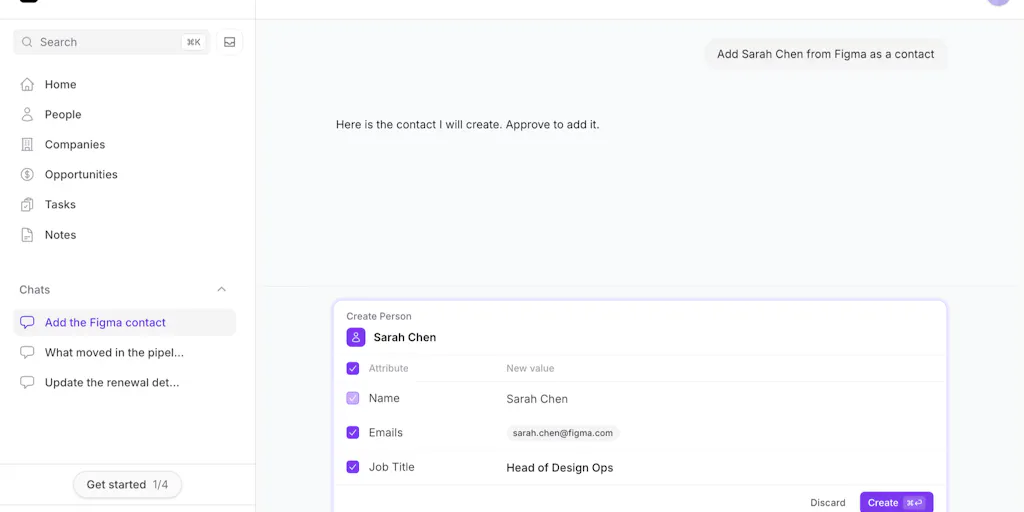
This is the exact problem Manuk Minasyan, the solo founder of Relaticle, says he hit while building the product over two years. He started with a conventional open-source CRM, then added agents and realized he couldn’t dodge a fundamental question: how much authority should each kind of client get? Read-only access was too limited to be useful, but silent writes into customer data felt wrong. So he built two distinct trust levels into the system. External MCP clients—think Claude Desktop, Cursor, or any other client that speaks the Model Context Protocol—authenticate over OAuth and write directly through 37 tools, essentially operating like an API client. The in-app assistant, however, is held to a stricter standard: every write it wants to make becomes a proposal card, and a human approves or skips it record by record before anything lands in the database.
That per-record approval gate is the feature that should matter to you. Not because you’re going to rip out your current CRM and self-host this one tomorrow, but because it forces you to articulate a policy for how AI touches your customer data. Most cross-border operators don’t have that policy. They have vibes. They have “the tool hasn’t broken anything yet.” That’s not a compliance framework; it’s a countdown to a data integrity disaster.
Why Amazon sellers should care more than Shopify ones
If you’re a Shopify DTC operator, your customer data is comparatively clean. You own the checkout, you own the email list, and you can export a clean CSV of every order with custom fields for things like “preferred size” or “how did you hear about us.” Your CRM is a nice-to-have that helps you segment for Klaviyo flows.
Amazon sellers live in a different world. Your customer data on Amazon is a black box. You get order IDs, maybe a masked email, and a ZIP code. The data you actually own—the stuff that differentiates your brand—lives in your own systems: your review tracker, your supplier communication log, your reimbursement claims spreadsheet. That’s the data that AI agents will inevitably want to touch, and it’s the data where a wrong write does the most damage. If an agent on the Shopify side writes a wrong tag, you might send one slightly-off email. If an agent on the Amazon side corrupts your reimbursement tracking, you’ve just lost a claim worth real money because you can’t prove the evidence trail anymore. The approval gate isn’t a burden for Amazon sellers; it’s an audit trail.
How Relaticle Differs from the Incumbent Stack
The CRM market is crowded with incumbents that are all doing the same dance: take a traditional data model, add a chat window, and call it “AI-powered.” HubSpot has its AI assistant that can draft emails and summarize deals. Salesforce has Einstein, which is less an assistant and more an ecosystem of predictions bolted onto a legacy interface. Pipedrive and Zoho CRM have similar features. The common thread is that these tools treat AI as a layer on top of the database—something that suggests, drafts, and predicts, but rarely executes writes. When they do execute, it’s often with a broad “trust the system” approach that makes it hard to see what changed and why.
Relaticle’s bet is that the future isn’t a chatbot that suggests—it’s an agent that does real work on your data, but only with a human in the loop. The distinction between external MCP clients and the in-app assistant is a design choice worth studying. The external clients get API-level trust because they’re tools you’ve explicitly connected and authenticated. The in-app assistant, which works alongside human users, gets proposal-level trust because it’s operating in a context where a human is present and can make a judgment call. The founder explicitly says batches are reviewed record by record: you approve or skip each one, and whatever you approved is kept. That granularity is unusual. Most AI-CRM integrations give you a binary choice: either the AI can write (dangerous) or it can’t (useless). Relaticle is trying to carve out a middle path where the AI can propose, and the human disposes.
The other differentiator is the open-source angle. The whole thing is AGPL and self-hostable, including the model inference via Ollama. That means you can run the entire stack—CRM, AI agents, and the model itself—inside your own infrastructure. For a cross-border operator dealing with GDPR in Europe, PIPL in China, or just paranoid about sending customer data to third-party APIs, that’s a meaningful compliance lever. You’re not just trusting a vendor’s promise that they’ll handle data responsibly; you can inspect the code and control the deployment.
Where the math breaks
But let’s be honest about the trade-offs. The per-record approval model has a throughput problem. If your AI assistant is proposing 50 updates to customer records a day, and each one requires a human to read and click approve or skip, you’ve just turned your AI into a very expensive way to generate more work for your team. The founder himself is wrestling with this, asking in the Product Hunt thread whether per-record approval is the right granularity or whether it becomes noise once you trust the assistant. One commenter, Naim Azoutar, asks a sharp question: can you set rules so certain fields can be automatically written while others always require approval? The founder’s answer is a candid “not currently.” That’s a gap.
The other gap is the lack of an undo trail. Cole Gawin points this out in the comments: approval doesn’t mean you’ll never need to take it back. The founder agrees it makes sense, but it’s not built yet. For a cross-border operator, that’s a dealbreaker for certain workflows. If you approve a price change on a supplier record and then realize you misread the currency conversion, you need to be able to roll that back instantly. An approval gate without a robust undo mechanism is like a bank that lets you authorize a wire transfer but doesn’t let you recall it.
What Cross-Border Sellers Can Borrow from This Design
You don’t need to adopt Relaticle to benefit from its design philosophy. Here’s what I’d steal from this launch and apply to your own tooling stack this quarter.
First, audit every AI tool you currently use that has write access to your customer data. That includes your email marketing platform, your helpdesk software, your inventory forecasting tool, and yes, your CRM. For each one, ask: what happens when the AI makes a mistake? If the answer is “it just updates the record and we hope someone notices,” you have a problem. You need a tool that shows you the proposed change before it lands, or at minimum, a robust audit log that lets you see what changed, when, and why.
Second, think about your trust levels the way Relaticle does. Not every tool needs the same level of access. Your inventory forecasting agent probably needs to read historical sales data and write projected stock levels—that’s low-risk. Your customer support AI that drafts replies to angry buyers should never have the ability to issue refunds or edit order history without a human approving. Segment your tools by the blast radius of their mistakes, and gate accordingly.
Third, consider the compliance implications of self-hosting. If you’re selling into the EU, you’re already dealing with GDPR. If you’re selling into China via TikTok Shop or Tmall, you’re dealing with PIPL. Most SaaS CRM tools store your data in their own infrastructure, often in the US. That’s a potential compliance headache. An open-source, self-hostable option gives you a path to keep customer data inside your chosen jurisdiction. Even if you don’t switch, the existence of this option puts pressure on the incumbents to offer better data residency guarantees.
The “trust this kind of change” switch is the real prize
The most interesting thread in the comments is the idea of earning autonomy over time. Sid Sharma suggests it would be nice for the AI to learn behavior and rules over time so it can earn autonomy and not have to be gated. The founder responds that he likes the idea of earning autonomy over time, and asks which updates you’d trust it with first. This is the direction every serious AI-CRM integration needs to head: not a static approval gate, but a graduated trust model. Start with the AI proposing everything, then as it demonstrates accuracy on low-risk fields, grant it autonomy on those fields while keeping the gate on high-risk ones. The approval line shouldn’t be a wall; it should be a series of doors that open as the AI proves itself.
For a cross-border operator, this maps directly to how you’d onboard a new VA or junior team member. You don’t hand a new hire the keys to your Amazon Seller Central account on day one. You start with read-only access, then let them draft responses, then let them send messages, and only after they’ve demonstrated judgment do you give them refund authority. Your AI agents should be treated the same way.
Where My Judgment Says It Falls Short
Relaticle is a promising launch, but it’s not a finished product, and I’d be doing you a disservice if I pretended otherwise. The founder has been building for two years, mostly solo, and it shows in both the strengths and the gaps.
The biggest gap is the lack of field-level approval rules. As it stands, every write the in-app assistant makes becomes a proposal card, regardless of whether it’s updating a customer’s phone number or changing a deal stage. That’s an all-or-nothing approach that will become noise fast. In a real cross-border operation, you’d want to auto-approve low-risk fields like “last contacted date” while requiring human sign-off on anything that touches financial data or customer segmentation. The founder acknowledges this isn’t built yet, but it’s the difference between a tool your team will actually use and one they’ll abandon after a week.
The second gap is integration depth. The launch mentions 37 tools for external MCP clients, but it doesn’t mention native integrations with the platforms that matter to cross-border sellers. There’s no mention of Shopify order sync, no Amazon Seller Central integration, no Klaviyo or Helium 10 connectors. That’s fine for a solo founder’s first launch, but it means the product is currently more of a developer tool than an out-of-the-box solution for e-commerce operators. If you’re not comfortable with self-hosting and managing your own AI model inference, this isn’t ready for your production stack.
The third issue is the AGPL license itself. For a solo operator or a small team, AGPL is fine. For a larger company with proprietary code, AGPL can be a problem because it requires you to make your own source code available if you modify and distribute the software. If you’re running this as an internal tool and not distributing it, you’re probably fine, but it’s worth understanding the license implications before you build anything on top of it.
What I’d Watch / Test Next
Here’s what I’d do this week if I were running a cross-border operation and wanted to pressure-test the ideas from this launch without committing to a full migration.
First, pull up Relaticle’s Product Hunt page and read through the comment thread. The founder is genuinely engaging with feedback, and the discussion about approval granularity and earning autonomy is a masterclass in product design thinking. Even if you never use the tool, watching how a solo founder navigates these trade-offs will sharpen your own thinking about AI governance.
Second, audit your current CRM and marketing automation stack. If you’re using HubSpot, check whether its AI features have an approval workflow. If they don’t, that’s a gap you need to manage manually. If you’re on a smaller tool, consider whether the AI features are actually writing to your database or just suggesting text. The difference matters more than you think.
Third, run a small pilot where you connect an AI agent to a test environment of your CRM and give it a set of tasks. Watch what it proposes, how often its proposals are wrong, and how much time it takes to review them. You’ll quickly learn whether per-record approval is viable at your volume or whether you need field-level rules. If you’re using Cursor or Claude Desktop, the MCP support in Relaticle means you could test this relatively quickly in a sandbox.
Finally, keep an eye on the Relaticle roadmap. The founder is clearly listening to feedback, and the features that get built over the next six months—field-level rules, undo trails, earned autonomy—will tell you a lot about where AI-CRM design is heading. The approval line isn’t going away; it’s just going to get smarter. You want to be on the right side of that curve when it happens.