The missed call is a cross-border revenue leak, not a personal annoyance
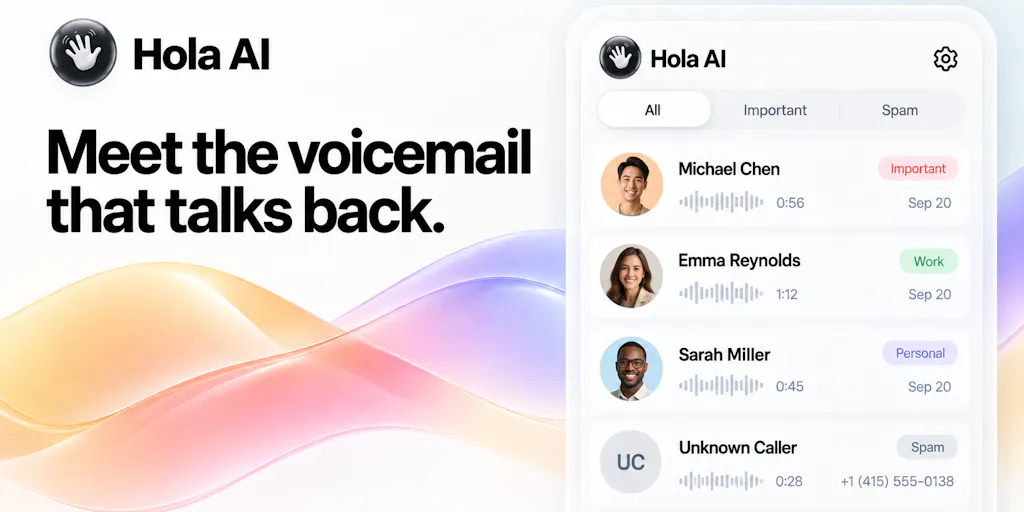
Every cross-border operator I know runs a business that lives and dies on inbound calls they cannot personally answer. A US buyer calls your Shopify store’s support line at 2 a.m. Shenzhen time. A German wholesale prospect dials the number on your Amazon Seller Central storefront while you’re asleep in California. A supplier in Guangzhou calls back the Alibaba inquiry you fired off before bed. In all three cases the caller hears a ring, then nothing — and you wake up to a missed call with zero context. That is the exact pain Hola AI is attacking, and it is worth more to a seller than to a commuter. The pitch is simple: an AI voice agent answers when you can’t, talks to the caller, filters spam, takes a message, records and transcribes the conversation, and hands you a summary before you call back. The makers frame the goal as staying reachable without being available.
That framing undersells it for our industry. For a seller, an unanswered call is not an inconvenience — it is a lead that routed itself to a competitor, a return that escalated into a chargeback, or a supplier quote that expired. So the right question is not “does this feel useful?” It is “can this thing sit on the phone number that my storefront, marketplace listings, and freight forwarders already publish?” Let me work through what Hola AI actually does, where it sits against the incumbents you’re probably already paying for, what a cross-border operator should steal from its design, and where I think the launch material leaves real gaps.
What Hola AI actually solves — and what it deliberately doesn’t
Strip the launch copy down and Hola AI is a call-handling layer with five concrete capabilities. It answers calls you can’t take, holds a natural conversation with the caller, extracts the reason for the call, takes a message, filters spam, and then records, transcribes, and summarizes the exchange so you get context before you dial back. The makers describe the founding frustration bluntly: “you can’t always answer a call, but you still want to know why someone called” — meetings, driving, flights, deep work, or simply an unknown number. Co-founder Komal Chandra frames the value as missed calls meaning missed opportunities, with Hola AI speaking to the caller, filtering spam, taking a message, and sending an instant summary. Another maker, Nikhil Dotasara, adds the detail that matters most: instead of just leaving a voicemail, the agent “can actually talk to the caller and tell you what the call was about.”
That last distinction is the whole product. Traditional voicemail is a passive recording device. This is an active conversation partner. For a seller, the difference is whether a caller who wants to place a bulk order actually states the quantity, the SKU, and the deadline — or hangs up because they got a beep.
What Hola AI is not, based on the launch material, is an outbound dialer, a CRM, a helpdesk, or an e-commerce integration. There is no mention of Shopify order lookups, no Zendesk or Gorgias handoff, no Twilio-style programmable call flows, and no pricing disclosed anywhere on the page. The makers ask for feedback on what would make them trust an AI with more of their calls — which tells you the trust boundary is still being negotiated in public.
Why Amazon sellers should care more than Shopify ones
Here’s a judgment call worth stating plainly. A DTC operator on Shopify can push nearly all support into email, chat, and a Klaviyo flow; phone is optional. An Amazon FBA brand owner does not have that luxury. Amazon’s own buyer-seller messaging and the expectations around seller responsiveness mean that a phone number is often the escalation path when a return, a lost shipment, or an A-to-z claim goes sideways — and those calls arrive in the buyer’s time zone, not yours. A seller running Amazon Seller Central across US, EU, and JP marketplaces is effectively staffing three call windows with one human. That is the operator for whom an AI that answers, triages, and summarizes is not a novelty but a night shift.
Shopify merchants selling into one country with a lean catalog can largely ignore this category. Multi-marketplace sellers cannot. The asymmetry is the story.
How it stacks up against the tools you’re already paying for
The honest comparison set is not “voicemail.” It is the call-tracking and answering stack that serious sellers already run, plus the emerging AI receptionist cohort.
Start with the boring incumbent: Google Voice gives you a number, voicemail transcription, and screening, for free or near-free. It does not converse. Next rung up: virtual receptionist services like Ruby, which answer live and take messages but bill per minute and cannot scale to 3 a.m. volume without a painful invoice. Then the AI-native layer, where Hola AI lands — and where the competition is already thick. Dial is the most instructive foil, because a commenter from that team, Gal Dayan, showed up on Hola AI’s own launch thread to describe Dial as building “the other side of this problem” with agents that place and answer calls programmatically. That is a different product with a different buyer: Dial is infrastructure for teams that want to build call flows; Hola AI is a finished consumer-grade answering layer.
For cross-border sellers, the more relevant incumbents are the ones already inside your stack. Twilio gives you programmable voice and number provisioning but zero conversation intelligence out of the box — you build it. CloudTalk and Aircall give sales teams cloud calling with routing and analytics, but they assume a human picks up. Gorgias and Zendesk own the ticket layer where a call summary should land, and neither is natively wired to an AI receptionist on this page. That integration gap is the real competitive question, not whether Hola AI can transcribe.
Where the spam-filter math breaks
The single sharpest critique on the launch page came from Dayan, and every operator should internalize it. He asked whether Hola AI’s spam filtering is trained on caller-ID and carrier signals, or whether it actually listens to the first few seconds of audio and makes a real-time judgment before deciding to engage or silently voicemail. Then he named the failure mode: a legitimate caller who sounds like a robocall opener — “hi, is this a good time to talk about…” — getting auto-filtered before they can explain themselves.
That is not a hypothetical for a cross-border seller. Your best wholesale lead often opens exactly like a spam call. Your freight forwarder calling about a customs hold sounds like a cold outreach. Your 3PL calling about an inbound discrepancy uses the same cadence as a telemarketer. If the filter errs toward blocking, you lose revenue silently and never even know the call happened — which is strictly worse than a missed call, because a missed call at least shows up in your log. Any operator evaluating this category should demand to know the filter’s false-positive behavior before pointing a storefront number at it.
What cross-border sellers should borrow from this design
Even if you never install Hola AI, the launch is a useful design brief for how to handle inbound voice across time zones. Three things are worth stealing.
First, treat every unanswered call as a structured data object, not a recording. The product’s core insight is that a summary with context beats a voicemail every time. If you run any kind of phone presence — even a cheap virtual number — route it so that every call produces a text artifact: who called, why, what they wanted, what the next step is. A seller who can read a one-line summary of a 2 a.m. buyer call and reply by email before their morning coffee is operating at a different speed than one scrubbing audio.
Second, separate spam triage from message capture. These are two different jobs and most cheap tools conflate them. Spam filtering is a classifier problem with asymmetric costs. Message capture is a comprehension problem. If you’re evaluating any AI receptionist, ask which one you’re buying and how each is measured.
Third, put the phone number where the buyer already is. The launch material doesn’t discuss marketplace integrations, but the operator takeaway is obvious: the number that matters is the one printed on your Amazon storefront, your Shopify contact page, your TikTok Shop seller profile, and your eBay listings. If your AI answering layer can’t sit on those numbers, it’s a personal productivity toy, not a business system.
The marketplace-number problem nobody solves yet
Here’s the operational wall. Marketplaces and payment processors increasingly want a reachable human or a verifiable business line for account health, dispute resolution, and verification. An AI receptionist that answers, takes a message, and summarizes is genuinely useful — but if a marketplace trust-and-safety team calls and reaches a bot that can’t verify account details, you may have made your account health worse, not better. I have not seen any product in this cohort publish a policy on marketplace verification calls, KYC checks, or payment-processor callbacks. That is the gap that will decide whether this category gets adopted by sellers or stays a personal tool.
Where my judgment says Hola AI falls short
Four things give me pause, and I’d want answers before recommending it to anyone running real GMV through a phone line.
No disclosed pricing. The launch page names no price, no plan tiers, and no usage limits. For a seller comparing this against a Ruby per-minute bill or a Twilio usage meter, that’s a blank. “Not disclosed” is the honest answer, and it’s a real barrier to evaluation.
No integration surface. No mention of Shopify, Gorgias, Zendesk, HubSpot, Slack, or even a webhook. A summary that lives only inside Hola AI’s app is a summary your team will forget to check. The value multiplies the moment that summary lands as a ticket, a CRM note, or a Slack message.
The trust question is unresolved by the makers’ own admission. They explicitly ask “what would make you trust an AI to handle more of your calls?” That’s a candid and likable thing to say on launch day, but it also means the product is asking you to be an early design partner, not a satisfied customer. Early design partners pay in operational risk.
Language and accent coverage is unaddressed. This is the cross-border killer. A seller taking calls from buyers in Germany, Japan, Brazil, and the Gulf needs an agent that handles accented English, code-switching, and possibly multiple languages. The launch material says nothing about language support. Until that’s answered, Hola AI is a domestic-market product wearing a global pitch.
The retention risk hiding in “life saver” reviews
The comment section is uniformly warm — one user calls it a life saver against spam, another says it saved them from “a million spam calls.” I believe them, and I also note that spam-blocking is a feature with a low switching cost and a thin moat. Once every carrier and OS ships a competent AI call screen — and they will — the standalone spam-filtering value proposition compresses fast. The durable value is in the summary layer and the integrations, not the blocking. If Hola AI wants to survive the platform squeeze, it needs to own the workflow after the call, not just the interception during it.
What I’d watch / test next
If you run a cross-border operation with any inbound call volume, here’s what I’d actually do this week — no procurement committee required.
- Audit your missed calls. Pull the last 30 days of call logs from whatever number sits on your storefront and marketplace listings. Count how many were buyers, suppliers, or logistics — versus spam. If the buyer/supplier share is above roughly 20%, this category deserves a real test.
- Run a two-number experiment. Keep your primary business line human-answered. Spin up a secondary number — the one on a single low-stakes listing — and point it at an AI receptionist. Compare lead capture and response time for 30 days.
- Stress-test the spam filter before you trust it. Have a colleague call the AI line opening with a classic robocall cadence but a legitimate order inquiry. If it gets silently filtered, you’ve found the failure mode that matters most.
- Demand the integration answer. Ask any vendor in this space — Hola AI included — exactly where the call summary lands: their app, your email, your helpdesk, or a webhook. If the answer is “our app,” treat it as a personal tool, not infrastructure.
- Ask about language coverage and marketplace verification calls. Both are unaddressed on the launch page, and both determine whether this is usable for a seller with non-English buyers and live marketplace accounts.
The category is real and the pain is real. The question is whether the current cohort of AI receptionists is ready to sit on a revenue-bearing phone line — or whether it’s still a very good personal assistant waiting for the integrations that make it a business system.


