The Curation Layer Is the Missing Piece in Your Product Research Stack
Every cross-border seller I know runs the same broken loop: you open a dozen tabs — Amazon Movers & Shakers, TikTok Creative Center, a handful of Telegram sourcing channels, three newsletters, a competitor’s YouTube channel — and you skim until your eyes glaze over. The bottleneck was never access to information. It’s judgment at volume. So when I saw Radaric launch on Product Hunt, pitched by Kirill Oleinichenko — the editor behind Zhurnalus, a weekly design digest that has shipped 500+ issues since 2016 — my ears pricked up. This is a tool built by someone who has actually done the curation grind for nearly a decade, not a growth hacker who discovered “AI summaries” last quarter. The interesting question for operators isn’t whether it’s a nice RSS reader. It’s whether “teach the filter your taste” is a workflow you can steal for product research, competitor monitoring, and trend-spotting across marketplaces.
What Radaric Actually Solves (And Why It’s Not Another RSS Reader)
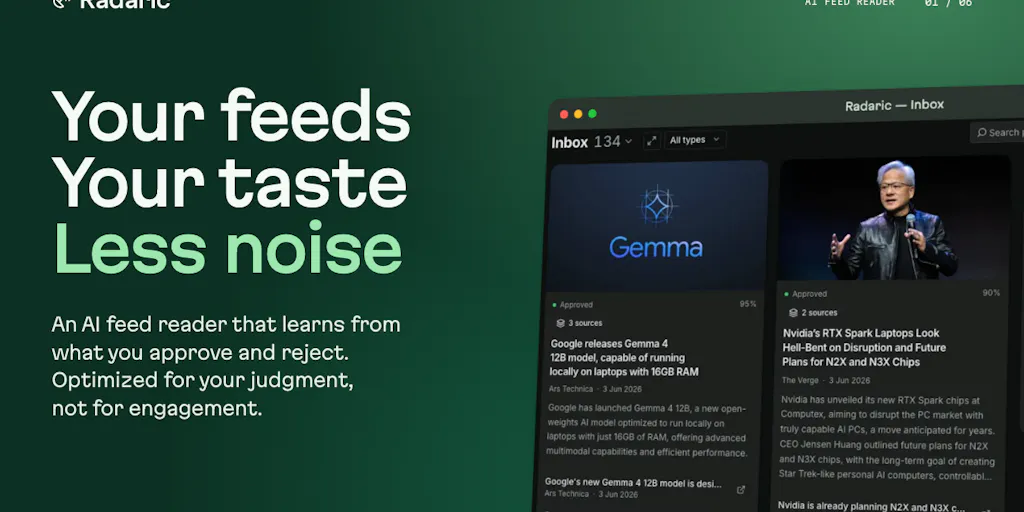
Strip away the launch-page framing and Radaric is a trainable editorial filter sitting on top of a multi-source firehose. It pulls from RSS, Telegram (including private channels), and YouTube, with Twitter/X gated behind the Pro tier. When several sources cover the same event, it groups the posts into a single story and keeps the original links attached. That dedup behavior alone is worth more than most people realize — anyone who has monitored a product recall or a viral TikTok trend across ten feeds knows that the same wire item gets syndicated into oblivion.
But the actual product thesis is the feedback loop. You describe in plain language what matters to you. You approve or reject posts, and — critically — you can attach a reason to a rejection. That reason becomes context the model uses on future decisions. You can inspect its reasoning and revisit what it filtered out. Kirill’s framing on the launch thread is the sharpest part of the pitch: “A practical case study, a minor product update and a piece of corporate PR can all match the same keywords.” That is precisely the failure mode of every keyword-based alert you’ve ever set up in Google Alerts or a Slack RSS bot.
The rejection-reason mechanic is the whole product
In the comments, a commenter asked the obvious question — how many approve/reject decisions does it take before the filter matches your taste? Kirill’s answer reframes the onboarding entirely: almost no training was needed, because before the filter ever saw a single decision, he wrote down the rules he actually judges by — a set of global editorial rules plus per-source rules. The filter started close to his taste from the first pass, and after that it was small corrections. His line — “a short reason on a rejection does more than a hundred silent thumbs down” — is the design principle. Most “AI personalization” products learn from implicit signals (clicks, dwell time) and call it a day. Explicit, reasoned rejection is a much higher-quality training signal, and it’s the thing I’d copy first regardless of whether I ever pay for this tool.
How It Stacks Up Against the Incumbents You’re Already Paying For
Let me be blunt about the comparison set, because this is where operators get lazy. The default stack for most sellers is some combination of Feedly for RSS and AI topic boards, Google Alerts for brand and competitor mentions, and a pile of newsletters. Feedly’s Leo AI does topic filtering and prioritization well, but it’s tuned around topics and entities, not around a per-editor editorial standard. It will happily surface the corporate PR alongside the case study because both mention your category. Google Alerts is even cruder — pure keyword matching with no judgment layer at all.
Then there’s the enterprise end: media monitoring suites like Meltwater or Brandwatch, which cost orders of magnitude more and are built for comms teams tracking sentiment at scale, not for a solo operator deciding what deserves ten minutes of attention. And there’s the marketplace-native layer — Helium 10 and Jungle Scout for Amazon demand signals, TikTok Creative Center for ad and trend discovery. Those are quantitative. Radaric is qualitative. They’re complementary, not competitive, and anyone who tells you otherwise is selling something.
Where Radaric genuinely differs is the explainability of the filter. You can see why it kept or killed something and revisit the discards. That audit trail matters more than the accuracy number, because it lets you debug your own taste criteria. If your filter keeps surfacing fluff, the fix is usually that your written rules were vague — and discovering that is itself valuable.
Why Amazon sellers should care more than Shopify ones
Here’s a distinction I’d draw that the launch page doesn’t. Shopify DTC operators tend to live inside a narrower set of inputs — ad platforms, email metrics, a few creator feeds. Amazon FBA brand owners, by contrast, are drowning in unstructured signal: category shifts, competitor listing changes, review-mining themes, sourcing chatter in private Telegram groups, regulatory noise in their category. The Telegram private-channel support is the sleeper feature here. A lot of sourcing and category intel in cross-border e-commerce moves through private Telegram channels that no RSS reader touches. If Radaric can genuinely ingest those and apply a trained filter, that’s a real edge for anyone doing product research or supplier discovery. The catch: you have to actually write the rules. Garbage rules in, garbage feed out.
What Cross-Border Operators Should Borrow From This
Even if you never sign up, there are three transferable moves here.
First, write your editorial rules down before you automate anything. Kirill’s admission that he wrote global rules plus per-source rules before the filter saw any decisions is the most underrated detail in the whole launch. Most sellers do the opposite — they subscribe to twelve newsletters, get overwhelmed, and then look for a tool to fix a problem they created by never defining what “relevant” means. Spend an hour this week writing down: what makes a competitor update worth acting on versus ignoring? What separates a genuine category shift from a press release? That document is more valuable than any subscription.
Second, treat explicit rejection as data. Whether you’re training Radaric, tuning a Klaxoon-style workflow, or just curating your own reading list, the discipline of writing why you rejected something forces clarity. Silent skimming teaches you nothing and teaches your tools even less.
Third, dedup before you judge. The story-grouping behavior — collapsing multi-source coverage of one event into a single item with original links attached — is a pattern worth demanding from every monitoring tool you use. If your current setup shows you the same announcement five times from five outlets, you’re burning attention on redundancy, not signal.
Where the math breaks
Pricing is where I get skeptical. Lite is $9/month; Pro is $59/month and adds X. Kirill was refreshingly honest in the thread about why there’s a 30-day money-back guarantee instead of an open free trial: every post the filter reads costs real AI money, so an open trial invites fraud and signup floods. He then corrected himself mid-thread — sign-ups arriving via the Product Hunt link get 7 days free, no card required, with the money-back guarantee applying once you’re paying. I appreciate the transparency, but the correction itself is a small yellow flag: launch-day copy and launch-day answers weren’t fully in sync.
The bigger question is the $59 Pro tier. For a solo operator, $9 is a no-brainer test. For $59, you need the X integration to be load-bearing for your workflow, and X is exactly the platform where signal-to-noise is worst. If your research depends on Twitter/X chatter — creator-led products, meme-driven categories, TikTok-adjacent trends — it might justify itself. If not, Lite is the honest tier.
Where My Judgment Says It Falls Short
Two structural limits stand out, and one of them comes straight from the maker’s own mouth.
The first is the original-reporting-versus-press-release problem. A commenter asked whether Radaric can separate original reporting from syndicated copies of the same wire item — the core noise problem in any media monitoring feed. Kirill’s answer: not yet. Today it merges coverage of the same event into one story, but telling original reporting from the PR behind it is still a human call, and he named it as the distinction he’d most like it to learn. I respect the honesty enormously. But for a cross-border seller, that distinction is often the entire value: a press release about a competitor’s “expansion” is noise; an investigative piece about their supply chain is signal. Until the filter learns that, you’re still doing the hardest judgment manually.
The second limit is domain mismatch. Radaric was built for a design digest editor. Design taste and e-commerce operational judgment are different animals. “Is this a practical case study or corporate PR” maps reasonably well onto “is this a real product trend or vendor hype.” But it doesn’t map onto “will this SKU’s margin survive Q4 ad inflation” or “is this supplier’s Telegram claim credible.” You’ll be writing your own rule sets from scratch, and the tool gives you no templates for e-commerce use cases — not disclosed, and I’d bet they don’t exist yet.
The onboarding paradox
There’s a subtle tension in the pitch. On one hand, the filter “won’t know your taste on day one” and needs your input. On the other, Kirill says almost no training was needed because he front-loaded written rules. Both are true, but they point at different user behaviors. The tool rewards people who think like editors — who can articulate standards in prose. It punishes people who expect magic. If you’re the kind of operator who wants to click “make this smart” and walk away, you’ll churn inside a week and blame the product. If you’re willing to write a real rules document, the ceiling is high.
What I’d Watch / Test Next
Three concrete moves for this week. One: before touching any tool, write a one-page “editorial standard” for your product research feed — global rules plus per-source rules, exactly as Kirill described. Define what a signal looks like in your category versus what’s fluff. Two: if you want to test Radaric, come in through the Product Hunt link for the 7-day no-card Lite trial, connect two or three of your highest-noise sources — ideally a private Telegram sourcing channel plus a competitor YouTube feed — and spend the week rejecting with written reasons. Track whether the feed improves by day five. Three: benchmark it honestly against Feedly running the same sources with topic filters, because that’s the incumbent you’d actually replace. My prediction: Radaric wins on explainability and dedup, Feedly wins on breadth and polish, and neither replaces the marketplace-native data in Helium 10 or TikTok Creative Center. The real lesson isn’t the subscription — it’s that curation is a skill you can specify, and any tool that forces you to specify it is doing you a favor whether you keep paying or not.


