The Serious Business of Unserious Products: What a Pixel Duck on Your Wrist Teaches Us About DTC Differentiation
Let me start with a confession that might get me banned from every e-commerce strategy Slack channel I’ve ever joined: I’m tired of reading about AI-powered customer segmentation and predictive inventory models. Not because they don’t work — they do, and you should be using them — but because they’ve become the default answer to every problem. When your competitor’s product is functionally identical to yours, when your Amazon listing is fighting a race to the bottom on price, and when your Shopify store’s conversion rate has plateaued at 1.8% despite your fourth redesign, the last thing you need is another optimization playbook. You need something that makes a human being feel something. That’s why I spent my morning reading about a solo developer in Gothenburg who turned the Apple Watch’s depth sensor into a pixel-art rubber duck swimming simulator, and why I think every cross-border seller should pay attention to what Plask is doing, even if — especially if — you sell something as far from whimsy as power tools or protein powder.
The cross-border e-commerce landscape has matured to the point where operational excellence is table stakes. You can’t win on logistics alone because everyone has decent logistics now. You can’t win on price because Temu will always undercut you. You can’t even win on product quality, because the manufacturing ecosystem has commoditized that too. What’s left is the only moat that actually compounds: the emotional connection between a product and its user. And that’s precisely where this absurd little app — a $1.99 one-time purchase that puts pixel ducks on your wrist — has more to teach us than another SaaS dashboard ever will.
The Problem Nobody Knew They Had: Hardware Without a Soul
Here’s the situation Danni Efraim identified, and it’s one that should feel uncomfortably familiar to anyone who’s ever bought a warehouse of inventory based on a spec sheet. Apple ships a serious dive instrument in the Ultra and Series 10+ — the depth sensor is genuinely impressive technology, the kind of thing that justifies a premium price point for outdoor enthusiasts and safety-conscious swimmers. But here’s the dirty secret of hardware sales: most owners never use it once. The sensor sits there, inert, a feature that was sold but never adopted. It’s the Apple Watch equivalent of that treadmill in your spare bedroom that’s now a very expensive clothes rack.
This is the same problem that plagues cross-border e-commerce at every price point. You sell a smart water bottle that tracks hydration, and six months later the customer is using it as a regular bottle because the app was too complicated. You sell a security camera with AI person detection, and the buyer never configures the zones. You sell an ergonomic standing desk with programmable height presets, and the user just jabs the up and down buttons manually. The hardware was purchased, the margin was realized, but the experience was never delivered. And that’s a silent killer for your brand, because that customer isn’t coming back, and they’re telling their friends the product is a gimmick.
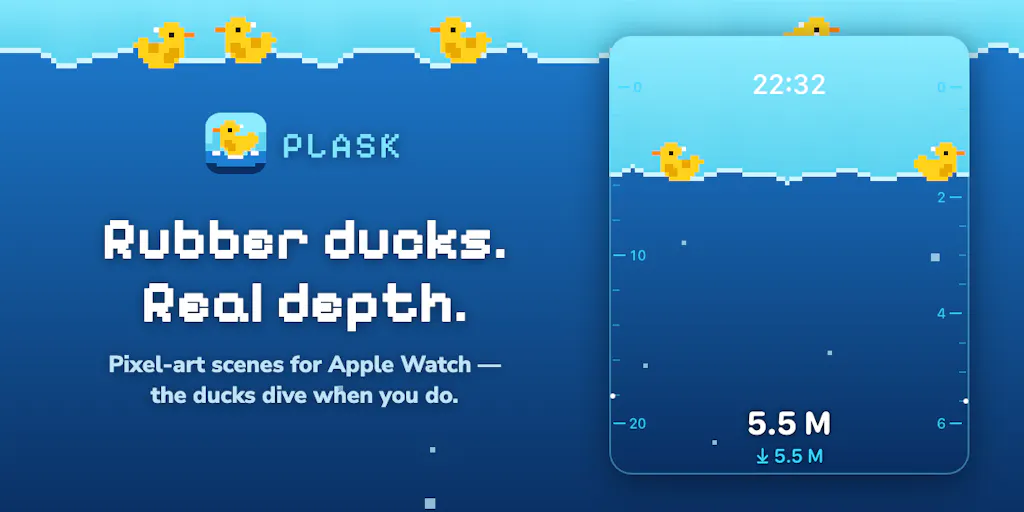
What Plask does differently is almost insultingly simple: it takes a sensor that exists and gives it a reason to be used. Not a practical reason, mind you. Not a “productivity hack” or a “life optimization” angle. A fun reason. Pixel-art rubber ducks swim on your wrist, and because the depth data is real, they dive when you do. Live depth, max depth, water temperature — all the data points that Apple built for serious diving, now rendered as a tiny digital aquarium that lives on your wrist. On depth-gauge watches, the app even launches itself the moment your wrist goes under, which is the kind of frictionless onboarding that most SaaS companies would kill for.
For a cross-border operator, the lesson isn’t about ducks. It’s about the gap between what your product can do and what your customer actually does with it. Every feature you ship that goes unused is dead weight — not just in development cost, but in perceived value. The brands that win are the ones that find a way to make their hardware’s capabilities delightful, not just functional.
How This Differs From Everything Else on the Market
Let me be clear about what Plask isn’t. It’s not a fitness app. It’s not a dive log. It’s not a health tracker. And that’s precisely why it works. The incumbent approach to watch-based water activities — think apps like Strava for swimming or Apple’s own Fitness app — is fundamentally utilitarian. They measure your splits, chart your heart rate, and give you a summary of your workout that you’ll glance at once and never think about again. They treat swimming as exercise, which is fine if you’re training for a triathlon, but it completely ignores the fact that most people who own an Apple Watch Ultra are not professional athletes. They’re people who like gadgets and occasionally go to a pool.
Plask, by contrast, treats swimming as play. The Kungliga Badverket — a fictional Royal Swedish Bath Authority — issues 42 pixel-art certificates for your “bathing career,” from your first splash to dips below five degrees. Earn enough achievements and the duck gets a hat. There’s a scene with surströmming, the fermented Swedish herring that’s notorious for being one of the most foul-smelling foods on Earth. This is not a product designed by a committee. This is a product designed by someone with a specific, weird, personal vision — and that’s exactly why it stands out in a marketplace where everything feels like it was focus-grouped into blandness.
Compare this to the typical app launch on the App Store or Product Hunt. You get a productivity tool with a clean interface, a free tier with limited features, and a subscription model that starts at $9.99/month. It’s all so serious. Plask’s pricing is a direct rebuke to that model: free with the yellow ducks, forever, and a one-time purchase of $1.99 — no subscription, no account, and it collects nothing — unlocks nine more scenes. In an era where every software company wants recurring revenue, this is a deliberate, almost political choice. It says: this is a toy, and toys shouldn’t have monthly fees.
For sellers, this is a masterclass in positioning. You don’t have to compete on the same axis as everyone else. If the market is saturated with serious, feature-rich, subscription-based products, there’s a massive underserved segment of customers who just want something fun. That’s a wedge you can drive into almost any category — from kitchen gadgets to pet accessories to desk toys. The question isn’t “how do we add more features?” It’s “how do we make the features we have more delightful?”
What Cross-Border Sellers Can Actually Borrow From This
Let’s get practical, because I know that’s why you’re here. The Plask launch isn’t just a feel-good story about a solo developer’s creative success — it’s a playbook for differentiation in a crowded market. Here are the specific moves you can steal.
First, find the unused feature in your product and give it a reason to exist. Every product has capabilities that customers ignore. For the Apple Watch, it was the depth sensor. For your product, it might be something you’ve never even considered. Do you sell a portable power station? Most buyers never use the app that monitors discharge rates. Do you sell a robot vacuum? Most owners never set up room-specific cleaning schedules. The opportunity is to build a secondary experience around that unused feature — something that doesn’t replace the core value proposition but adds a layer of play or delight that makes the product feel more alive. You don’t need to build a full app; you could include a set of printable achievement certificates in the box, or create a social challenge around a product feature that’s currently ignored.
Second, embrace the power of a fictional narrative. The Royal Swedish Bath Authority is a brilliant piece of world-building. It gives the app a sense of place and history that a simple “achievements” screen would lack. You can do the same with your brand, no matter how mundane your product. A kitchen gadget company could create a “Department of Culinary Affairs” that issues certifications for mastering different recipes. A camping gear brand could invent a “Bureau of Outdoor Exploration” with badges for various wilderness achievements. This isn’t just marketing fluff — it’s a way to create a community around your brand that transcends the product itself.
Third, and this is the big one: reconsider your pricing philosophy. Plask’s $1.99 one-time purchase is a statement. In a world of subscription fatigue, where every app wants $9.99/month and every SaaS wants an annual contract, there’s a powerful counter-positioning available to you. I’m not saying you should abandon your subscription model if it’s working — recurring revenue is the lifeblood of many DTC brands, particularly in the consumables space. But you should ask yourself: is there a toy version of your product that could be sold as a one-time purchase? A digital companion, a physical accessory, a limited edition variant — something that’s pure fun, no commitment, and serves as a gateway to your more serious offerings?
Why Amazon Sellers Should Care More Than Shopify Ones
If you’re selling on Amazon Seller Central, you might be thinking this is all very cute but irrelevant to your world of PPC bids and Buy Box optimization. You’d be wrong. Amazon is the ultimate commoditized marketplace — your product is one click away from a dozen identical alternatives, and price is often the only differentiator. The brands that escape this trap are the ones that create an experience that extends beyond the product itself. They’re the ones that get customers to search for their brand name, not just their product category.
Plask-style whimsy is a way to build that brand affinity. If you sell a water bottle, include a QR code that unlocks a “hydration quest” with silly achievements. If you sell a desk organizer, include a collectible sticker series that encourages repeat purchases. These aren’t core features — they’re the emotional hooks that turn a one-time buyer into a repeat customer. On Amazon, where reviews and repeat purchase rates are king, that emotional connection is worth more than any optimization you can do to your listing.
Where the Math Breaks: The Limits of the Plask Model
I’ve been singing this app’s praises, but I have to be honest about the limitations, because they’re instructive for anyone trying to copy the approach. Plask is a solo developer’s passion project with a $1.99 price tag. It’s not a business model — it’s a portfolio piece, a love letter to a platform. The economics don’t scale. Even if it sells 100,000 copies, that’s $199,000 gross, minus Apple’s 30% cut, which is a decent year for a solo dev but not exactly a growth-stage startup. The Product Hunt launch is charming, but it’s not a customer acquisition engine.
More critically, the core experience is locked to a specific hardware generation. The depth sensor only exists on the Ultra and Series 10+ models, which means the primary market is a tiny sliver of the Apple Watch install base. The maker’s response to a Series 9 owner asking about compatibility — “older watches will have to settle with the demo mode” — is a polite way of saying “you’re not the target audience.” That’s fine for a passion project, but it’s a fatal flaw for a scalable product. You can’t build a sustainable business on a feature that only 5% of your potential market has.
This is the tension every cross-border seller faces. You want to create something delightful and differentiated, but you also need to reach a critical mass of buyers. Plask’s approach works because it’s not trying to be a business — it’s trying to be a delight. And while you should absolutely borrow the spirit of that approach, you need to be more strategic about the execution. Find the fun, but make sure it’s accessible to your entire customer base, not just the ones with the latest hardware.
The Bigger Picture: Why Fun Is a Competitive Advantage
I want to zoom out for a second, because I think the Plask launch is a symptom of a larger shift that’s happening in consumer technology and e-commerce. We’ve spent the last decade optimizing everything — conversion rates, click-through rates, average order value, customer lifetime value. We’ve built dashboards, hired growth hackers, and A/B tested every button color. And what have we gotten? A marketplace that’s technically efficient but emotionally sterile. Products that work perfectly but feel like nothing. Brands that are indistinguishable from their competitors except by price.
The next wave of differentiation isn’t going to come from better analytics or more sophisticated ad targeting. It’s going to come from personality. The brands that win will be the ones that make people smile, that create moments of unexpected joy, that treat their customers like humans with a sense of humor rather than conversion funnels to be optimized. Plask is a tiny, almost invisible example of this — a pixel duck on a wrist — but it points the way toward a larger truth.
Think about the brands that have built cult followings in cross-border e-commerce. They’re not the ones with the best specs or the lowest prices. They’re the ones with a voice — like Oatly with its irreverent packaging, or Liquid Death with its metal-branded water. These brands understand that the product is just the starting point; the experience is the brand. Plask is a microcosm of this philosophy, applied to a single app feature. The fact that it’s free with yellow ducks and charges a one-time $1.99 for the full experience is almost a protest against the monetization-at-all-costs mindset that has infected the software industry.
What I’d Watch / Test Next
So what should you actually do this week, armed with this knowledge? Here are my concrete suggestions, in order of effort.
First, audit your product for its “depth sensor” — the feature that’s technically impressive but rarely used. List out every capability your product has, then check your customer reviews and support tickets to see which ones are actually being mentioned. The gap between the two is your opportunity. If you find a feature that customers aren’t using, ask yourself: how can I make it fun? You don’t need to build a full app — a simple challenge, a certificate, a social sharing prompt might be enough.
Second, experiment with a “toy” SKU or a one-time-purchase digital add-on. If you have a Shopify store, create a low-cost digital product — a printable achievement set, a branded wallpaper pack, a silly quiz — and see if it generates any engagement. The goal isn’t revenue; it’s to test whether your audience responds to whimsy. If they do, you’ve found a differentiation angle that your competitors will struggle to copy.
Third, study the Product Hunt launch as a customer acquisition playbook. Notice how the maker responds to every comment with personality and enthusiasm. Notice how the product is positioned as “deeply unserious” — a deliberate contrast to the seriousness of the tech industry. You can apply the same principles to your own launches, whether on Product Hunt, Amazon, or social media. Don’t be afraid to be funny, to be weird, to be human.
Finally, reconsider your pricing model. I’m not saying you should abandon subscriptions — they’re the foundation of predictable revenue for many DTC brands. But ask yourself if you have a “yellow duck” version of your offering: something that’s free or nearly free, requires no account, and exists purely to delight. That might be the most effective marketing tool you’ve never considered. In a world where everyone is fighting for attention with louder ads and deeper discounts, a moment of genuine joy might be the most memorable thing you can offer. And unlike a price cut, it doesn’t erode your margins — it builds your brand.


