Why a Paper Toy App Should Make Every Cross-Border Seller Rethink Their SKU Strategy
Every few months, something crosses my desk that looks like a children’s craft project and reads like a masterclass in modern e-commerce economics. Paper Critters is that thing this quarter. On the surface, it’s a web app where kids design custom paper toys with sticker controls, print them, and fold them into physical objects. Beneath the surface, it’s a direct challenge to the inventory-heavy, manufacturing-dependent model that most of us in cross-border trade have accepted as the only way to sell physical goods. For sellers drowning in MOQs, container shipping costs, and return rates on fragile plastic goods, this lightweight approach to creator IP and physical product is not a toy story — it’s a supply chain thesis. If you can print a product at home, you can sell it globally without a single warehouse unit. That changes the math for anyone selling on Amazon, Shopify, or Etsy, and it changes what “product-market fit” means for a small brand.
The Problem Paper Critters Actually Solves: The Tyranny of the Mold
Let’s be honest about the pain point here. The maker, Ruperto Fabito, Jr., frames it perfectly in his launch post: producing physical collectible toys usually requires heavy upfront manufacturing costs, injection molds, and complex fulfillment. For indie artists and brands, that’s the wall. You either have $10,000 to drop on a mold for a vinyl figure, or you don’t get to play. The existing alternatives are not kind. You could go the print-on-demand route for apparel, but that’s flat, two-dimensional, and frankly, played out. You could try to launch a Kickstarter for a resin figure, but then you’re in the fulfillment nightmare business, packing and shipping heavy, fragile items to backers across 40 countries.
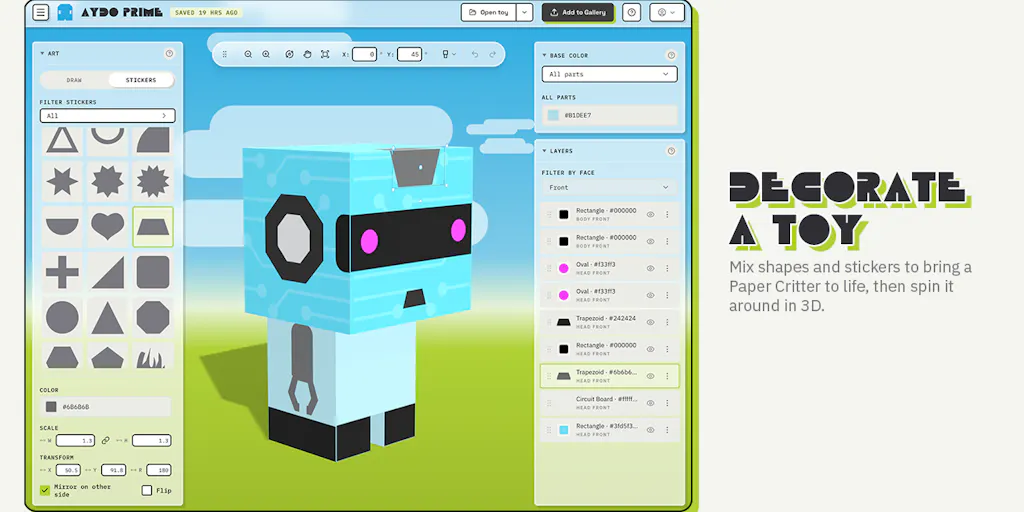
Paper Critters sidesteps the entire production line by making the customer the factory. The web app gives kids (and let’s be real, adults) full sticker decoration controls to design a character. The output is a high-resolution template with cut and fold lines. The user prints it, cuts it, folds it, and assembles it. No injection molding. No freight forwarding. No customs brokerage on a per-unit basis. The only physical logistics involved are a sheet of paper and the user’s own printer.
This is a profound shift for cross-border operators. We spend so much time optimizing the last mile, but the product itself is the problem. If the product is just data — a PDF template — then the last mile is the user’s living room. The cost of goods sold approaches zero. The inventory risk is zero. The return rate is effectively zero, because if a fold goes wrong, the customer just prints another one. For a cross-border seller, that’s not a craft project; that’s a margin revolution. It’s the same logic that made digital downloads attractive, but it’s solved the one thing digital downloads couldn’t — the desire for a physical, tangible artifact.
Why Amazon Sellers Should Care More Than Shopify Ones
If you’re running a Shopify store, you’re already comfortable with the idea of selling digital files or low-ticket items. You have the flexibility to experiment with this kind of product. But if you’re an Amazon FBA seller, this should really grab your attention. Amazon punishes inventory inefficiency. You pay storage fees for every unit sitting in a warehouse. You pay long-term storage fees if it doesn’t move. A product like this, if adapted to a printable format, eliminates the FBA model entirely. You’d be selling a downloadable file, or perhaps a physical card with a download code, which is light enough to ship via Buy Shipping without ever touching FBA. It’s a way to test a character IP or a design concept on Amazon without committing a single unit to the fulfillment center. It’s a market research tool disguised as a toy.
How It Differs From Existing Options: The Incumbent Landscape
When I look at the competitive landscape for this, I don’t see a direct clone. The closest comparisons are things like Cricut design space or Silhouette Studio, which are powerful but have a steep learning curve and require expensive cutting machines. Paper Critters is frictionless by comparison. It’s a Progressive Web App (PWA) that installs to the home screen with no app store download required. That’s a huge differentiator for a kids’ product. Parents don’t want to manage another app store account or deal with in-app purchase walls. The fact that it’s a PWA means it works on any device with a browser, which is a massive advantage in international markets where cheap Android tablets dominate and the App Store isn’t the default gateway.
Then you have the “collectible toy” incumbents. Companies like Funko sell vinyl figures, but they rely on mass retail distribution and the gamble of pop culture licensing. Paper Critters is the anti-Funko. It’s user-generated IP. The kid isn’t buying someone else’s character; they’re creating their own. This taps into the same vein as Roblox, where user-generated content is the core product, but it brings it back into the physical world. It’s also a direct answer to the question posed in the Product Hunt discussion: “What does the future of lightweight creator IP look like?” The answer is not a warehouse full of plastic; it’s a server full of PDFs.
The privacy angle is also a differentiator. The maker notes that they collect no email and require no account to try the product, built around child privacy constraints from day one. This is a massive trust signal. Compare that to the data-hungry nature of most mobile games for kids, which are often criticized for data collection. In a cross-border context, this is even more critical. GDPR in Europe and COPPA in the US have teeth, and if you’re selling a kids’ product internationally, privacy compliance is a minefield. By baking this in from the start, Paper Critters has removed a huge regulatory barrier that would otherwise kill the scalability of this idea.
Where the Math Breaks: The “One-Time Purchase” Conundrum
Let’s talk about the monetization, because this is where my operator brain starts to poke holes. The model is free to design and explore, with a one-time purchase to print high-resolution templates with cut and fold lines. On the surface, that’s clean. It’s a lead magnet and a conversion funnel. But the math is tricky. The price point for a digital template is going to be low — likely in the $2 to $5 range to compete with other printables on Etsy. To make real revenue, you need massive volume. And volume in the kids’ space is seasonal. You’ll see spikes in Q4 and during summer vacation, but the rest of the year might be a slow drip.
The bigger issue is retention. A child designs one character, prints it, and assembles it. The novelty might wear off after a few uses. To make this a sustainable business, the “sticker controls” need to be deep enough to keep kids coming back. It needs a progression system, perhaps a gallery where they can see other kids’ creations for inspiration (which they have, with human moderation on all public gallery submissions). But without a subscription or a robust in-app economy, the lifetime value of a customer is capped at the price of a few printable templates. For a cross-border seller, this is a cautionary tale. The distribution model is brilliant, but the monetization is thin. If I were advising this maker, I’d suggest a “print pack” subscription — a monthly fee for a bundle of new templates and seasonal designs. That’s where the recurring revenue lives.
What Cross-Border Sellers Can Borrow From This Playbook
You don’t need to sell paper toys to learn from this launch. There are three concrete lessons that apply to any DTC or marketplace operation.
First, the digital-to-physical bridge is underutilized. We all sell physical products, but we rarely think about selling the blueprint for the product. If you sell furniture, can you sell a downloadable plan for a smaller accent piece? If you sell clothing, can you sell a PDF sewing pattern? This isn’t just for toys. The success of Etsy for digital downloads proves the demand. It’s a way to enter a new market with zero shipping costs and zero customs friction. You can test a design in Germany, Brazil, and Japan simultaneously without worrying about whether the product will clear customs or fit in a mail box.
Second, frictionless access is a global strategy. The decision to build a PWA instead of a native app is a masterstroke for international reach. Native apps are a pain for cross-border users. They require app store accounts, which often require credit cards, which not all users have. A PWA works on a $50 Android phone in a developing market just as well as it works on an iPhone in New York. If you’re building a tool or a product experience, consider whether you actually need an app. The web is still the most universal platform, and this launch is a reminder that “mobile-first” doesn’t have to mean “app-first.”
Third, privacy is a feature, not a burden. The maker’s emphasis on kid-safe privacy, with no email collection and human moderation, is a selling point. In cross-border trade, data residency and privacy laws are a nightmare. If you can design your product to collect less data, you not only reduce your compliance burden, you also build trust with a global audience that is increasingly wary of how their data is used. This is a competitive advantage that most sellers ignore because they want to build massive email lists. Paper Critters is betting that trust will convert better than spam.
The Fulfillment Angle: Print-on-Demand for the Physical World
There’s a deeper trend here that connects to the broader logistics landscape. We’ve seen the rise of print-on-demand for apparel with companies like Printful and Printify. Those services solved the inventory problem for t-shirts and hoodies. But they still rely on a centralized network of printers shipping boxes to customers. Paper Critters goes one step further: the customer is the printer. This is the ultimate decentralization of fulfillment.
For a cross-border seller, this has huge implications for the “last mile” problem. The last mile is often the most expensive and the most prone to failure — lost packages, damaged goods, porch pirates. If your product is a digital file that the customer prints at home, the last mile is eliminated. You are only responsible for the first mile: delivering the bits. This model is particularly attractive for markets with unreliable postal services. If you’re selling to customers in regions where logistics are challenging, a printable product is a way to serve them without the headache of international shipping. It’s a way to offer a “physical” product in markets where you previously couldn’t justify the shipping cost.
Where My Judgment Says It Falls Short
I’ve been enthusiastic so far, but let me put on my skeptic hat. The first issue is quality control. When you rely on the customer to print and assemble, the final product quality is variable. A kid using a low-ink printer on cheap paper will have a very different experience than a kid with a high-end laser printer and cardstock. This variability can damage the brand. The maker’s focus on “high-resolution templates with cut and fold lines” helps, but it doesn’t solve the hardware disparity. This is why I don’t see this replacing traditional toys anytime soon. It’s a complement, not a substitute.
The second issue is the ceiling on complexity. Paper is a limiting medium. You can make a cube, a humanoid, or an animal, but you can’t make articulated joints or complex mechanical parts. The design space is constrained to “foldable” geometry. This limits the age range. I suspect the sweet spot is ages 6 to 10. Older kids will find it gimmicky. This is a narrow demographic, and it makes the customer acquisition cost (CAC) on platforms like TikTok Shop potentially high, because you’re targeting a very specific parent-child dynamic.
Third, the monetization is too weak for a standalone business. As I mentioned, the one-time purchase model is a dead end for scaling. The maker needs to think about a subscription, a marketplace for user-generated templates where creators can earn a cut, or a licensing model where schools buy bulk licenses. Without that, this will remain a niche tool, not a business. For cross-border sellers, the lesson is to look at this as a feature or a marketing asset for a broader brand ecosystem, not as a standalone SKU.
The “Borrowed” Comparison: Etsy Sellers and the Printable Economy
If you’re an Etsy seller, you probably already know the printable economy is real. Some of the most successful shops on Etsy sell nothing but digital downloads — wedding invitations, wall art, and yes, paper toys. Paper Critters is essentially a tool that automates the design side of that business. It takes the skill out of creating a printable toy. This is both a threat and an opportunity. It’s a threat to the Etsy sellers who currently sell static PDF templates for paper crafts, because this tool makes the design process interactive and customizable. It’s an opportunity for savvy sellers to use this tool to generate a massive catalog of unique designs to sell on Etsy, without needing to be a graphic designer.
The comparison to Canva is also apt. Canva democratized graphic design. Paper Critters is trying to democratize 3D papercraft. If it succeeds, it will flood the market with user-generated content. This is good for the platform, but bad for individual sellers who are trying to stand out. The barrier to entry becomes so low that the market gets commoditized. The only way to win is through strong IP — a distinctive character that kids recognize and love. That’s a branding game, not a manufacturing game. And that’s a harder game to play.
What I’d Watch / Test Next
If I were running a cross-border operation, I wouldn’t just read about this and move on. I’d take concrete steps this week to test the thesis.
First, I’d audit my existing physical SKUs and ask: “Can any of these be converted into a printable version?” If you sell a simple wooden puzzle, can you sell a printable version that the customer cuts out? If you sell a wall clock, can you sell a paper clock template that teaches kids to tell time? The goal isn’t to cannibalize your physical sales; it’s to create a low-cost entry point for new customers and a way to enter new geographic markets without shipping risk.
Second, I’d build a simple PWA or a mobile-optimized landing page that delivers a digital product. Don’t build an app. Follow the Paper Critters playbook and make it web-first. Use a tool like Shopify with a digital download app to handle the transaction and delivery. Test the market with a low price point and see if the conversion rate justifies the effort.
Third, I’d study the privacy compliance angle. If you’re going to sell to kids or parents of kids, bake in privacy from day one. Look at how Paper Critters handles human moderation and no-account browsing. This isn’t just about avoiding fines; it’s about building a brand that parents trust. In a cross-border context, trust is the ultimate currency.
Finally, I’d watch the Product Hunt launch thread to see what feedback the maker gets on the sticker decoration controls and the print-to-assembly experience. That feedback is gold. It tells you what the friction points are in a digital-to-physical workflow. If the assembly is too hard, that’s a product design issue. If the printing is too expensive, that’s a pricing issue. Whatever you learn from their failures, you can apply to your own experiments.
This isn’t about launching a paper toy company. It’s about recognizing that the border between the digital and the physical is thinning. The sellers who win in the next five years will be the ones who figure out how to sell the blueprint, not just the box. Paper Critters is a small, scrappy example of that future. It’s worth your attention, even if you never plan to fold a paper cat.