Why a Citation-Obsessed Research Tool Should Matter to Every Seller Who’s Ever Trusted an AI Chatbot
Here’s the uncomfortable truth for anyone running a cross-border operation in 2025: the same LLM convenience that lets you draft a listing in thirty seconds is quietly rotting the foundation of your competitive intelligence. You ask ChatGPT for a summary of the German marketplace landscape, it hands you a confident paragraph, and you build a sourcing strategy on a statistical probability dressed up as fact. The Big 4 consulting firms — the people who charge seven figures for market entry advice — have been caught publishing reports with fabricated references, as noted in the launch discussion for Occasio. If they can’t keep citations honest, your product research pipeline absolutely isn’t. This isn’t an academic nicety; it’s a supply chain vulnerability. When you’re deciding whether to commit 40-foot containers to a new Amazon EU marketplace based on a chatbot’s synthesis of competitor reviews, the difference between a real source and a hallucinated one is inventory you can’t return. That’s why I’m paying attention to a tool that wants to make citation mechanics the core of how teams build knowledge — because for cross-border sellers, the cost of unverified intelligence has never been higher.
The Problem: Your AI Research Stack Is Building on Quicksand
Let me be specific about what’s broken, because it’s not just “AI makes mistakes.” The deeper issue is that the tools we’ve adopted for speed have systematically stripped away the one thing that makes research actionable: traceability. When you’re operating across time zones, marketplaces, and regulatory regimes, you need to know why you believe something about a market. Not just what you believe.
The founder of Occasio Insights, Camilla S Andersen, articulates this frustration better than most in her launch post. She points out that LLMs produce “generic summaries that disregard nuance and lack specificity” and “fabricated citations that disrespect context and lack explainability.” For a seller, this translates directly into operational pain. Consider a typical scenario: you’re researching whether to expand from Amazon US to Amazon UK. You ask an AI assistant about VAT registration thresholds, competitor pricing strategies, and seasonal demand patterns. The answers come back clean, structured, and utterly unverifiable. You can’t click through to the original source to check if the data is from 2022 or 2024, whether it applies to third-party sellers or first-party vendors, or if it’s just a hallucinated statistic that sounds plausible.
The existing tools haven’t solved this. Guru and Mintlify — both mentioned by a commenter in the Product Hunt thread as comparable organizational knowledge tools — are great for internal documentation and API reference. But they’re not built for the specific workflow of capturing a discrete insight, anchoring it to an immutable source, and then reassembling those insights into a strategic view. They’re knowledge bases, not evidence repositories. The difference matters when you’re trying to audit your own decision-making after a failed product launch. With Guru, you have a wiki of what your team believed. With Occasio’s model, you’d have a trail of where those beliefs came from — which is exactly what you need when your UK expansion loses money and you need to figure out whether your research was bad or your execution was.
What Occasio Actually Does: A Unit-of-Value Approach to Research
The core framework here is worth understanding, even if you never sign up for the tool, because it maps cleanly onto how a sophisticated e-commerce operation should think about intelligence.
The Insight as a First-Class Object
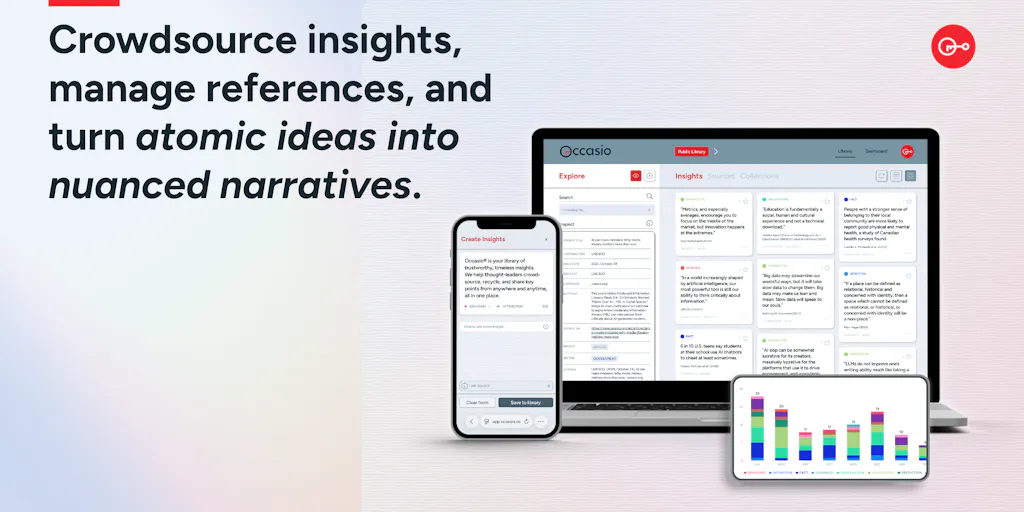
Occasio treats an “insight” as the fundamental unit of value — a specific perspective, a powerful quote, a core idea extracted from a larger source. This is a subtle but important shift. Most research tools are document-centric; you save a PDF, you bookmark a URL, you clip an article. But the actual value isn’t the document, it’s the one paragraph in that document that changes your mind about something. For a cross-border seller, this is the difference between saving a competitor’s entire Amazon listing and extracting the single price anchoring strategy that explains why they’re winning the Buy Box.
The insight gets anchored to a “source” — the formal reference that gives it credibility, whether that’s a published paper, live event notes, or internal docs. This is where the tool gets interesting for operators. The founder’s pitch emphasizes that sources range from published papers to internal docs. For a DTC brand, that means you could capture a competitor’s pricing change from a live monitoring session, anchor it to the screenshot and timestamp, and then combine it with a supplier’s comment about raw material costs from a WeChat conversation. The platform handles the metadata automatically — pulling from URLs, DOIs, and ISBNs, and formatting citations in IEEE, Harvard, MLA, Chicago, or APA style. You’re building a proprietary database of verified market intelligence, not just a folder of bookmarks.
Libraries and Collections: The Zero-Duplication Promise
The “Library” is the central repository, with intelligent search and AI trend dashboards. The “Collection” is where you combine insights thematically, with zero duplication, and you can open collections to external collaborators or export them as a crib sheet. This is the part that should make a logistics or operations lead sit up. Imagine you’re planning a Q4 push into TikTok Shop. You create a collection called “TikTok Shop Q4 Strategy.” You pull in insights from your US team’s TikTok experiments, your China team’s notes on supplier trends, and third-party reports on platform fee changes. The zero-duplication bit — which a commenter asked about, wondering if it dedupes at the insight level or source level — means you’re not getting three versions of the same stat floating around your org chart.
Why Amazon Sellers Should Care More Than Shopify Ones
Here’s where I’ll make a judgment call that might ruffle some feathers. Shopify merchants — especially the DTC brands running their own storefronts — have a more forgiving research environment. Their traffic data, conversion rates, and customer behavior are all first-party. They can see what’s working in real time. Amazon sellers don’t have that luxury. Seller Central gives you your own numbers, but the competitive intelligence you need — what’s driving traffic to your competitors’ listings, which keywords are converting, how the algorithm is ranking — is opaque. You’re relying on third-party tools like Helio 10 or Jungle Scout to interpret the black box, and those tools are only as good as the data they can scrape and the assumptions they make.
For an Amazon seller, the ability to build a verified repository of competitive insights — anchored to actual screenshots, actual ASINs, actual dates — is not a luxury. It’s the difference between guessing and knowing. When you’re deciding whether to invest in PPC for a keyword that a chatbot told you was “high-intent,” you need to know the source of that claim. Was it from a 2023 Helium 10 report? A Reddit thread from a seller who was doing $10M a year? A hallucinated stat? Occasio’s model forces you to answer that question, even if the tool itself needs more work to be Amazon-specific.
Where the Math Breaks: My Honest Concerns
I want to be clear that I’m not endorsing this as a plug-and-play solution for e-commerce operations. There are real gaps, and any serious operator should go in with eyes open.
The Insight Taxonomy Problem
A commenter named HJ raised a sharp critique in the thread: “Some of the insight types are hard for me to tell apart - Thought, Observation, Perspective, Wordcraft. Reading other people’s cards it doesn’t matter much, but now that I’m writing my own I hesitate every time.” This is a genuine UX and conceptual issue. If the tool’s core value proposition is capturing “specific words and nuanced perspectives,” but the taxonomy for categorizing those perspectives is ambiguous, you’re going to get inconsistent data entry. And inconsistent data entry means your AI trend dashboards are analyzing noise. For a cross-border team where English might not be the first language for some contributors, this friction could be fatal to adoption.
The Collaboration Model Assumes Good Actors
The platform allows unlimited external contributors to collaborate in real time. That’s powerful for research groups and think tanks, but for a competitive intelligence operation, it’s a liability. If you’re a brand owner and you invite a supplier or a logistics partner to contribute insights, you’re giving them visibility into your strategic thinking. The tool doesn’t seem to have granular permissioning or audit trails built in yet — the roadmap mentions “automatic insight extraction, interactive knowledge graphs, voice notes, and a Chrome extension,” but nothing about role-based access controls or data residency options. For cross-border operations dealing with sensitive pricing data or proprietary sourcing strategies, that’s a dealbreaker until it’s addressed.
The Export Is a Crib Sheet, Not a Workflow
The founder mentions you can export collections as a “downloadable crib sheet.” That’s fine for a one-off briefing, but it’s not an integration. For this to become a core part of an e-commerce stack, it needs to connect to the tools where decisions actually get made. I’d want to see exports to Notion, Slack alerts when new insights are added to a collection, and ideally a Zapier or Make integration to push insights into a CRM or a project management tool. Without that, it’s a standalone research repository that will get abandoned after the initial enthusiasm wears off.
What Cross-Border Sellers Can Borrow From This — Even Without the Tool
The launch discussion itself is a useful artifact for any operator thinking about how to systematize research. The founder’s framing — that “the sum of our collective intelligence rarely adds up to be greater than its parts” — is exactly the problem you face when you have a distributed team across Shenzhen, Los Angeles, and London all feeding Slack messages about market trends. Here’s what you can implement this week, whether or not you create a free library at app.occasio.cc.
First, start a “source log” for every strategic decision. When your head of sourcing recommends a new supplier based on an AliBaba listing, require a link to that listing, a screenshot, and a note on why this supplier was chosen over alternatives. This is the insight-source framework applied manually. It will feel bureaucratic for a week, then it will save you from a bad decision.
Second, audit your AI research prompts. If you’re using ChatGPT or Claude for market research, force the tool to cite sources in its response. If it can’t, treat the output as a hypothesis, not a fact. The Big 4 consulting firm scandal that Camilla references in her launch post should be a warning: if the people who get paid millions for research are cutting corners, you need to be paranoid about the free tools you’re using.
Third, think about your own “collections.” Identify the three most important strategic questions you need to answer this quarter — maybe it’s “Should we expand to Temu?” or “What’s the real cost of returns on Amazon EU?” — and build a shared document where every insight related to those questions gets logged with a source. You’re building a poor man’s Occasio, but the discipline is what matters.
What I’d Watch / Test Next
I’m going to keep an eye on Occasio for three specific reasons, and I’d suggest any cross-border operator do the same.
First, I want to see how the Chrome extension works when it launches. If it can capture an insight from an Amazon listing page, a Helium 10 report, or a TikTok Shop analytics dashboard with one click and automatically pull the metadata, that’s the moment it becomes genuinely useful for e-commerce workflows. Until then, the manual entry requirement is a significant barrier.
Second, I’m curious about the AI trend dashboards. The promise is that you can build a proprietary database to power your internal intelligence systems. If that means I can eventually query my own verified insights with the same convenience I get from ChatGPT — but without the hallucination risk — that’s a compelling value proposition. I’d test it with a small collection of competitive intelligence data and see if the trend analysis surfaces anything I didn’t already know.
Third, I’d watch for integrations. The roadmap mentions knowledge graphs and voice notes, but the missing piece is connectivity. If they add a Zapier integration or a Slack bot that lets you drop an insight into a collection without leaving your workflow, adoption becomes realistic. I’d also want to see how they handle data export — if I build a library of proprietary market intelligence, I need to be able to take it with me.
For now, here’s the practical move: take one strategic question you’re wrestling with — a market expansion, a new product category, a pricing strategy — and spend thirty minutes this week building a source-backed insight document. Use whatever tool you have. The discipline of anchoring every claim to a verifiable source will feel slow at first, but it’s the only defense against the statistical-confidence trap of modern AI. The tool is nice; the habit is essential.