Why a Bio-Updater for Indie Hackers Actually Matters to People Selling Physical Goods
If you run a cross-border e-commerce operation — whether you’re pushing Amazon FBA inventory through PPC, building a Shopify DTC brand with TikTok Shop bleed, or wrestling with TEMU’s pricing treadmill — you already know that trust is the only currency that scales. Every Amazon listing fights a war of reviews, every Shopify store is one “sketchy” checkout away from a cart abandonment, and every organic post on X (née Twitter) or LinkedIn is a credibility play dressed up as content marketing. So when I saw Nuvio — a tool that auto-updates your X bio with live, verified metrics from Stripe, GA4, and Search Console — my first reaction wasn’t “cute indie-hacker toy.” It was “finally, someone is packaging the proof layer that cross-border sellers have been hacking together with screenshots and manual updates.” Because the same problem Nuvio solves for SaaS founders — “anyone can claim $50k MRR, but showing real, verified stats is another story” — is the exact problem we face every time we try to convince a wholesale buyer, an agency partner, or a platform algorithm that our store is legitimate. The difference is that our metrics are harder to pull and more fragmented across marketplaces, logistics providers, and payment gateways. Nuvio doesn’t solve that directly. But its approach to live, authenticated data is a blueprint for how we should be thinking about trust signals in our own external profiles, and it exposes a gap that someone (maybe one of us) should fill for e-commerce operators.
What Nuvio Actually Does (and Why Its Core Insight Is More Important Than the Tool)
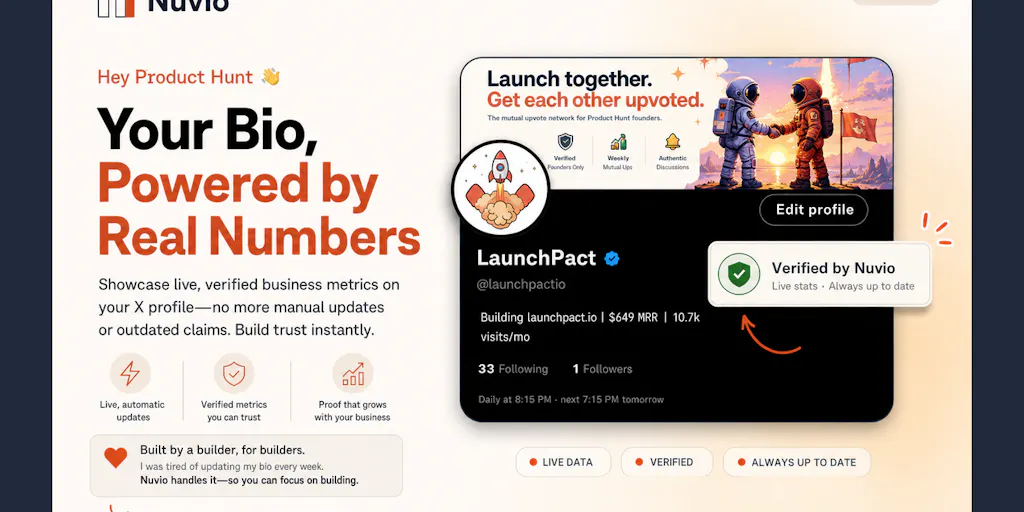
Ammar Rayess, the founder, built Nuvio because he was tired of manually updating his X bio whenever his metrics changed. The tool connects directly to Stripe, Google Analytics 4 (GA4), and Google Search Console, then automatically refreshes your X profile — bio text, header image, maybe a “verified by Nuvio” badge — with live numbers: revenue, traffic, SEO performance. No copy-paste, no stale screenshots, no claim you can’t back up.
The Product Hunt comment thread makes it clear that this is aimed at indie makers and SaaS builders who want to show MRR, page views, and keyword rankings as social proof for investors and potential users. But strip away the X-bio use case, and what you have is a trust-as-a-service integration layer: pull authenticated data from a source of truth, format it for a public display surface, and keep it synced in real time. That’s a powerful abstraction.
For cross-border sellers, the equivalent would be: pull verified sales data from Amazon Seller Central, Shopify admin, Stripe (for DTC), TikTok Shop back end, and logistics cost data from ShipBob or Flexport, then display a composite “live revenue” or “orders fulfilled today” badge on your LinkedIn profile, your brand’s about page, or even your wholesale buyer portal. We do this manually — “$2M sold on Amazon” in the bio, “10,000+ happy customers” on the homepage — but those numbers are static, often cherry-picked, and increasingly ignored by savvy buyers. Nuvio proves that the infrastructure to make those numbers live and verifiable already exists. The question is whether anyone will build the e-commerce version.
How Nuvio Differs from Existing Trust Signals (and Where Incumbents Fall Short)
The Manual Screenshot Era
Before Nuvio, the default credibility play for indie makers was a quarterly screenshot of Stripe dashboard revenue, cropped and uploaded to Twitter. Same for e-commerce operators: we screenshot Amazon’s “Your Sales Dashboard,” throw it into a LinkedIn post, and call it a win. But as Ammar points out (scroll to the first comment), “half the MRR screenshots floating around are stale or cherry-picked the one good month.” That’s true for Amazon screenshots too — the seller who shows $100k in a November spike but omits the January slump is still technically telling the truth, just not the whole truth.
The Badge Economy (Trustpilot, Sitejabber, etc.)
Tools like Trustpilot and Sitejabber offer live review widgets, but they’re tied to a third-party platform with its own verification issues (fake reviews, incentivized ratings). Nuvio’s approach is different: it reads directly from your Stripe and GA4 — sources that are harder to game because the data is transaction-level or user-level. For e-commerce, the closest analog is verifying inventory or sales via an API from the marketplace itself, not from a separate review platform. Amazon’s Brand Registry gives you some verification of ownership but not of revenue. Shopify’s Storefront API could theoretically expose live order counts, but most store owners don’t use it for external trust signals.
The “Verified by” Hosting Approach
Some low-credibility services offer a “verified revenue” badge by requiring you to give them read-only access to Stripe — essentially the same mechanism as Nuvio but sold as a widget for your website. Nuvio’s differentiation is that it puts that data where your audience already is: X. For cross-border sellers, the equivalent surface might be LinkedIn (B2B wholesale), TikTok (DTC audience), or even Amazon’s own Store Rich Media (A+ Content) where you could theoretically embed a live sales counter. No one does that yet because the API dependencies are messy. But Nuvio shows the pattern works.
Why Amazon Sellers Should Care More Than Shopify Ones
Shopify store owners have a unified dashboard where they can see total revenue, order count, and traffic from Google Analytics. If you’re on Shopify, you could theoretically build a Nuvio-like integration today using the Shopify Admin REST API — pull orders, calculate revenue, push to a social bio. The biggest friction is not the API but the mental model: Shopify sellers are used to showing “total sales” as a vanity number, and many already do it manually.
Amazon sellers face a different challenge. Your revenue is split across multiple marketplaces (US, UK, DE, JP, etc.), plus you may have Amazon Advertising costs, FBA fees, and returns that net your actual profit to something far below gross sales. A “live revenue” badge that shows $5M gross but ignores $4.5M in fees and COGS is worse than no badge — it’s misleading. Nuvio’s model of connecting to Stripe (which is net of payment processing) is cleaner. For Amazon, you’d need to connect to the Selling Partner API for financial events, which is a nightmare of throttling and region-specific endpoints. That’s why you rarely see Amazon sellers display live revenue publicly. Nuvio’s simplicity actually makes it harder for Amazon sellers to adopt directly, but it sharpens the question: if you could show live, verified net profit on your Amazon business, would it build more trust than a static number? Probably yes. But the infrastructure isn’t there yet.
What Cross-Border Sellers Can Borrow from Nuvio (Right Now, Without Buying It)
You shouldn’t rush to plug Nuvio into your X bio unless you’re also running a SaaS product that transacts via Stripe and drives traffic from Google. Most cross-border e-commerce businesses have revenue coming from Amazon, TikTok Shop, or maybe direct DTC via Shopify — none of which Nuvio supports out of the box (though the founder mentions a RevenueCat integration in the pipeline for mobile apps, which doesn’t help you). So what can you actually take away?
1. The principle of live, verified data > static claims
If you’re still writing “10,000+ orders shipped” in your LinkedIn bio and updating it once a quarter, consider building a simple automation that refreshes that number monthly from your order database. Even a Zapier connection between Shopify and a spreadsheet, then a manual copy-paste into your bio, is better than a stale number. Nuvio’s real innovation is not the technology — it’s the realization that freshness and verifiability are the two trust dimensions. You don’t need a tool to start applying that to your own profiles. Pick one public stat (e.g., “X orders fulfilled this year”), set a monthly calendar reminder to update it, and note the source. That alone puts you ahead of 90% of operators.
2. The “vanity floor” concept for dip protection
In the comments, users asked for a way to schedule metric freezes so a slow weekend doesn’t tank your bio number. The founder calls it a “vanity floor” — a minimum value that the display won’t drop below, even if the actual data is lower. This is smart psychology. If you’re sharing live metrics on a storefront or social profile, a 10% dip on a Tuesday isn’t information, it’s noise. Set a 30-day rolling average as your floor. For e-commerce, you could implement this by showing “average monthly revenue over the last 12 months” instead of “revenue today.” Stability signals competence.
3. The badge as a third-party verification anchor
Nuvio offers an optional “verified by” badge. For cross-border sellers, this is an interesting model for B2B trust. If you’re trying to get your product into a wholesale retailer’s catalog, a “verified by Amazon” or “verified by Shopify” badge on your pitch deck could shorten the credibility loop. That doesn’t exist yet as a service, but you can simulate it by linking directly to your Amazon storefront or Shopify domain in your email signature and bio. Show, don’t just tell.
Where the Math Breaks: Nuvio’s Shortcomings for E-Commerce Operators
The subscription pricing misalignment
Ammar explains that they can’t offer a lifetime plan because “X apis cost us money.” That’s fair — but for a cross-border seller running thin margins, a per-month SaaS fee for a feature that only affects your X bio is hard to justify. The value prop is indirect: better bio credibility might lead to more inbound partnership inquiries. That’s a stretch for most operators who fight for every PPC dollar. Unless you’re a public-facing founder or agency owner, the ROI on Nuvio’s specific integration is near zero for you.
Integration gap: Amazon, TikTok Shop, logistics
The tool is useless if your revenue comes from Amazon, TikTok Shop, or even a non-Stripe payment gateway. The founder mentions future integration with RevenueCat, but that’s for mobile subscriptions. No mention of Amazon SP-API, TikTok Shop API, or even Shopify’s API (which is straightforward). This is a classic “horizontal product built for a specific vertical” problem. If you’re an e-commerce operator, Nuvio isn’t for you — but the competition that builds the Amazon-connected version is.
The “performance dip” problem for marketplaces
Even if Nuvio connected to Amazon, the data would be misleading. Amazon sellers deal with returns, chargebacks, and Amazon’s own discount programs that make gross revenue a vanity metric. A live “$1.2M sold” badge that doesn’t account for $400k in returns and $300k in FBA fees is not trust-building — it’s deceptive. Nuvio avoids this by reading net revenue from Stripe, which is already cleaned. For e-commerce, you’d need to compute net profit from multiple sources. That’s a much harder problem, and it’s why no one has built the e-commerce equivalent yet.
Where I’d Watch / Test Next
Nuvio’s launch is a useful signal, not a tool to adopt today. Here’s what I’d do as a cross-border operator this week:
Audit your current trust signals across all surfaces. Go to your LinkedIn, X, brand about page, Amazon storefront, and wholesale deck. Count how many metrics are manually updated more than 30 days ago. Pick one — e.g., total orders fulfilled — and set up a monthly Google Sheets update using a Zapier connection from your e-commerce platform. This costs $20/month and gives you the “fresh data” half of Nuvio’s value proposition.
Test a simple “live-ish” badge on your DTC Shopify store. Use Shopify’s Online Store API to pull real-time order count and display it as a counter on your homepage. Tools like Nudge or Proof already do this for social proof. The twist: make the number clickable, linking to your Shopify store’s live sales dashboard (if you’re comfortable with that) or a quarterly earnings page.
If you’re on Amazon, stop using gross revenue as a trust signal. Instead, highlight “products shipped” or “countries served” — metrics that are less susceptible to margin distortion. You can display them on your Amazon Brand Registry A+ Content or in your seller profile using static badges. It’s not live, but it’s honest.
Watch for the tool that connects directly to Amazon’s SP-API and TikTok Shop API. Someone will build it within the next 12 months. When they do, you’ll want to be the early adopter who can show verified, live net profit across marketplaces. That will be the e-commerce equivalent of Nuvio’s core insight — and it will change how we think about seller credibility at scale.