Why a Nervous System Assessment Belongs in Your Cross-Border Playbook
Every cross-border operator I know is running the same experiment: how to scale a brand without scaling the chaos. You’re juggling Amazon’s ever-shifting algorithm, TikTok Shop’s creator economy whiplash, and Shopify’s endless app stack — all while trying to keep a team aligned across time zones. The tools we buy to manage this are almost all external: inventory software, ad platforms, feedback tools. But the real bottleneck is internal. It’s your nervous system, and your team’s. When you’re running a flash sale at 2 AM or dealing with a chargeback storm, your default response to stress determines whether you make a clear-headed decision or a costly one. That’s why a personalized assessment tool like the NS1 Assessment — built by Jonny Miller, the creator behind the Nervous System Quotient — is worth your attention, even if it looks nothing like your usual SaaS stack. It’s not a marketing tool. It’s a decision-making tool, and for sellers whose margins live or die on judgment calls, that’s a category worth watching.
The Problem It Actually Solves: Ending the One-Size-Fits-All Stress Fix
The biggest mistake most operators make — and I’m including myself here — is treating stress management like a generic playbook. You read a blog post about breathwork, you try it, and if it doesn’t work, you conclude the practice is useless. But that’s like abandoning email marketing because one cold campaign flopped. The maker’s own framing nails it: there is no one-size-fits-all solution because every nervous system is unique. For some people, an up-regulating breathwork practice might be exactly what they need; for others, it can actively make symptoms worse.
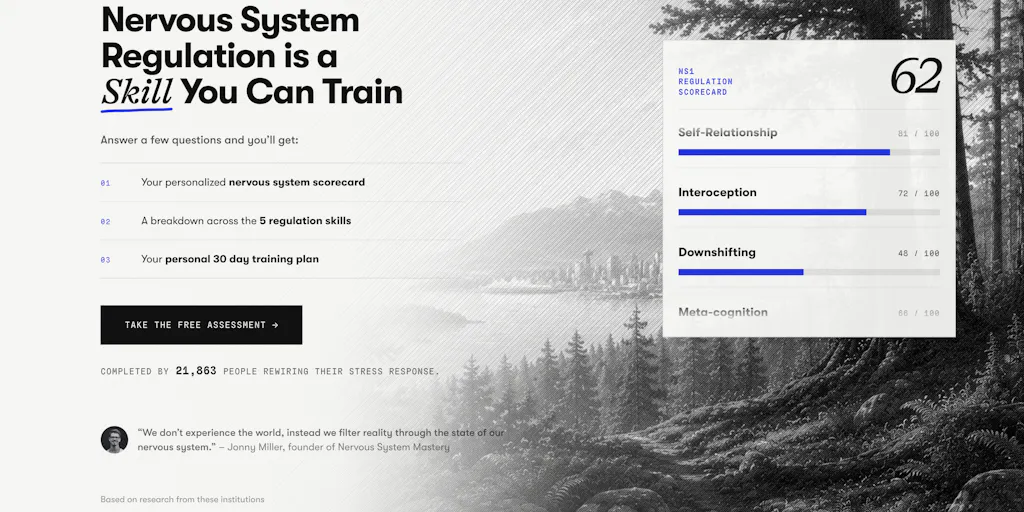
This is the same logic that separates a good cross-border operator from a great one. You don’t run the same ad creative across every marketplace. You don’t use the same pricing strategy in Germany that you do in Brazil. You segment, you test, you personalize. The NS1 Assessment applies that same mindset to your physiology. It gives you a detailed breakdown of how your system responds to stress, what that means for your specific situation, and what you can do to improve. That’s not wellness fluff — that’s a diagnostic.
The tool is built on the idea that your default response to stress falls somewhere on a spectrum between hyperarousal and hypoarousal. Hyperarousal is when you’re wired, anxious, and reactive — the state you’re in when Amazon sends you a suspension notice. Hypoarousal is when you’re numb, flat, and checked out — the state after a brutal Q4 where you can’t even muster the energy to open your dashboard. Most tools on the market treat both states the same way. This one doesn’t.
Why Amazon sellers should care more than Shopify ones
Here’s a judgment call: if you’re an Amazon Seller Central operator, this tool matters more to you than to a Shopify DTC brand owner. Why? Because Amazon’s environment is fundamentally more reactive. You’re at the mercy of algorithm changes, buy box fluctuations, and competitor price wars. Your stress response is triggered multiple times per day by factors outside your control. A Shopify store owner, by contrast, has more control over their traffic and conversion levers. They can iterate on a landing page without fear of a marketplace overlord. The NS1 Assessment’s focus on how you respond to stress — and how to rewire your default patterns — is directly relevant to the high-frequency, high-stakes decisions that marketplace sellers face daily.
How It Differs From Existing Options: Beyond Wearables and Generic Apps
The wellness and biohacking space is crowded. You’ve got Whoop tracking your recovery scores, Oura measuring your sleep, and a dozen meditation apps telling you to breathe. What they all share is a data-first approach: they measure your output, then give you generic recommendations based on population averages. The NS1 Assessment flips that model. It starts with a questionnaire, not a sensor, and it produces a personalized report that explains why your system behaves the way it does, not just what it’s doing.
One of the most interesting exchanges in the Product Hunt comments is about integration with wearables. A user asks whether there are plans to hook this up with trackers like Whoop, and the maker’s response is telling: “I have explored that, it’s easier to do as an iOS app but I’ll investigate. Is there any particular feature you’d like to see or more just being able to layer health metrics + data into the report?” That’s a builder who understands the difference between data collection and insight generation. A wearable tells you your heart rate variability is low. This tool tells you what that means for your decision-making under pressure and what to do about it.
The other differentiator is the follow-up path. Most assessments are one-and-done — you get a score, you read a PDF, you move on. The NS1 Assessment is designed to be dynamic. When a commenter asks whether taking the assessment on a rough week versus a calm week would change the score, the maker confirms that the regulation score would change, but the skill scores and your default response to stress would remain consistent. That’s a meaningful distinction. Your baseline wiring is stable, but your current state fluctuates. The tool accounts for both, and the follow-up path takes into account your goals — whether that’s rewiring anxiety or burnout recovery.
What Cross-Border Sellers Can Borrow From It: Personalization as a Product Principle
Let me step back from the wellness angle for a moment, because I think the real lesson here for cross-border operators is about personalization as a product principle. The NS1 Assessment is essentially a segmentation tool for your nervous system. It identifies which category you fall into, then delivers a tailored action plan. That’s exactly how you should be thinking about your customer base.
When you’re selling on TikTok Shop or Etsy, you can’t treat every buyer the same. A customer in Japan has different expectations for packaging and shipping than one in the US. A buyer on eBay is more price-sensitive than one on Temu. The brands that win are the ones that segment their audience and personalize the experience. The NS1 Assessment is a masterclass in that approach — it’s a product that literally cannot work without personalization, and it’s built that way from the ground up.
There’s also something to borrow in how the maker is handling the go-to-market. The Product Hunt launch is a classic community-driven rollout. The maker is actively engaging with every comment, answering questions about integrations, and even pointing to a side project — Human MD — that creates a more in-depth context file for AI agents. That’s not a polished corporate launch; it’s a builder having conversations with early adopters. For DTC operators, this is a reminder that your best marketing is often the direct, unscripted engagement you have with your first hundred customers.
Where the math breaks: the data integration gap
I want to be clear about where I think this tool falls short, because no product is perfect. The biggest gap is the lack of native wearable integration. The maker acknowledges that it’s “easier to do as an iOS app but I’ll investigate,” which means right now, the assessment is a snapshot, not a continuous feed. For a cross-border operator who wants to track their stress response across a Q4 peak or a product launch, that’s a limitation. You’d have to retake the assessment periodically to see how your regulation score changes, and that’s friction.
The second gap is the PDF export. The maker suggests you can download the report and import it into an LLM, which is a clever workaround, but it’s not a seamless pipeline. Compare that to the Customer.io promotion at the top of the Product Hunt page — that’s a tool that automates messaging across every channel natively. The NS1 Assessment is still in the “manual export” phase. For operators who are used to tools that integrate with their stack automatically, this will feel clunky.
Where My Judgment Says It Falls Short: The Validation Problem
Here’s my honest take as someone who’s seen dozens of Product Hunt launches: the NS1 Assessment has a validation problem. The science behind nervous system regulation is real, but the tool’s efficacy is based on self-reported data. There’s no objective biometric input unless you manually layer in data from a wearable. That creates a circular logic issue — you’re assessing your nervous system based on your own perception of your nervous system. That’s not inherently wrong, but it’s not the same as a clinical assessment.
The maker’s response to a comment about rough versus calm weeks is revealing. He says the regulation score would change, but the skill scores and default response would be consistent. That’s a confident claim, but without longitudinal data from users, it’s hard to verify. For a cross-border operator who’s used to A/B testing and data validation, this is the kind of claim that needs more evidence.
There’s also a practical limitation: the tool is designed for individuals, not teams. If you’re running a 20-person operation across three countries, you can’t easily aggregate your team’s nervous system data to identify systemic stress patterns. That’s a missed opportunity. The biggest cost in cross-border e-commerce is not ad spend — it’s poor decisions made under stress. A tool that could identify which team members are in hyperarousal before a major launch would be invaluable. This tool doesn’t do that yet.
What I’d Watch / Test Next
Here’s what I’d do this week if I were a cross-border operator who found this interesting. First, take the assessment yourself, but treat it as a diagnostic, not a verdict. Use the report to identify your default stress response — are you hyperaroused or hypoaroused? — and then apply that knowledge to your decision-making. If you’re hyperaroused, schedule your high-stakes decisions for the morning when your system is calmer. If you’re hypoaroused, build in activation routines before you tackle your most demanding tasks.
Second, experiment with the Human MD angle. The idea of creating a context file for your AI agent is genuinely useful, not just for wellness but for your business. Imagine uploading your assessment results to an AI assistant that then helps you plan your day with your stress patterns in mind. That’s a workflow worth testing.
Third, watch how the maker responds to the wearable integration question. If he ships a Whoop or Oura integration in the next few months, the tool becomes significantly more powerful. If he doesn’t, you’ll know the product is staying in the self-report lane.
Finally, don’t buy it as a business tool — buy it as a personal one. The ROI isn’t in your P&L; it’s in your ability to make better calls when the marketplace throws you a curveball. And in cross-border e-commerce, that’s the only edge that matters.