You’ve been running Amazon PPC through the summer chaos, stacking TikTok Shop creatives, and obsessing over your Shopify checkout abandonment rate. The last thing on your mind is a Product Hunt AI moderator that reads facial expressions during user interviews. And that’s exactly the mistake.
Cross-border e-commerce is built on a hundred tiny assumptions about what a customer in Munich, Mumbai, or Manila actually wants. You launch a listing based on a Jungle Scout estimate and a Keyword Inspector volume check. You do a survey and participants tell you they’d buy the 12-pack. Then the data comes in: nobody buys the 12-pack. You blame pricing, ad fatigue, or seasonality. But the real culprit is a phenomenon most operators never measure: the gap between what a customer says and what they feel. Every failed product, every wasted ad dollar, every “we doubled down on a dud” post-mortem traces back to that gap.
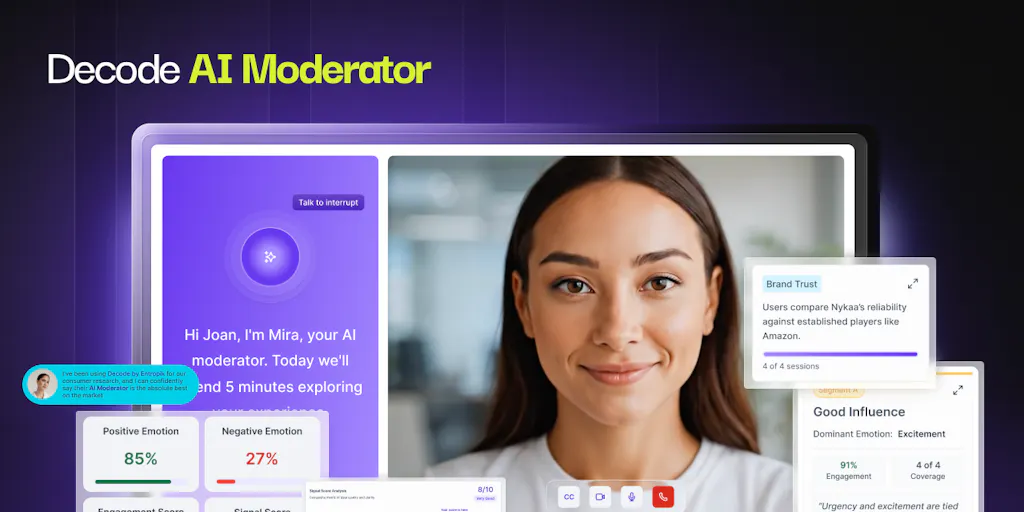
I’ve spent years watching sellers burn $50,000 on tooling stacks that measure clicks but not confusion. So when I saw Mira — an AI moderator that captures the say/feel gap in real time via facial coding, voice emotion, and eye tracking — I didn’t see a researcher’s toy. I saw a potential layer for the e-commerce product intelligence stack that no one is talking about yet. Let me unpack why you should care, even if you never moderate a study yourself.
The Problem Mira Actually Fixes (And Why It’s Your Problem Too)
Every cross-border seller runs some form of customer research. If you’re sophisticated, you use Helium 10’s Cerebro for keyword gaps or Jungle Scout’s product database for demand signals. If you’re scrappy, you run five-minute surveys after purchase on a Klaviyo flow. If you’re DTC, you hop on Zoom with ten customers and ask what they think.
All of these methods suffer from what the Mira team calls the Say-Do Gap. As Lavakumar E (the founder) notes in the Product Hunt thread, “people don’t report their experience accurately. Not because they’re dishonest. Because self-reporting is hard.” Participants round off hesitation, describe their behavior more charitably, and say “yes, I’d probably use this” when what they felt was closer to “maybe, if the price were different.” That’s not just a research problem — it’s a direct cost to your bottom line.
Think about the last time you did a concept test for a product variation. You showed three mockups to a panel. 85% said they liked Option B. You sourced the molds, ran MOQ, and launched. Sales were flat. Now consider what Mira claims to do: it runs the full interview workflow — recruiting, moderating, analyzing, reporting — but uniquely captures what participants say and feel in real time. When someone says “I love it” but their face shows hesitation, Mira catches it and probes deeper during the same conversation. That real-time triangulation is something no survey tool or transcript-only service can offer.
The product is built on 17 patents and supports 70+ languages, with a built-in panel of 100M+ participants across 120 countries. Trusted by Unilever, Nestlé, and 150+ brands. That scale matters because cross-border means cross-cultural, and the say/feel gap amplifies when a participant in Indonesia tells you what they think you want to hear rather than what they’d actually swipe a card for.
Why Amazon Sellers Should Care More Than Shopify Ones
If you sell on Shopify, you own the customer relationship. You can run post-purchase surveys, email follow-ups, and even invite your best customers to a live interview. Amazon sellers don’t have that luxury. You can’t email your buyers. You can’t invite them to a Zoom call. Your customer research has to happen before the product goes into FBA — during the concept or early prototype phase, using third-party panels.
That makes Mira’s integrated panel and AI moderation particularly valuable for Amazon brand owners. You can recruit participants from your target market (say, Germany for a kitchen gadget), run a moderated concept test with emotion tracking, and get a report in minutes instead of weeks. The alternative today is either expensive in-person focus groups (which you don’t have time or budget for) or cheap survey tools that give you optimistic numbers. Mira sits in a middle ground that doesn’t really exist yet: scalable, AI-moderated, emotion-aware interviews at a price point that fits a product launch budget.
How Mira Differs From What You’re Already Using (Or Should Be)
The natural comparison is to tools like UserTesting, Lookback, or even the cheaper cousin — Otter.ai for transcription plus manual analysis. But none of these products read emotion in real time. UserTesting gives you video recordings and a transcript. Lookback gives you session replays. Otter gives you a text file. You still have to watch the recordings and guess when the participant was faking enthusiasm.
Mira’s differentiator is that the emotional layer runs during the interview, not after. As the maker team explains in the Product Hunt comments, the AI “reads facial expressions, voice emotion, and eye gaze in real time during the session.” That means the moderator (in this case, the AI) can follow up on a hesitant pause or a micro-expression of confusion immediately. In their words: “When a participant says ‘I like it’ but their face shows hesitation, Mira catches it and probes deeper in the same conversation.”
That’s a fundamentally different data capture model. Traditional tools record an event; you analyze it later. Mira captures an interaction and adapts to it. For cross-border operators who need to understand why a product failed in a specific market, that adaptive probing could surface insights a static script would never reveal.
Another key difference: Mira’s output isn’t just a transcript with sentiment tags. It surfaces confidence levels on emotional signals, an emotional timeline, and raw disagreement data when verbal and non-verbal cues conflict. Crucially, the founder states: “We don’t collapse them into a single confidence score or pick a winner. That would defeat the entire point.” They surface the gap itself — “the moment where the two signals split.” That transparency is rare in AI tools, which usually smooth over ambiguity.
Where The Math Breaks
I want to be measured here. The polished demo is compelling, but there are three major caveats for anyone running cross-border studies.
First, cross-cultural validity of the emotion models. The most insightful comment on the page comes from Dipankar Sarkar, who asks: “Do you re-validate the emotion mapping per region, or is it one global model?” The maker’s response is honest but not fully reassuring: they do individual baseline calibration (measuring deviation from the participant’s own neutral, not a global norm), and their training data spans non-Western populations after nine years of data collection. But they admit: “Where we’re still building: complete per-region model variants at the AU level.” So if you’re launching in a market like Indonesia or Nigeria, the emotional read carries more uncertainty than in a Western market. You can still use the tool, but you have to manually weigh the confidence scores.
Second, the false positive problem. A participant’s frown could mean confusion with the product concept, or it could mean they’re uncomfortable on camera with an AI voice. The maker addresses this with confidence thresholds and sustained pattern detection — a single frown frame means nothing; they look for emotional patterns sustained across 3–5 seconds minimum. They also cross-reference facial expression with voice tone and eye tracking. Still, if a participant is naturally expressive or nervous, the baseline calibration can only do so much. As a seller, you’d want to run small validation studies before trusting the emotion data at scale.
Third, the price. The Product Hunt page offers the first study free with code PH20 at entropik.io/platform/ai-moderator. But they haven’t disclosed long-term pricing. For a single product concept test, it might be affordable; for ongoing research across multiple markets, it could add up fast. Compare that to a cheap survey tool like Typeform at ~$30/month or SurveyMonkey at enterprise plans. Mira’s value proposition depends on how much you believe the say/feel gap is costing you. If you’ve lost $50k on a bad product launch, a $1k study is cheap insurance. If you’re testing five product variants a month, it becomes a line item that needs ROI justification.
What Cross-Border Sellers Can Borrow From Mira Right Now (Without Buying It)
You don’t have to sign up for Mira tomorrow to benefit from its core insight. Here are three operational shifts you can make this week, based on the product’s thesis.
1. Run a micro-version of the say/feel test in your own customer calls. If you currently interview customers on Zoom, record the session and watch it twice: once for the words, once for the face. Freeze frame at moments of hesitation. Ask yourself: did the customer say “yes” while their expression said “maybe”? If you see that pattern, you’re already validating the gap Mira is commercializing. Then adjust your concept or your pitch accordingly.
2. Segment your survey responses by confidence. Most survey tools let you ask “How likely are you to buy?” on a 1–10 scale. Add a follow-up question: “How certain are you of that answer?” The say/feel gap often manifests as confident numbers attached to uncertain feelings. If you see high purchase intent but low certainty scores, you’ve found a Mira-style warning sign.
3. Piloting small-scale in-person or video interviews in your target market. Tools like Mira require webcam access. If your target customers are in countries with low bandwidth or privacy concerns (think older demographics or markets like Saudi Arabia where face recording is sensitive), you might get zero valid emotional data. In those cases, the old-fashioned method — local moderators who can read cultural cues — is still better than an AI that hasn’t been calibrated for that region. Use Mira’s panel size as a benchmark: they have 100M+ across 120 countries, but coverage doesn’t equal validity. Start with a market you know well before expanding.
What I’d Watch / Test Next
Here are concrete steps an operator can take this week, without waiting for a budget approval.
Book a demo that Mira offers at entropik.io/book-demo. Use the free first study to test one product concept you’re unsure about — not the whole catalog. Compare the report’s emotional timeline against your own gut feeling as a seller. See if the say/feel gap data changes your decision.
Run a parallel test with a traditional survey (same product concept, same target demographic, same sample size). Compare the purchase intent numbers. If Mira’s emotional data suggests lower confidence than the survey implies, you’ve just surfaced a hidden risk. That alone is worth the cost of the free study.
If you’re launching in a non-English market, ask the Mira team about regional model variants during the demo. They’ve been transparent about their limitations on cross-cultural validity. Use that honesty to decide whether the tool is ready for your specific market, or whether you need to supplement with local human moderators.
For Amazon sellers, consider using Mira for pre-launch concept testing. The built-in panel of 100M+ participants means you can target your exact audience demographics — maybe even specifically prime members or Amazon buyers (though the panel source isn’t confirmed). Run a concept test of a new product variation and use the “emotional disagreement” markers to decide whether to invest in inventory.
The say/feel gap isn’t a new problem. Mira is just the first scalable tool that attempts to measure it in real time and probe deeper. Whether it becomes a staple in the cross-border tooling stack depends on how well it handles cultural nuance and how cheap it gets. But the thesis is sound: most product failures stem from what your customers won’t tell you. If you can hear the silence, you can save the budget.


