The “First Useful Reply” Problem Is a Cross-Border Growth Problem
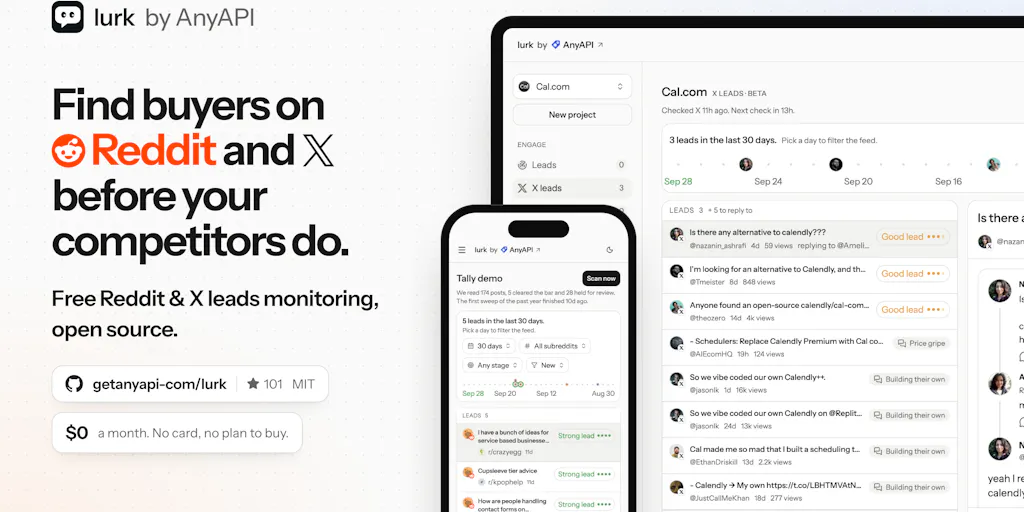
Every cross-border seller I know has the same quiet addiction: refreshing Reddit and X for the moment a stranger asks “what’s a good alternative to X?” — because whoever answers first with something real gets the click, the DM, the trial signup. That dynamic is brutal for operators selling into English-speaking markets from a time zone eight hours ahead. By the time you wake up, the thread is dead and the buyer has already been poached by someone in EST. So when lurk showed up on Product Hunt pitching a tool that watches Reddit and X, scores each post, and drops qualified leads into your inbox, Slack, or Discord, I paid attention — not because it’s another social listening dashboard, but because it attacks the one asymmetry cross-border teams can never fix with headcount: reaction latency.
What Problem Lurk Actually Solves
The founder, Kevin Wang, describes the pattern with unusual honesty: someone posts “is there an alternative to Calendly that just does round-robin?”, the first two or three useful replies get the click, and by the next morning the thread is finished. He says he kept refreshing searches to catch those moments, so he built a tool that does the refreshing for him. You paste your URL, it works out who buys and where they post, then watches Reddit and X and tells you — in one sentence — why each post is worth your time.
That’s the whole pitch. It is not a monitoring dashboard, not a sentiment analysis platform, not a “brand listening” suite. It’s a lead-capture layer for conversational platforms, and the deliverable is a sentence of justification per post. That single-sentence framing is the most interesting design decision in the product, and I’ll come back to why.
A few operational details matter more than the marketing copy:
- It’s free, and Wang says there’s no plan to buy.
- It’s MIT-licensed, and
docker compose upruns it with no limits at all. - It never posts or drafts replies for you. It finds the conversation; the words are yours.
That last constraint is the one I’d underline for any cross-border operator. The graveyard of social selling tools is full of products that auto-replied on Reddit and got their users’ accounts nuked within a week.
Why Amazon sellers should care more than Shopify ones
Here’s a distinction I don’t think the launch page makes sharply enough. If you run a Shopify DTC brand, Reddit and X are nice-to-have acquisition channels sitting behind your paid stack — Meta, Google, TikTok Shop, maybe Klaviyo for retention. Losing a Reddit thread costs you a marginal CAC bump.
If you sell on Amazon, the calculus is inverted. You have no email list you truly own, no first-party pixel, and — critically — no ability to run retargeting off-platform against a cold audience the way a DTC brand can. Your growth levers are reviews, rank, and off-Amazon demand that pushes search volume toward your ASIN. Reddit threads are one of the few places where a US or UK buyer asks “is this [brand] any good?” and you can show up as a human. For a category like supplements, pet gear, or home fitness — where Helium 10 can tell you the keyword volume but not the objection — a tool that surfaces “where is my product being discussed and why does this thread matter” is closer to product research than to marketing.
The same logic applies to Etsy sellers chasing niche communities and to anyone running a Temu or SHEIN storefront who is trying to build a brand halo around what is otherwise a price-competition game. The platforms where you own nothing are the platforms where conversational demand capture pays the highest multiple.
How It Differs From the Incumbents You Already Pay For
The obvious comparison set is Brand24, Brandwatch, Mention, and the social listening bolt-ons inside HubSpot or Sprout Social. I’ve used or evaluated most of these. The differences that matter:
Output format. Brand24 and Brandwatch give you a stream — mentions, sentiment scores, share of voice charts. That’s a reporting tool for a marketing manager who needs to present to a CMO. Lurk gives you a one-line reason per post. That’s a triage tool for a founder or a lean operator who has fifteen minutes between fulfillment issues and needs to know which three threads to reply to today. Wang explicitly says every post is read by “Jev” before it reaches you — I’ll flag that as an unverified claim below, but the intent is clear: filtering, not firehosing.
Pricing model. The incumbents are seat-based SaaS with annual contracts and quote-only enterprise tiers. Lurk is free and MIT-licensed. That’s not a pricing strategy; it’s a distribution strategy. Wang says they can only offer it free because of how cheaply they serve this social data on AnyAPI and because classification/scoring is handled by Jev. Whether that holds at scale is the real question.
Action boundary. This is the sharpest differentiator. Most “social selling” tools drift toward automation — suggested replies, scheduled posts, engagement bots. Lurk refuses that lane entirely. Wang’s answer to a direct question about Reddit clamping down on bot access was telling: “Yup, and we only give you the leads that you decide you want to interact with or not. We’re not commenting or suggesting what to post on your behalf.”
That’s a compliance posture as much as a product one. Reddit has been aggressive about API access and bot behavior, and any cross-border seller who has watched an account get shadowbanned knows the recovery cost is brutal. A tool that stays on the read side of the line is worth more than one that saves you ten minutes and costs you your account.
Self-hosting. When a user asked whether the open-source version would update alongside the main product, Wang said: “Not automatically but you can pull the new containers when there’s updates.” For a seller in a region with data-residency concerns, or one who simply doesn’t want another vendor holding their prospecting workflow, that’s a real option — not a marketing checkbox.
Where the math breaks
Free + MIT-licensed + “no limits at all” on self-host is a combination that should make any operator ask one question: what’s the actual cost of the social data underneath? Wang points to AnyAPI as the reason it’s cheap. But cheap is not free, and if the hosted version is subsidized by the founder’s own infrastructure budget, the sustainability question is unanswered. If you self-host, you’re presumably on the hook for whatever API costs the containers call. That’s not disclosed, and it’s the first thing I’d verify before routing real prospecting volume through it.
What Cross-Border Sellers Should Borrow From This
Even if you never install lurk, there are three transferable ideas here that I think matter more than the tool itself.
1. Latency is a growth metric, not just a support metric
Most cross-border teams obsess over shipping latency and customer-service response time. Almost none treat market conversation latency as a KPI. But the “first useful reply wins” dynamic Wang describes is a real, measurable advantage. If your team is in Shenzhen and your buyers are in Ohio, you are structurally disadvantaged on every conversational channel. The fix isn’t hiring night-shift staff — it’s building a triage layer that surfaces the right threads the moment they appear, so a single person can cover a much wider window. That’s the same logic behind why Amazon sellers use Jungle Scout alerts instead of manually refreshing BSR charts.
2. The one-sentence justification is the product
If you’re evaluating any AI tooling right now — and every cross-border operator is drowning in it — the test is simple: does it reduce the number of decisions I have to make, or does it just move them somewhere else? A dashboard that shows you 400 mentions has moved the decision to you. A tool that says “this thread matters because the poster is comparing you to a competitor they’re already paying for” has made the decision cheaper. Apply that filter to your entire stack, from Shopify apps to your Klaviyo flows.
3. Refusing to automate is a moat, not a limitation
The instinct for every cross-border seller is to automate everything — replies, follow-ups, review requests. But on community platforms, automation is the fastest way to get banned. Lurk’s refusal to draft or post replies isn’t a missing feature; it’s the reason the tool is usable at all. That’s a design principle worth stealing for your own social playbook: automate finding, never automate speaking.
Where My Judgment Says It Falls Short
I want to be direct, because the launch page has some gaps that a cross-border operator should not gloss over.
“Jev” is undefined. Wang says every post is read by Jev before it reaches you, and credits Jev with the classification and scoring. But the source never explains what Jev is — a model, a person, an internal system, a codename. For a tool that promises to filter noise, the filtering mechanism is the entire value proposition, and it’s a black box. Until that’s clarified, I’d treat the “one-line reason” as a hypothesis to test, not a guarantee.
“We can only offer it for free” is a claim, not a business model. Free tools from solo founders have a predictable half-life. The MIT license and self-host path mitigate this somewhat — you can fork it if the hosted version dies — but only if you have the engineering capacity to maintain it, which most cross-border sellers emphatically do not.
Reddit access is the existential risk. Wang was asked directly whether lurk can get around Reddit’s crackdown on bot access and answered “Yup” — but that’s a one-word answer to a question that has killed entire products. Reddit’s API pricing and enforcement have been volatile, and a tool whose entire value depends on reading Reddit at scale is one policy change away from being broken. This is the single biggest thing I’d stress-test before building a workflow around it.
No disclosed coverage of non-English markets. For a cross-border audience, this matters enormously. If you sell into Germany, Japan, or Brazil, the communities where your buyers actually talk are not Reddit and X — they’re local forums, local subreddits, and regional platforms. The launch page mentions Reddit and X only. That’s a significant geographic limitation for anyone outside the US/UK/Canada/Australia axis.
It’s a lead-finder, not a lead-qualifier. Wang asked users to share bad leads, which is a good sign of intellectual honesty, but it also signals that precision is still being tuned. For a cross-border seller with limited English-native writing capacity, a high false-positive rate is expensive — every bad lead costs a reply you have to write in a second language.
What I’d Watch / Test Next
If you’re a cross-border operator and this resonates, here’s what I’d actually do this week — not install it blindly, but run a controlled test.
First, spin up the self-hosted version via docker compose up on a cheap VPS and point it at one product URL — ideally your highest-margin SKU, not your flagship. Run it for seven days and log every lead it surfaces alongside your own manual Reddit search for the same terms. Measure the delta: how many threads did lurk catch that you missed, and how many of its “worth your time” calls were actually worth your time? That’s your precision number, and it’s the only number that matters.
Second, time-box your response window. Set a rule that any lead flagged as high-intent gets a human reply within four hours, regardless of time zone. If your team can’t hit that, the tool’s core value — latency advantage — evaporates.
Third, watch for the API cost question. If you self-host, track what the underlying social data calls actually cost you per month. If it’s more than a Brand24 seat, the “free” framing is marketing, not economics.
Fourth, ask the founder the Jev question directly in the Product Hunt thread. He explicitly invited it: “It’s Hypership Day, so tell me what’s missing and I’ll try to ship it today.” A founder who ships on launch day is worth testing. A founder who can’t explain the filtering layer is worth waiting on.
The bigger takeaway for cross-border sellers isn’t lurk specifically. It’s that the “first useful reply wins” dynamic is a structural disadvantage for anyone selling across time zones — and the tools that fix it will look less like dashboards and more like triage systems. Watch this category closely. The operators who solve conversational latency in 2025 will have a CAC advantage their competitors can’t buy their way out of.