The Hiring Pipeline Is Your Supply Chain
Every cross-border seller I know manages more spreadsheets for people than for products. The operation itself is a pipeline: source, list, sell, ship, support, repeat. Hiring the people who run that pipeline is the same shape, yet most of us still run it out of Gmail and a shared Google Sheet. That’s why the launch of Dover MCP from Dover matters even if you never hire a recruiter. It’s a working example of an AI agent that doesn’t just summarize information but takes actions inside a live operational system — reviewing applicants, moving them through stages, scheduling interviews, writing follow-ups. If that pattern works in an ATS, it’s coming for your order exception queue next. The border between recruiting software and ecommerce operations is thinner than it looks. Both are workflow problems. Both are about moving objects from “inbound” to “done” without dropping the details.
Why a Recruiting Product Belongs in an Ecommerce Reading List
As a cross-border operator, your real bottleneck isn’t ad costs or customs clearance. It’s operational bandwidth. You need listing writers who can localize, PPC managers who can read Amazon’s console in their sleep, supply chain coordinators who can argue with freight forwarders, VAs who can handle TikTok Shop customer service at 3 a.m. Hiring these people takes weeks, they get poached, and the cycle restarts. The tools most sellers use for that pain are a mess.
Enterprise ATS products like Lever, Greenhouse, and Ashby were built for companies with dedicated recruiting teams. They give you pipelines, scorecards, interview loops, and reporting — and they charge per seat and per add-on. For a 20-person DTC brand hiring seven people a year, that’s overkill. You don’t need a corporate ATS; you need someone to run the process without you watching every email. Dover is aimed at that gap. The product page positions it as an all-in-one recruiting solution that combines “a marketplace of top fractional recruiters with a free ATS and sourcing toolkit built for early-stage teams.” The reviews page carries a 4.8 rating from 13 reviews, with reviewers praising ease of use, applicant sorting, and responsive human support.
The free ATS handles the mechanics: post jobs, source candidates, manage applicants, coordinate interviews, track pipelines. The marketplace brings in experienced operators across recruiting, HR, legal, marketing, customer success, and more — as paid help when you need a human. That’s a familiar pattern to anyone who has used Helium 10’s free tier or Klaviyo’s freemium model: the tool earns the workflow, then monetizes the upgrade or the expert layer.
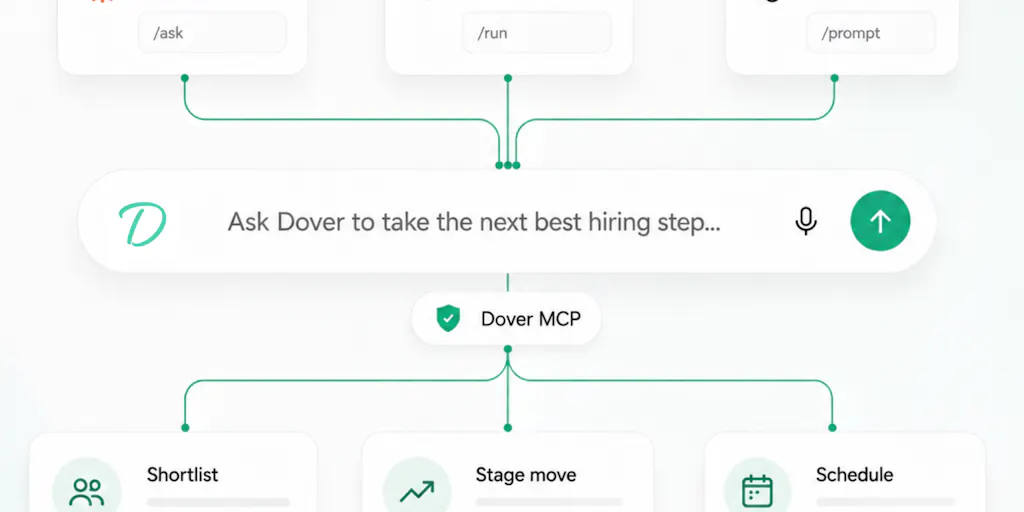
But the MCP piece is what I care about. This is the 12th launch from Dover, and the launch text says the MCP “connects Dover’s free ATS to ChatGPT, Claude, Cursor, and other AI tools.” Instead of opening another dashboard, you ask an AI assistant to review the strongest applicants, schedule interviews, move candidates through stages, add notes, and coordinate hiring. The most important line is buried near the bottom: “Access is secure and respects your team’s existing permissions.” That’s not a nice-to-have. That’s the difference between a tool you hand to a VA and one your compliance person quietly kills.
Why Amazon sellers should care more than Shopify ones
If you run a Shopify DTC brand, you already live inside a connected toolchain: order APIs, Klaviyo flows, Gorgias ticket workflows. Adding an AI agent on top is still hard, but the plumbing exists. Amazon sellers live in Seller Central, which is not a collaboration layer. The system of record is a shared spreadsheet nobody updates, VA turnover is brutal, and account health is a daily fire drill. The hiring workflow is exactly as chaotic as the inventory workflow. An MCP-style layer matters more for Amazon sellers because they have no native wiring to speak of. Dover MCP is a strong-looking example of what a permission-scoped connector can do. If the pattern works for hiring, it can work for supplier onboarding and account health triage.
What Dover MCP Actually Does Differently
Most AI hiring products are still chat-on-top. They summarize resumes or generate interview questions. One commenter on the launch, Etienne Garcia, nailed the difference: “Most AI hiring features just summarize resumes or generate interview questions. Being able to actually move candidates and schedule interviews from Claude or ChatGPT definitely feels different.”
That’s the core differentiator: write access to an operational workflow, not read-only advice. The founder, George Carollo, describes a closed loop: ask Claude to find a candidate, schedule an interview, prepare a hiring manager, add debrief notes afterward, move the candidate to the next stage, and draft the follow-up email. That’s identify, act, record, update, communicate — the same sequence you’d want for a fulfillment exception or a supplier issue. The AI isn’t a copilot in the chat window. It’s an operator in the pipeline.
This works because MCP — the Model Context Protocol — is an open interoperability standard that lets AI tools read from and write to external systems. Dover isn’t forcing you to live inside its interface; it’s putting a connector into Claude’s directory and the ChatGPT plugin listing. That flips the SaaS model: the AI chat becomes the UI, the ATS becomes the data layer. For cross-border sellers drowning in tools, that is the direction everything is heading.
Dover’s launch cadence also shows a deliberate build-up. The earlier AI Applicant Sorting launch was a chat-powered assistant to review resumes 10x faster. Then came RateMyJD, which used AI to improve job descriptions, and the Free Sourcing Extension, which promised email finding and candidate sourcing in one click. Each release added data and trust until they could offer an MCP connection without scaring users.
A free ATS is a wedge, not a business model
Dover’s free ATS is not pure charity. The company also promotes Dover Recruiting Partners — “Hire top talent with a top 2% fractional recruiter” — and the broader marketplace for startup experts. The free ATS captures the workflow; the marketplace monetizes the high-value intervention. This is a useful lens for cross-border sellers choosing software. When you evaluate an ecommerce tool, ask what the free tier is collecting. Helium 10 uses free keyword tools as a funnel. Klaviyo uses free email volume as a funnel. None of this is evil, but it tells you where the roadmap will go.
What Cross-Border Sellers Can Borrow From the MCP Playbook
The transferable insight isn’t “use Dover.” It’s “build permission-scoped agent workflows.” Here is the same loop applied to ecommerce operations: ask Claude to find the five open orders sitting in a shipping exception status, check the carrier notes, draft a message to the freight forwarder, update the status, and send the customer follow-up. That’s Dover’s “find candidate, schedule interview, add notes, move stage, draft email” translated into logistics. The old approach asks a VA to spend an hour clicking through tabs. The new approach asks an agent to do the same work in a minute, then have a human approve the final action.
Second, the permission model is the product’s real future. The most pointed comment on the launch, from Rabnoor Singh, warns that MCP integrations often “inherit the permissions of whoever connected them rather than whoever is asking.” That is dangerous with hiring data because the leak is invisible. George’s reply says Dover has “a strong permissions model in place” — but that’s a claim you verify, not a feature you assume. For cross-border teams, this matters because VAs and overseas contractors should not all have access to customer PII, supplier terms, or true margin data. An AI agent must be scoped to the same data the human user can see, and no more.
Third, the marketplace-plus-free-tool pattern is worth stealing. Instead of building an in-house hiring process, use a free tool for the mechanics and spend only on a fractional expert for the high-stakes calls. That’s the same logic as using a free inventory dashboard but paying for a freight audit when something feels off.
Where the math breaks
MCP connectors do not fix bad data. One Dover reviewer’s “needs improvement” note is “syncing issues.” If the ATS syncs poorly, an AI agent will confidently act on stale candidates. In ecommerce, the same failure is scarier. If your inventory feed lags, an agent can promise a customer a product you don’t have. If your Amazon account health data is delayed, it can pause an ad that is actually winning.
The second break is the false precision of scheduling. Scheduling an interview is a mechanical win. Deciding which candidate should be interviewed is judgment. Dover MCP automates the former, not the latter. The same applies in operations: issuing a refund is easy; deciding whether to refund a repeat returner is policy judgment. The agent should hand you decisions, not make them silently.
Where My Judgment Says It Falls Short
Dover MCP is a promising connector, but it has clear limitations for cross-border ecommerce operators specifically.
It is deliberately startup-focused, not global-operations-focused. The launch material says nothing about multilingual candidate pipelines, timezone-aware scheduling across five countries, or international tax and payroll considerations. The marketplace of fractional recruiters may be excellent for a US venture-backed startup, but a cross-border brand hiring a Romanian customer support lead or a Chinese-speaking production QA manager has different needs.
The permission story is under-specified. The maker says access “respects your team’s existing permissions” and claims a strong permissions model, but the launch doesn’t publish audit logs, per-request authorization traces, or data residency options. For teams handling EU customer data under GDPR, or Chinese supplier data under local law, that’s not enough to trust. It’s a feature you have to probe before connecting real hiring data, and certainly before connecting real customer data.
It also automates labor, not judgment. The workflow loop is real, but the highest-leverage parts of hiring — culture fit, candidate quality, compensation negotiation — still need humans. Same in ecommerce. An agent can draft the apology email, but it can’t know when to grant a loyalty refund to save a brand relationship.
Finally, the competitive response will be fast. Ashby and Greenhouse are API-first companies; they will ship their own MCP connectors quickly. The open question is whether a free ATS can outlast enterprise ATS pricing pressure. If Dover’s free tier produces a data advantage, the wedge holds. If not, the MCP feature becomes a commodity feature in someone else’s roadmap.
What I’d Watch / Test Next
If you’re hiring this week, put one open role into Dover’s free ATS and connect it to Claude or ChatGPT. Ask the assistant to move a candidate from “applied” to “interview scheduled” and note where friction appears. That’s a one-hour experiment that tells you whether agentic workflows are ready for your operations.
If you’re not hiring, don’t chase the ATS. Map one operational pipeline — supplier onboarding, return triage, listing QA — into stages. Then ask any AI tool you already use to play the Dover role: identify strong candidates, propose an action, log the note. From every MCP tool you evaluate, demand three answers: Are permissions enforced per user per request? Is every AI action auditable? Can I see exactly which data the model read? If they can’t answer, keep it in the sandbox.
I’ll be watching Dover’s security documentation and whether reviews stay strong as the user base scales past startups. If the connector layer holds up, ecommerce tooling will copy it within a few quarters.