Why This Matters to Every Cross-Border Operator Who’s Sick of the “Just Use AI” Mantra
If you’ve launched a single product on Amazon or run a DTC brand on Shopify in the last two years, you’ve been bombarded with AI promises: “Generate your entire store in 30 seconds,” “Let AI write your listings,” “Automate your ad creative.” Most of it is vaporware dressed up in a GPT wrapper. But every so often, a tool emerges that actually changes how you work, not just what you output. The Product Hunt promotion for Framer AI Agents and the adjacent maker story from Oncel Cebeci about his Mac-first video editor AVE point toward something deeper: a shift from “generative” to “agentic” tools that respect your existing assets. For cross-border sellers, this isn’t just a design or video novelty—it’s a potential workflow revolution. The question isn’t whether you can generate a landing page. It’s whether you can generate one that knows your catalog, your logistics constraints, and your audience’s cultural biases without you having to spoon-feed every variable.
The Real Problem Most AI Site Builders Ignore (and How Framer AI Agents Bypasses It)
Every e-commerce operator has tried a DIY site builder at some point—Webflow, Wix, or even Shopify’s Online Store 2.0. The friction isn’t the drag-and-drop interface; it’s the blank page syndrome plus the endless tweaks to typography, spacing, and mobile responsiveness. Templates help, but they’re generic. The typical solution has been to hire a designer (expensive, slow) or use an AI Page builder that spits out a layout but ignores your actual content hierarchy.
What Framer AI Agents appears to tackle is the intent layer. Instead of asking you to describe a “professional site,” it lets you feed in source materials—brand guidelines, existing product images, even competitor URLs—and then agents handle the composition. That’s closer to how a real design agency operates: they interview you, take your assets, and iterate. For a cross-border seller who maintains multiple storefronts for different markets (a European store on Shopify, a Japanese store on Shopify or Amazon Japan), being able to generate market-specific landing pages from a single asset library is a massive efficiency gain. The tool’s promise of “design and publish professional sites with AI” (from the Product Hunt tagline) implies a direct output pipeline, which is critical when you need to A/B test localised checkout experiences quickly.
Compare that to incumbents:
- Unbounce’s Smart Builder uses AI to generate copy and layout but requires manual asset uploads per variant.
- Wix ADI asks a few questions then builds a site—but it’s notoriously hard to edit post-generation without breaking the design logic.
- Framer itself (before the AI agent update) already had a strong visual editor and CMS integration, but the learning curve was steep.
Framer AI Agents seems to lower that curve while keeping the guardrails of a professional tool. The key difference: it’s agentic, meaning it can reason about your multiple assets and make decisions (does this hero image need a dark overlay? Should this CTA button be accent blue or green?) without you babysitting. That’s especially useful for cross-border sellers who manage dozens of SKUs across three marketplaces.
Why Amazon Sellers Should Care More Than Shopify Ones
Shopify sellers are used to customising themes and building landing pages outside the platform. Amazon sellers, by contrast, have traditionally been locked into Amazon’s rigid A+ Content templates. But the rise of Amazon Brand Registry and Amazon Posts means sellers can now drive external traffic to brand stores or custom Amazon landing pages (using Amazon’s Landing Page Builder or third-party tools). Framer AI Agents could become a secret weapon for creating pre- and post-purchase pages that convert on Amazon’s platform, especially if it can ingest your product attributes and reviews to automatically generate trust signals.
But the real opportunity is for brand owners who sell both on Amazon and on their own Shopify store. You could use a single Framer project to generate a Shopify landing page and an Amazon Brand Store page simultaneously, maintaining consistent brand identity while adapting to each platform’s layout constraints. That’s a workflow Helium 10 or Jungle Scout don’t touch.
What Cross-Border Sellers Can Borrow from AVE’s “Asset Intelligence” Philosophy
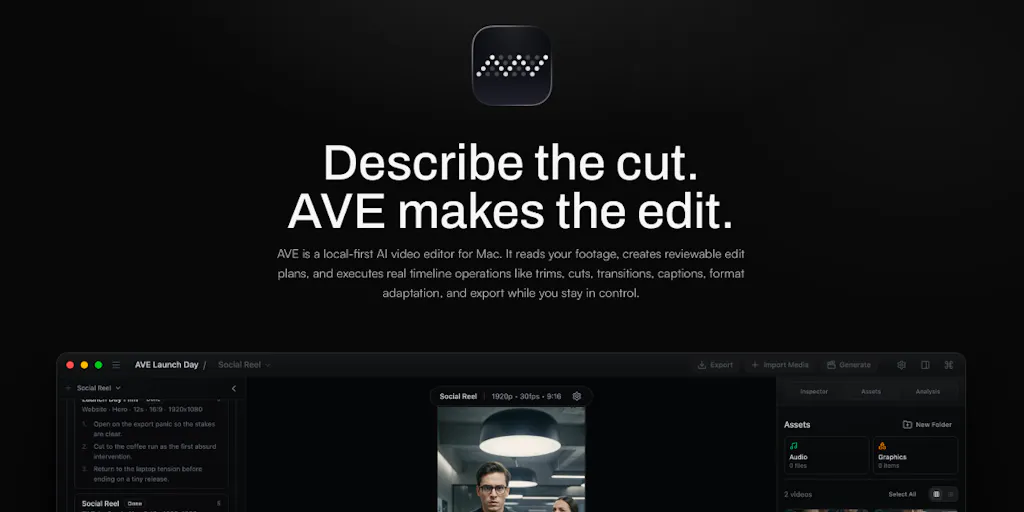
Oncel Cebeci’s AVE is a video editor, not a site builder. But the way he describes it—“asset intelligence: import local clips, analyze transcripts and visual notes, search for moments by intent, then turn selected shots into reviewable timeline edits”—is a lesson for any e-commerce operator drowning in video content.
Think about how many product videos you create per launch: teaser, unboxing, feature walkthrough, testimonial, UGC compilation. Most sellers shoot hours of footage, then spend days scrubbing through clips to find the “aha” moment. AVE’s approach of analyzing transcripts and visual notes locally (Mac-first, local-first) means you can search by intent—“find all clips where the product is shown with a smile” or “show me every scene that mentions shipping time.” That’s a semantic layer that tools like Descript or Adobe Premiere Pro’s AI features don’t yet nail, because they rely on cloud processing and have no concept of your specific catalog terms.
For cross-border sellers, the local-first aspect is huge. Uploading raw footage to the cloud for processing can be slow if you’re in regions with poor upload speed (e.g., sourcing from Shenzhen but editing in the US). Local processing also keeps sensitive product prototypes off third-party servers—a real concern for private-label sellers. AVE’s “analysis, timeline edits, and exports stay on the Mac by default” is a privacy and speed win.
But here’s the catch: AVE is Mac-first. That excludes the majority of Windows-based e-commerce teams, especially in Southeast Asia and Eastern Europe where Windows dominates. If it doesn’t ship a web or Windows version soon, its adoption in the cross-border world will be limited to boutique agencies and solo operators with MacBooks.
Where the Math Breaks for Framer AI Agents
I want to love Framer AI Agents, but I have three reservations specific to e-commerce use cases:
E-commerce CMS depth. Framer’s CMS is powerful for content sites, but it lacks native e-commerce features like product variants, inventory syncing, or payment processing. You’d still need to embed a Shopify button or link out to Amazon. That creates a disjointed user experience. For a true DTC site, Shopify or BigCommerce remain more complete. Framer AI Agents is best for landing pages and marketing microsites, not full stores.
Internationalization overhead. Cross-border sellers need multi-currency display, language switching, and region-aware content. Framer supports localisation, but setting it up for an AI-generated site adds complexity. You’ll likely need to manually correct translated copy generated by the AI, and the agent may not understand cultural nuances (like colour symbolism in China vs. the US). The tool is great for speed, but you still need a human editor with market knowledge.
Pricing opacity. The Product Hunt page does not disclose pricing. If Framer AI Agents ends up costing $100+/month per project, it’s hard to justify over a free Shopify theme or a one-time Webflow template purchase. Many cross-border sellers operate on thin margins (especially on Amazon). Unless the agent saves hours per week, the ROI won’t materialise.
My Judgment: Two Tools with Opposite Strengths and a Shared Weakness
| Aspect | Framer AI Agents | AVE |
|---|---|---|
| Best for | Rapid landing page creation for multiple markets | Video asset management and fast editing |
| Cross-border killer feature | Generating market-specific layouts from one asset base | Local-first processing for teams in low-bandwidth regions |
| Current weakness | No native e-commerce; requires external store integration | Mac-only; no collaboration features yet |
| Incumbent to beat | Webflow, Unbounce | Descript, Frame.io |
| Trust factor (early stage) | High potential, but needs real-case validation | Promising, but one-man show risk |
Both tools share a weakness: they are early-stage with limited user feedback. The Product Hunt launch is essentially a beta announcement. For a cross-border seller, adopting either one today means accepting bugs, feature gaps, and potential unannounced pricing changes. That’s fine for a solo operator testing the waters, but risky for a team running 20+ stores.
What I’d Watch / Test Next
If you’re a cross-border operator with a bit of slack in your schedule, here’s a concrete three-step plan for this week:
Try Framer AI Agents on a single low-stakes landing page—say, a product launch for an international market where you already have existing assets. Import your brand kit, feed it 3 product images and a PDF of your descriptions, and see if it generates a coherent hero section and feature grid. Compare the time spent vs. building the same page in Framer Classic or a Shopify theme. If it saves you more than 30 minutes, consider rolling it out for one-offs like flash sales.
Download AVE and test its “search by intent” function with a folder of raw product videos. Pick a 5-minute clip and try to find all moments where the product is handled or the word “shipping” is spoken. If AVE finds those in under 10 seconds, it’s worth replacing your current manual scrubbing workflow. Use the output to quickly assemble a 30-second ad for TikTok Shop or Amazon Posts.
Set up a feedback loop with both tools. Because they’re new, the developers are likely responsive to early users. Post your wishlist on their Product Hunt threads or community forums. The best AI tools improve fast based on real use cases—and cross-border sellers have very specific problems (multi-language, multi-Currency, multi-platform) that the makers might not have considered. Your input could shape a feature that benefits your entire industry.
The bottom line: neither Framer AI Agents nor AVE is a silver bullet for cross-border e-commerce. But they represent a direction I’m excited about—tools that understand your work instead of just generating noise. If you use them as diagnostic instruments rather than finished solutions, you’ll uncover productivity hacks that the broader seller community hasn’t yet clocked. That’s the kind of edge that compounds.


