The video bottleneck is quietly eating your ad budget
Cross-border sellers don’t lose to competitors with better products. They lose to competitors with better creative velocity. You already know this if you’ve watched a winning TikTok Shop hook decay in eleven days while your editor was still on revision three. The cost isn’t the edit itself — it’s the calendar days between “this angle is working” and “here are six variants of it.” Every tool I evaluate now gets judged against one question: does it compress that gap, or does it just move the bottleneck somewhere else? LaunchReel, a new Claude Code plugin from maker Gajanan Rathod, is the most interesting answer to that question I’ve seen this month — not because it’s built for sellers, but because the workflow it encodes is exactly the one your UGC pipeline needs.
What LaunchReel actually does, stripped of the launch-page gloss
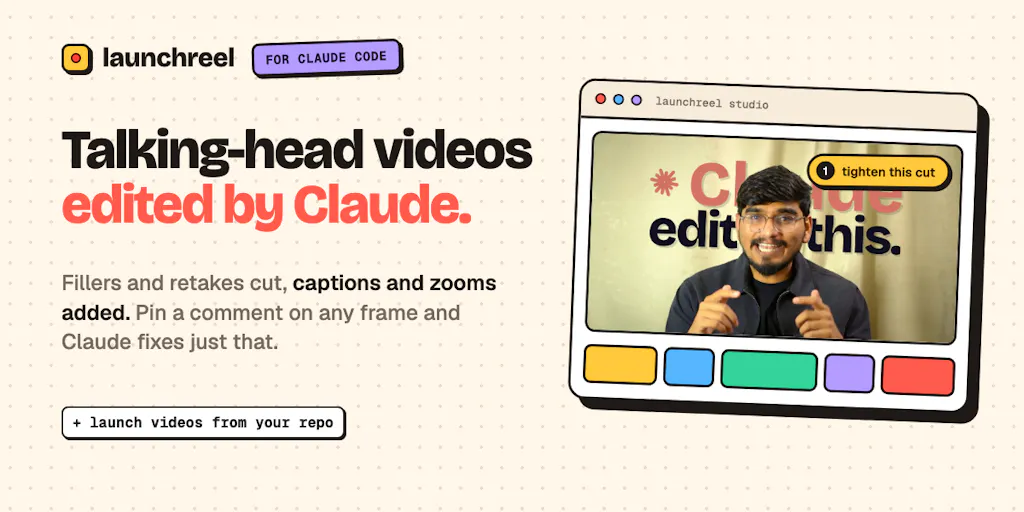
The pitch is two-pronged. First, talking-head reels: you feed it recordings, and it cuts fillers, pauses, and retakes, then layers captions, zooms, and supporting visuals. Second, and more unusual, launch videos generated from your product repository — Claude writes every scene as code against your real product rather than assembling stock B-roll. The maker’s framing is honest about the limits: “I know Claude won’t nail a video in one go. Nobody’s would.”
That admission is the whole product. The interesting part isn’t generation, it’s the review loop. LaunchReel ships a Studio where you pin a comment to any frame, Claude fixes that spot and replies, and — per the maker’s reply to Justin Rockmore — “whatever you pin and ask to fix gets fixed rest says as it is. nothing changes without being asked for.” Small edits like font, size, and color changes cost no prompt at all. Output runs to 16:9 or 9:16, up to 4K, with original music and voiceover, and footage stays local. First video is free; the first ten founders get 50% off for three months with code FOUNDING50. Pricing beyond that is not disclosed.
Why the frame-pinning detail matters more than the generation
Anyone who has run creative at volume knows the real tax isn’t making version one. It’s version seven — the one where legal wants the disclaimer moved, the marketplace team wants a different end card, and your editor re-renders the entire timeline and accidentally breaks the caption timing on scene two. Scoped, addressable edits are the difference between a tool your team tolerates and one they actually use. Rockmore’s comment nails the commercial stakes: “A client signs off on a version, not on a render, so the second pass is where you lose them.” Swap “client” for “media buyer” and you have the exact failure mode of every in-house UGC operation I’ve audited.
How it stacks up against what you’re probably using now
The honest comparison set isn’t other AI video generators. It’s three things you already pay for.
Against CapCut and manual editing. CapCut wins on control and cost. It loses on throughput the moment you need twelve hook variants of the same 40-second spot. LaunchReel’s bet is that prompt-plus-pin beats timeline-scrubbing for the 80% of edits that are mechanical — filler removal, caption sync, format reframing. For the 20% that are creative judgment, you still want a human in a timeline. Rathod’s own answer to Srinivasa Reddy, who asked whether to cut down an existing four-minute demo or start fresh, was telling: it can do both, but “I would suggest you to start fresh.” That’s a tool admitting its strength is generation from source material, not surgical rescue of legacy assets.
Against HeyGen and avatar-based tools. HeyGen solves a different problem — you don’t have a presenter, so it manufactures one. LaunchReel assumes you have footage and need it cut. For Amazon FBA brands doing founder-led content, that’s the more common reality. For dropshippers who never want to be on camera, HeyGen still owns that lane.
Against your agency or freelance editor. An editor at $40–80/hour who takes three days per revision cycle is not competing with LaunchReel on quality. They’re competing on accountability, taste, and the ability to push back on a bad brief. No plugin does that yet.
Why Amazon sellers should care more than Shopify ones
Shopify DTC operators have Klaviyo flows, email, SMS, and a owned audience to lean on when creative stalls. Amazon sellers have A+ Content, Sponsored Brands video, and a listing that lives or dies on conversion rate — which means video creative is not a brand exercise, it’s a direct lever on Amazon Seller Central metrics you check daily. Same for TikTok Shop sellers, where the algorithm rewards volume of distinct hooks and punishes creative stagnation within days. If you’re running Temu or SHEIN storefronts, your creative is largely templated by the platform anyway, so the marginal value is lower. The sellers who should be testing this first are Amazon FBA brand owners and TikTok Shop operators running paid traffic against video.
What cross-border operators should borrow from this, regardless of whether you buy it
Three transferable ideas, and they’re worth more than the tool itself.
1. Source-of-truth generation beats asset assembly
The repo-to-video angle sounds developer-specific, but translate it: your product data, your listing copy, your review corpus, your returns reasons — that’s your repo. Any creative tool that generates from structured product truth will beat one that generates from vibes, because it can’t hallucinate a feature you don’t ship. If you’re evaluating AI creative tools this quarter, ask where the source material lives. If the answer is “you upload whatever,” you’re buying a slot machine.
2. Scoped edits are the real unit of creative ops
Stop measuring your pipeline in “videos per week.” Measure it in “revision cycles per approved asset.” The frame-pinning model — fix exactly what’s flagged, change nothing else — is how you keep a media buyer’s approved variant from mutating into an unapproved one. Adopt this as policy even with human editors. It’s the single cheapest change you can make to your creative process.
3. Local footage handling is a compliance feature, not a privacy nicety
“Your footage stays on your machine” reads like a privacy bullet on a launch page. For cross-border sellers it’s closer to a compliance control. If you’re shooting product demos in a warehouse, a fulfillment center, or a supplier’s facility, you may have contractual or jurisdictional reasons not to ship that footage to a third-party cloud. Local processing removes an entire category of “should we be uploading this” conversations with your suppliers.
Where my judgment says this falls short
I’ll be direct about the gaps, because the launch page won’t be.
The buyer is a developer, not a seller. LaunchReel is a Claude Code plugin. That means your operator needs to be comfortable in a terminal-adjacent workflow, or you need someone on the team who is. Most Amazon FBA brand owners I know are not. Most TikTok Shop operators are not. The Studio lowers the floor, but the entry point is still technical. That’s a real filter, and it’s why I’d expect adoption to cluster among technical founders and small DTC teams with an engineer in the room.
The “start fresh” advice is a warning sign for legacy assets. If your best-performing creative is a two-year-old UGC clip that still converts, this tool’s sweet spot — generating from source — doesn’t obviously help you extend it. Rathod’s recommendation to start fresh rather than cut down an existing recording suggests the pipeline is optimized for net-new production. That’s fine if you’re shipping new angles weekly. It’s a mismatch if your strategy is milking proven creative.
No marketplace-native output specs. Nothing in the source mentions Amazon Sponsored Brands video dimensions, TikTok Shop’s specific aspect and duration sweet spots, or Etsy video requirements. 16:9 and 9:16 covers the broad strokes, but cross-border sellers live in the details — subtitle safe zones, end-card timing, marketplace-specific length caps. Expect to do manual QA on every export until (or unless) platform presets show up.
Pricing is opaque past the free tier. “Your first video is free” and a founder discount are fine for trial acquisition. They tell you nothing about unit economics at 40 videos a month. If you’re modeling this against an editor’s retainer, you can’t do the math yet.
Where the math breaks
Run the numbers honestly. If LaunchReel replaces 60% of a freelance editor’s hours at $50/hour and you produce 20 videos a month, you’re looking at real savings — but only if the review loop doesn’t eat the delta. The frame-pinning model is efficient, but you still have to watch every export, because AI-generated captions and zooms fail in ways that are invisible until a customer comments on them. Budget your own review time at 10–15 minutes per asset. If that’s more than the editor time you saved, the tool is a net loss regardless of what it costs.
What I’d watch / test next
This week, do three things. First, if you have a technical person on the team, run the free first video through LaunchReel using your best-performing product’s existing demo footage — not a new shoot — and time the full cycle from upload to export-ready. That number is your baseline. Second, take the frame-pinning idea and impose it on your current editor or agency: one consolidated feedback pass, scoped to flagged timestamps only, no open-ended “make it pop” notes. Measure whether revision cycles drop. Third, audit where your creative source material actually lives — listing copy, review data, return reasons — and ask whether your current tools generate from it or around it. The tool matters less than the workflow it’s selling you. Watch whether LaunchReel ships marketplace presets and transparent pricing in the next 60 days; those two things separate a founder’s experiment from something you can build a pipeline on.