The proactive assistant is the missing ops layer — and Kiwi shows why sellers should care
Cross-border operators don’t have a time problem; they have an interruption problem. Your day is a stack of asynchronous dependencies — a supplier confirming a revised carton count, a 3PL flagging an inbound discrepancy, a marketplace case that needs one more document, a flight that shifts your factory visit by ninety minutes. Each of those is a tiny decision that only you can make, and each one drags you back into a screen you didn’t want to open. So when I saw Kiwi launch on Product Hunt — a proactive assistant from maker Aneesh Modi that texts you first when something needs doing — I didn’t read it as a consumer productivity toy. I read it as a preview of the interface layer that e-commerce operations has been missing: not another dashboard to check, but a system that pushes the decision to you and executes on a single “yes.”
What Kiwi actually solves (and why “it texts you first” is the whole thesis)
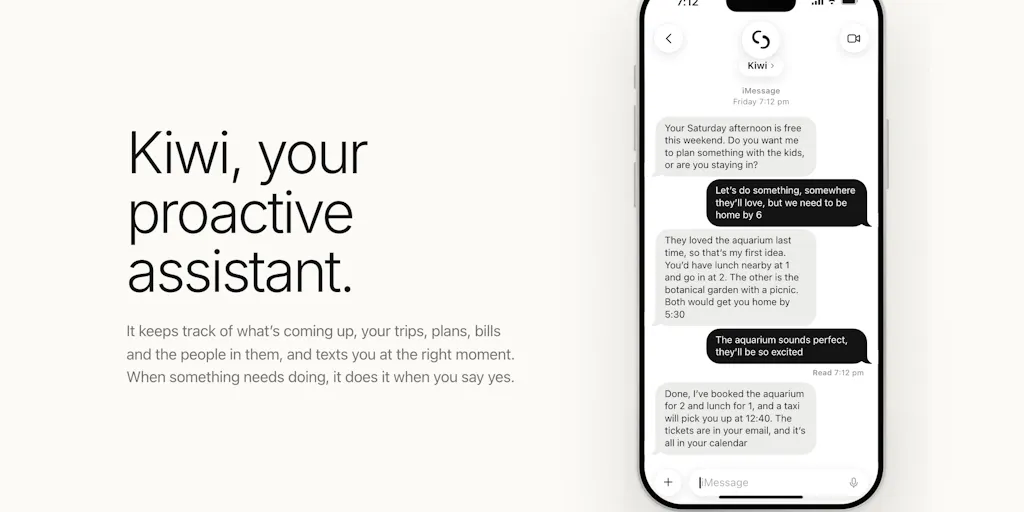
Most AI assistants are pull-based. You open a chat, you type a prompt, you get an answer. That model fails for operators because the bottleneck was never the answer — it was remembering to ask. Kiwi inverts the loop. Per the launch post, it monitors your email and calendar, watches for changes that alter your plans, and initiates contact: a delayed flight with an offer to book a taxi for the new arrival time, a parcel that needs a signature while you’re at the office with an offer to reschedule it to Saturday, a free Saturday afternoon with an offer to plan something. The maker’s framing is blunt: “Saying yes is the whole job.”
That’s a meaningful architectural claim, not a feature. The product does the checking across apps and websites, surfaces a decision with the price already shown, and only confirms a booking once the counterparty confirms it. The maker explicitly says it “always shows the price before booking, never types your card number, and never shows your passwords to an AI.” For anyone who has handed a virtual assistant their Amazon Seller Central credentials and regretted it, that constraint matters more than any feature list.
There’s also a hardware angle: the Kiwi Band, a screenless wristband that buzzes when Kiwi needs you and takes a tap or voice reply, free during the pilot. I’m skeptical of hardware in general, but the logic is coherent — if the point is to keep the phone in your pocket, a notification surface that isn’t a phone is the natural complement.
Why Amazon sellers should care more than Shopify ones
Shopify operators live in a browser tab and a Shopify admin they check reflexively. Amazon sellers live in a maze of Seller Central queues, case logs, and inbound shipment reconciliations where the failure mode isn’t “I forgot to look” — it’s “the thing changed and nobody told me.” A proactive layer that watches for state changes and pushes a one-tap decision is worth more in the Amazon context precisely because Amazon’s own notification surface is so noisy that operators learn to ignore it. The same logic applies to TikTok Shop seller centers and Temu supplier portals, where policy and compliance changes arrive as emails that get buried.
How it differs from the incumbents you’d actually compare it to
The honest comparison set isn’t Siri or Alexa. It’s three categories.
First, the horizontal assistants. Google Gemini and ChatGPT are extraordinarily capable and almost entirely reactive. You can build a proactive workflow on top of them with automations, but you’re the one wiring the triggers. Kiwi’s bet is that the trigger logic — what’s worth interrupting you for — is the product, and it should ship opinionated rather than configurable. The maker’s answer to a commenter asking how it decides what deserves a text is instructive: “A delayed flight always gets a text, because it changes your plans. Plans on a Saturday is more of a nice-to-have, so Kiwi only suggests something when it really fits.”
Second, the vertical ops tools. Klaxoon-style workflow tools, or for e-commerce specifically, the notification and task layers inside Helium 10, Jungle Scout, or a Klaviyo flow. These are excellent at telling you what happened inside their own silo. They are structurally incapable of telling you that your flight moved and therefore your factory visit should move too, because that fact lives in a different system entirely. Kiwi’s cross-app reach is the differentiator; its depth inside any one system is the trade-off.
Third, the browser-automation crowd. The “it books the tickets, lunch and the taxi” claim puts Kiwi adjacent to agentic browsing tools. The maker is refreshingly honest about the ceiling here: “some sites ask you to prove you’re human.” That single sentence is the most important line in the entire launch, and I’ll come back to it.
Where the math breaks
Kiwi’s model depends on a confirmation loop — it “only tells you something is booked once the company confirms it.” Good discipline. But confirmation latency is the hidden cost. If a booking takes four minutes of agentic browsing and you’re standing in a warehouse, the “one yes” isn’t one yes; it’s a yes followed by a wait followed by a possible failure. The product’s value collapses toward zero the moment you have to open the phone to check whether the thing actually happened. That’s not a knock on Kiwi specifically — it’s the structural problem with every proactive agent, and it’s why the confirmation-first design is the right call even if it makes the demo less magical.
What cross-border sellers can borrow from this
Three transferable lessons, in descending order of how fast you can act on them.
1. Interruption design is a real discipline. Kiwi’s comment thread is a masterclass in it. A user asks for quiet hours so a Saturday suggestion doesn’t land during a sleep-in; the maker says you can just text “don’t send me anything before 10 on weekends” and it sticks. Another asks whether dismissing a suggestion can suppress that category without killing important alerts; the answer is “stop suggesting restaurants” and it remembers, with an undo. Operators should steal this pattern wholesale for internal alerting. Your 3PL integration, your inventory alerting, your ad-spend anomaly pings — all of them should support natural-language suppression scoped to a category, with an undo, and a hard floor for genuinely critical events. Most seller tooling gives you a binary on/off and calls it preference management.
2. The “price before action” constraint is a governance model. The maker’s commitment that Kiwi shows the price before booking and never touches your card number is the right posture for any agent touching money. If you’re evaluating AI tooling for procurement, ad buying, or supplier payments this quarter, make “shows the number before committing, never stores the credential” a hard requirement in your evaluation. The vendors that can’t articulate this clearly are telling you something.
3. Proactivity beats dashboards for the long tail. The delayed-flight example resonated with commenters for a reason — it’s the canonical “I would have had to chase this myself” moment. Map your own operation for those moments: the inbound shipment that gets split, the returns window that’s about to close, the listing suppression that happens at 2am your time. Each is a candidate for a push decision rather than a dashboard you’ll check tomorrow.
The enterprise-email caveat is your integration warning
One commenter asked whether Kiwi handles work tasks. The maker’s answer: it has your email and calendar, it briefs you before meetings and flags emails needing replies — but “connecting your enterprise email sometimes works, sometimes doesn’t. It depends on your company’s IT settings.” That’s the honest version of a problem every cross-border team will hit. If your ops run on a shared inbox behind SSO and conditional access, most consumer-grade proactive agents will fail at the front door. Budget for this in any pilot: the integration friction, not the AI quality, is usually what kills adoption.
Where my judgment says it falls short
I like the thesis and I’m not yet convinced by the product’s scope. Three concerns.
The human-verification wall is not a footnote. “Some sites ask you to prove you’re human” is the maker’s own admission, and it’s the load-bearing failure mode for the entire promise. The moment a booking site throws a CAPTCHA, the “one yes” becomes “one yes, then a browser window, then a puzzle.” Proactive assistants will live or die on how many of their target actions survive anti-bot defenses — and the sites most relevant to operators (marketplace backends, carrier portals, supplier B2B systems) are exactly the ones most hostile to automation. I’d want to see a published list of what actually works end-to-end before trusting it with anything time-critical.
The consumer framing undersells the ops use case — or maybe correctly avoids it. Kiwi is pitched at personal life admin: flights, parcels, family plans. That’s a smart beachhead because the stakes are low and the tolerance for imperfection is high. But it means the product isn’t being built for the workflows I’d most want: multi-party coordination, audit trails, role-based access. If you’re a five-person DTC team, you don’t need a wristband; you need a shared decision log. Kiwi doesn’t claim to be that, and I shouldn’t fault it for not being something it isn’t — but operators reading this launch should be clear-eyed that they’re looking at a template, not a tool.
Hardware is a distraction risk. The Kiwi Band is free during the pilot, which is the right way to seed it, but screenless wearables have a long graveyard. I’d rather see the team pour that energy into the confirmation loop and the site-compatibility surface. The band is a nice story; the booking reliability is the business.
What the comment thread accidentally reveals
The best signal in any Product Hunt launch is what the maker answers unprompted. Here, the maker volunteered that iMessages stay private — “Kiwi only sees the messages you send to Kiwi itself” — while WhatsApp can be linked for plan-change detection. That’s a thoughtful privacy boundary and it’s the kind of thing operators should demand from any tool touching customer conversations. If you’re evaluating a WhatsApp Business API integration for CS this quarter, ask the vendor the same question: what exactly do you read, and what stays out of scope? The answers will separate the serious vendors from the ones hoping you won’t ask.
What I’d watch / test next
This week, do three things. First, run a personal two-week test of a proactive-assistant pattern — Kiwi if you can get into the pilot, or a hand-built equivalent using calendar and email triggers in Zapier — and log every interruption: was it worth it, did the action complete without you opening a browser, how long did confirmation take? That log is your spec for internal alerting. Second, audit your current seller tooling for interruption design: pick your three noisiest alerts and check whether they support category-level suppression with undo. If they don’t, that’s a line item in your next tooling review. Third, write down your own “delayed flight” list — the five state changes you currently chase manually — and ask each of your existing vendors whether they can push that event to you with a one-tap action. Most will say no. The ones that say yes are your integration priorities for the next two quarters.
The proactive assistant is coming to e-commerce ops whether or not Kiwi is the one that delivers it. The operators who win the next cycle won’t be the ones with the most dashboards — they’ll be the ones who taught their stack when to interrupt them, and made saying yes the whole job.