The back-office drag every seller knows too well
Cross-border e-commerce has spent a decade optimizing the customer-facing half of the funnel and almost none of it optimizing the operator-facing half. We will happily A/B test a hero image for three weeks, but the average seller still retypes the same supplier details, SKU specs, compliance answers, and brand boilerplate into a dozen portals a week — Amazon Seller Central cases, TikTok Shop onboarding forms, Temu supplier questionnaires, Etsy and eBay listing fields, freight forwarder intake sheets. It is invisible labor, it never shows up in a P&L line, and it is exactly the kind of work that AI is now good at. So when a Product Hunt launch quietly solves “stop retyping your own information into forms,” I pay attention — not because I want a job-hunting tool, but because the underlying pattern is the one cross-border operators keep failing to automate. Jobmate AI, built by David Herbert, is a job-search assistant. Read it as a design document for the seller back office and it gets a lot more interesting.
What Jobmate AI actually does — and why the mechanic travels
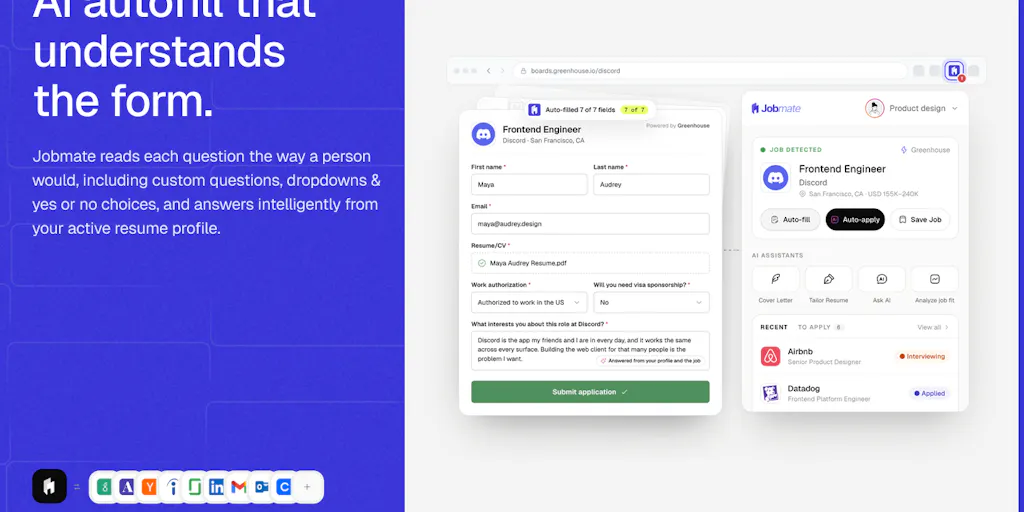
Strip away the job-search framing and the product is a form-filling and application-tracking engine with a human review gate. Per the maker’s own launch notes, it fills application forms from a stored profile, including free-text written questions, and shows every answer before it goes in; auto-apply can run applications end to end with optional per-application review; it pulls new roles from company career pages and job boards into a single feed; it tailors resumes and cover letters per role; it surfaces recruiters and hiring managers to contact; and it syncs applications and interviews from Google or Outlook Calendar. It runs on Chrome and Firefox, and you can start for free — pricing beyond that is not disclosed in the source.
Now map that onto a seller’s week. The “profile” is your brand fact sheet: legal entity, tax IDs, warehouse addresses, return policy, ingredient or material specs, certification numbers. The “forms” are supplier onboarding, marketplace applications, freight bookings, and compliance declarations. The “feed” is new marketplace programs, category invitations, and sourcing leads. The “tailoring” is per-channel listing copy and per-market compliance language. The “recruiter lookup” is finding the right category manager or vendor manager to email. The “tracker” is your open cases, applications, and disputes. Every one of those is a real, recurring, low-skill, high-error-rate task in a cross-border operation. Jobmate has simply productized the loop for individuals instead of companies.
Why Amazon sellers should care more than Shopify ones
A Shopify operator lives mostly inside one admin and a handful of apps; the surface area for repetitive data entry is narrow. An Amazon seller lives across Seller Central cases, brand registry, A+ content, compliance docs, and a support queue where every reply starts with restating the same ASIN and order context. Add TikTok Shop, Temu, SHEIN, Etsy, and eBay and the retyping multiplies. The more marketplaces you list on, the more Jobmate’s core mechanic — one canonical profile, many forms, review before submit — is worth stealing.
How it stacks up against the incumbents you’d actually compare it to
The honest comparison set is not other job tools. It is the automation layer you already pay for. Zapier and Make connect apps but choke on unstructured forms and free-text fields; they automate the plumbing, not the judgment. Browser autofill extensions handle name-and-address but not written answers or per-role tailoring. On the hiring side, LinkedIn Easy Apply and Indeed streamline their own walls but don’t touch the long tail of company career pages — which is precisely the fragmentation Jobmate targets. For sellers, the closest analogues are the AI listing tools like Helium 10 and the support-automation layers bolted onto Zendesk or Gorgias — strong inside one workflow, blind across the many portals a cross-border operator touches.
Jobmate’s differentiator is the review gate combined with cross-source aggregation. It is not trying to be the smartest writer; it is trying to be the reliable clerk that never forgets where an application stands. That is a defensible, unglamorous position — and it is the same position a seller-side “ops copilot” should occupy.
The review gate is the feature, not the compromise
One commenter on the launch, Saad El Gueddari, made the sharpest point: keeping AI review of written answers switched on matters because “the application still needs to sound like the person applying.” That is the whole ballgame for cross-border sellers too. Auto-submitted compliance answers, auto-generated listing claims, auto-filled customs values — these are exactly where a wrong field costs you a suspension or a seized shipment. Any tool that fills forms on your behalf must show you the answer before it submits. Jobmate bakes that in; most seller-side automation does not, and that is the gap I would hold vendors to.
What cross-border operators should borrow from this launch
Three transferable moves, in order of payoff. First, build a canonical brand-and-entity profile — one structured source of truth for every fact you retype — and force every tool and teammate to pull from it. Second, treat every portal as a form to be filled from that profile, with a mandatory human review step on anything free-text or compliance-adjacent. Third, aggregate your inbound opportunities (program invitations, sourcing leads, case updates) into one feed with status tracking, because the real cost is not the typing — it is losing track of where each thread stands. If you want a starting point, the Jobmate launch page is a clean spec for the loop; the maker’s Product Hunt profile is where he says he’ll be answering comments.
Where the math breaks
Jobmate is free to start, and pricing past that is not disclosed — which is fine for a consumer tool but a red flag for an ops team that needs per-seat, per-marketplace, and audit-log pricing before it can budget. A seller-side clone also has to handle multi-entity structures, multiple currencies, and localized compliance language, none of which a single-person job search demands. The mechanic travels; the data model does not travel for free.
Where my judgment says it falls short
It is early, and the maker says so. For a seller audience the gaps are structural: no mention of team accounts or approval chains, no audit trail for who submitted what, no marketplace-specific validation, and no indication of how it handles the CAPTCHAs and anti-bot walls that guard most supplier and marketplace portals. The job-board aggregation is only as good as its scrapers, and career pages are the easiest target — marketplace portals are far more hostile. None of this is a knock on a job tool; it is a warning against assuming a consumer-grade form-filler will survive contact with Seller Central.
What I’d watch / test next
This week, do the unglamorous audit: list every portal you retyped the same five facts into over the last 30 days, and count the minutes. Then build the canonical profile in a shared doc or a lightweight database and see how many of those portals you can feed from it manually before you buy any automation. Watch whether Jobmate ships team features and a visible audit log — that is the signal it could become an ops tool rather than a job tool. And pressure-test any vendor, including this one, on one question: does it show me the answer before it submits? If yes, it is worth a trial; if no, it is a liability dressed as a time-saver.