The Real Margin Killer in Cross-Border E-Commerce Isn’t Ad Spend — It’s the Copy-Paste Loop
Every cross-border operator I know runs the same invisible tax: the translation-and-rewrite loop. You draft a listing in your second language, paste it into a chat window, wait, copy the result back, then fix the tone by hand because the model flattened your brand voice. Multiply that by SKUs, marketplaces, and support macros, and you’ve quietly burned hours that should have gone into sourcing or creative. So when a solo developer ships a tool explicitly built to kill that loop — Jarq, from indie maker Birzhan Abishev — I pay attention, because the friction it targets is one every seller with a non-English-first team feels daily.
What Jarq Actually Solves (And Why the Framing Matters)
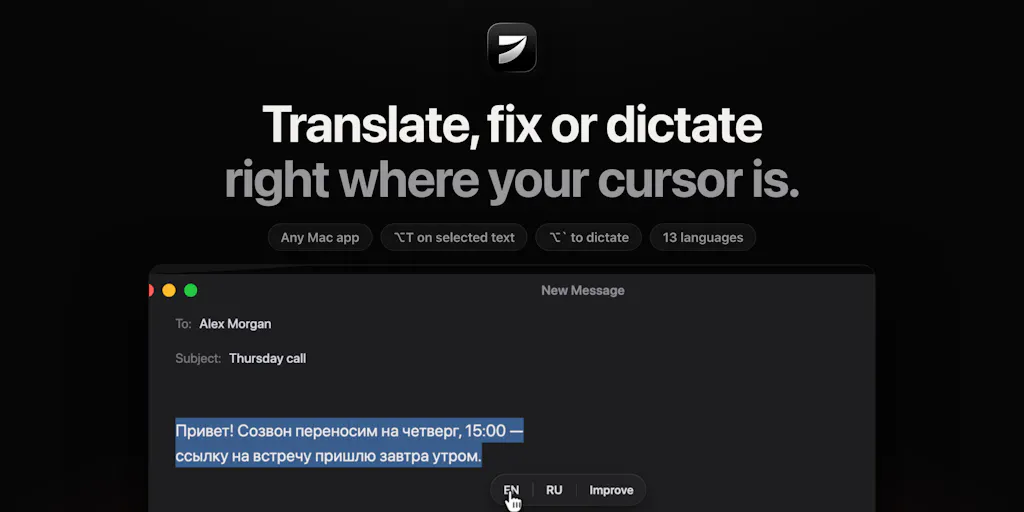
The pitch is deliberately narrow: select text in any Mac app, hit a hotkey, and the action happens at your cursor. Translate between any two of 13 languages, shorten/fix/rewrite in place, or dictate with ⌥` — speak one language, get punctuated text in another. No chat tab, no copy-paste round trip.
That last clause is the whole product thesis, and the maker says it plainly: Wispr Flow and Superwhisper are great at dictation, but Jarq is built around text actions, with translation as the core rather than an add-on. That’s a positioning decision worth studying, not just a feature list. Most “AI writing” tools in the e-commerce stack are destinations — you go to them. Jarq is ambient — it lives where the text already is.
For a seller, that distinction is not cosmetic. Your listing copy lives in Amazon Seller Central, your product descriptions live in Shopify admin, your supplier threads live in email, your ad copy lives in Meta Ads Manager. None of those are places you want to leave mid-task to go translate something.
Why Amazon sellers should care more than Shopify ones
Shopify operators usually write in one primary language and localize through an app or a translation vendor. Amazon FBA brand owners, by contrast, are often juggling five or six marketplaces — DE, FR, IT, ES, JP, MX — each with its own listing quality bar and keyword logic. If you’re a China-based or Eastern European seller writing English, German, and Japanese listings yourself, the per-SKU translation overhead is brutal. An in-place hotkey tool collapses that from a workflow into a reflex. That’s a bigger relative win for marketplace-native sellers than for DTC folks with a single storefront.
How It Differs From the Incumbents You’re Already Paying For
Let me be concrete about the comparison set, because “AI writing tool” is a useless category label.
Against DeepL and Google Translate. DeepL is still my default for raw translation quality on European language pairs, and it’s cheap. But it’s a destination — you paste into it. Jarq’s bet is that the context switch is the cost, not the translation itself. Whether that bet holds depends on quality parity, which the source doesn’t claim and I can’t verify.
Against ChatGPT and Claude in a browser tab. This is the real incumbent for most sellers. The maker’s own framing — and a commenter’s — nails it: people are tired of pasting stuff into a chat tab and pasting it back. If your team already has a ChatGPT workflow, Jarq is a latency play, not a capability play.
Against Wispr Flow and Superwhisper. These own dictation. Jarq concedes that ground and reframes around text actions. Smart, because competing head-on with entrenched dictation tools as a solo dev is a losing fight.
Against the e-commerce-native stack. Tools like Helium 10 or Klaviyo solve domain problems — keyword research, lifecycle email — not the generic “text on my screen right now” problem. Jarq is horizontal, which is both its strength (works everywhere) and its weakness (owned by no vertical).
Where the math breaks
The pricing is aggressive: free for 5 actions a day forever; Pro at $4.99/mo, $39/yr, or $200 lifetime, with a 14-day Pro trial and no card or account required. For a solo operator, the lifetime tier pays back in under a year against monthly. For a team of ten, you’re looking at $2,000 in one-time licenses versus a per-seat SaaS line item — which finance will either love or flag depending on how they model tooling.
But here’s where it breaks: it’s macOS 13+ on Apple Silicon only. If your ops team, your VA in the Philippines, or your sourcing agent in Shenzhen is on Windows, this is a non-starter. That single constraint disqualifies it for most distributed cross-border teams today. It’s a founder’s tool, not yet a team tool.
What Cross-Border Sellers Should Borrow From This
Forget whether you adopt Jarq. The product is a masterclass in a specific go-to-market move that sellers can steal for their own positioning.
1. Sell the removal of friction, not the feature. “Translate text” is a feature. “No copy-paste loop” is a felt pain. Your listings, your ads, your emails should name the friction your customer is currently tolerating, not the spec sheet of what you built.
2. Concede the crowded ground explicitly. The maker openly says Wispr Flow and Superwhisper are great at dictation — then pivots to where he wins. That’s confident positioning. Too many sellers try to claim they’re “the best at everything,” which reads as generic. Pick your one sharp edge.
3. Price for the solo operator first. Free tier, no account, no card, lifetime option. That’s a trust-building funnel for indie buyers who’ve been burned by subscription creep. If you sell software or services to other sellers, the no-account trial is a conversion lever worth testing.
4. Localize the workflow, not just the words. Jarq’s insight is that translation is an action, not a destination. If you’re building any internal tooling or SOPs for a multilingual team, ask whether you’re forcing context switches that could be eliminated.
The dictation question worth watching
A sharp commenter, Gal Dayan, raised the exact technical question I’d want answered before recommending this for real-time work: when you speak one language and it outputs another, does it wait for a pause to commit the translation, or stream and correct as you talk? That’s the difference between “magic” and “laggy” — and it’s the same question that determines whether voice is usable for live supplier calls, customer support, or just async note-taking. The source doesn’t answer it. Neither does the maker in the thread.
Where My Judgment Says It Falls Short
I want to be fair but honest, because my readers make tooling decisions with real money.
The privacy story is only half-reassuring. The maker states that Jarq uses cloud AI models like GPT and Whisper, doesn’t keep your text on its servers, and keeps your history on your Mac. That’s a reasonable posture — but “we don’t store it” is not the same as “it never leaves your machine,” and for sellers handling supplier contracts, pricing sheets, or unreleased product names, sending text to a third-party cloud is a real consideration. Not a dealbreaker, but not nothing.
Solo-dev bus factor. Birzhan is described as a designer and solo indie developer from Kazakhstan. That’s a beautiful origin story and often produces the sharpest tools. It also means if he gets a day job, your workflow dependency evaporates. For a $5/month personal tool, fine. For a team-wide dependency, I’d want a fallback.
No Windows, no team management, no integration layer. No admin seats, no shared glossaries, no brand-voice memory across a team. Those are exactly the features an e-commerce operator with a 20-person content team would need. Jarq is not that product yet — and may never be, by design.
The 13-language ceiling. For most cross-border sellers that’s plenty. But if you’re pushing into Thai, Vietnamese, or Arabic, verify coverage before you build a workflow on it.
What I’d Watch / Test Next
Concrete moves for this week, whether or not you install Jarq:
Test the friction thesis on yourself. For two days, log every time you leave a task to translate or rewrite something. If that number is high, the category is validated regardless of vendor — and you should evaluate Jarq against your current ChatGPT tab habit head-to-head.
Run a quality bake-off on your hardest language pair. Take five of your actual listing bullets in your worst-performing marketplace and run them through Jarq, DeepL, and your current process. Judge on brand voice retention, not just grammatical correctness.
Check your team’s OS reality first. If anyone on your content or support team is on Windows, this is a personal productivity toy for you, not a team rollout. Don’t buy seats you can’t deploy.
Watch the dictation streaming question. If the maker answers Gal Dayan’s question and it streams cleanly, voice-to-listing in a second language becomes genuinely interesting for supplier comms and support macros. If it waits for pauses, it’s async-only.
Pressure-test the lifetime tier. At $200 one-time, the payback math is obvious against monthly — but only if the tool survives two years. For a solo dev product, treat lifetime as a bet, not a bargain.