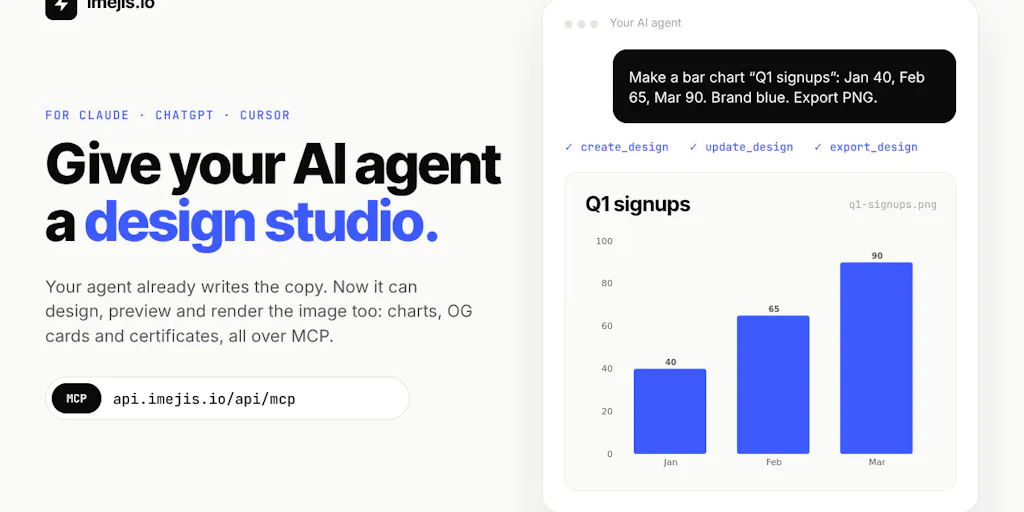
The render layer is where most cross-border creative stacks quietly fall apart
Cross-border sellers have spent two years wiring LLMs into listing copy, ad variants, and customer replies, and the results are now good enough that the bottleneck has moved. Ask an agent to write ten Amazon bullet points and it delivers. Ask it to produce the matching A+ module graphic, the TikTok Shop cover frame, the Shopify OG card, and the Etsy thumbnail — and you get a screenshot, a paragraph describing what the image should look like, or a diffusion render with a mangled logo and hallucinated SKU text. That gap between “agent can write anything” and “agent can ship a finished visual” is the real story behind imejis.io, a template-based image engine with an MCP server launched by twin brothers Dharmendra and Dharmik Jagodana. For anyone running multi-marketplace catalogs, this is less a novelty and more a missing piece of plumbing.
What imejis.io actually solves, stripped of launch-day framing
The core claim from the makers is narrow and specific: agents can create, edit, preview, and render real designs — OG images, social cards, certificates, QR codes, barcodes — plus 22 chart types including candlestick, treemap, sankey, funnel, and KPI tiles. You connect Claude, ChatGPT, or Cursor to the MCP endpoint at https://api.imejis.io/api/mcp, sign in once, and the agent gets a design tool rather than an image guesser.
The distinction that matters is stated plainly in the launch copy: “It’s a renderer, not a diffusion model. The same input gives the same pixels every time, so your fonts, logo and numbers come out right.” That single sentence is the whole thesis. Determinism is not a technical footnote — it is the difference between a tool an operator can put in a production pipeline and a toy that produces plausible-looking garbage you have to manually QA.
For sellers, the practical unit of work is the template. One template, one permanent render URL, and an image for every row of your data. That is the same mental model as a Shopify product page template applied to a feed: change the row, get a new image, no designer in the loop.
Why determinism is a compliance feature, not just a quality feature
Marketplaces have spent the last several years tightening rules around AI-generated imagery, misleading renders, and inaccurate product representation. A diffusion model that redraws your logo slightly differently every run is a liability in a listing image. A renderer that stamps the same font, same logo placement, and same number every time is auditable. If you have ever had a listing suppressed for an image that didn’t match the variation, you already understand why “same input, same pixels” is worth more than “more creative options.”
How it stacks up against what you’re probably already using
Most cross-border operators are not choosing between imejis.io and nothing. They are choosing between it and a pile of tools that each solve 60% of the problem.
Canva and its API layer. Canva is the default for social cards and ad creative, and its Connect APIs have gotten genuinely useful for programmatic design. But Canva’s automation story is still oriented around human-in-the-loop editing and brand templates, not agent-native rendering inside an MCP session. If your workflow is “marketer opens a doc and tweaks,” Canva wins. If your workflow is “agent generates 400 variant images from a CSV at 2am,” Canva is friction.
Bannerbear and similar render APIs. Bannerbear has been the quiet workhorse for programmatic image generation — OG images, social cards, dynamic certificates — for years, and it does the core job well. The difference is architectural: Bannerbear is a REST-first API you call from your own code. imejis.io’s bet is that the caller is increasingly an agent, not a developer, and that the MCP interface is the right abstraction for that world.
Helium 10, Jungle Scout, and the listing-optimization stack. These tools own keyword research, rank tracking, and listing audits. None of them render images. The reason to mention them here is that the natural integration point is obvious: a listing tool knows which keyword is underperforming, an agent knows how to rewrite the bullet, and now something needs to render the updated infographic. That last mile has been manual. Helium 10 and Jungle Scout are not competitors to imejis.io — they are upstream feeders.
Zapier, Make, and n8n. The makers note the same engine has a visual editor, a REST API, and integrations with Zapier, Make, and n8n. This is the pragmatic path for sellers who are not yet running agents but are already running automations. A new row in a Google Sheet triggers a render, the render URL lands in a Slack channel or a listing draft. That is a Tuesday-afternoon project, not a quarter-long build.
Image-generation models (Midjourney, DALL·E, Firefly). These are the tools the launch copy is implicitly arguing against. They are excellent at mood, terrible at typography, and structurally incapable of guaranteeing that your logo appears in the same spot with the same proportions across 50 SKUs. For hero lifestyle imagery, keep them. For anything with text, a logo, or a number, they are the wrong tool.
Why Amazon sellers should care more than Shopify ones
Shopify merchants have more creative latitude — a slightly off-brand OG image is annoying, not existential. Amazon sellers operate inside a rulebook where image requirements are explicit, variation families must be visually consistent, and a mismatched render can trigger suppression. The determinism argument lands harder on Amazon Seller Central than on a DTC storefront. The same logic applies to TikTok Shop and Temu, where feed-driven creative volume is high and consistency across variants is a ranking input, not just a brand nicety.
What cross-border operators can actually borrow from this launch
Even if you never touch imejis.io, three patterns in this launch are worth stealing for your own stack.
1. Treat templates as the unit of automation, not images. The launch’s most useful line for operators is “one template can make an image for every row of your data.” That is the correct abstraction for a catalog business. Stop thinking about generating an image and start thinking about defining a template once, then feeding it rows. Every marketplace you sell on — Etsy, eBay, SHEIN, Amazon — has a feed-shaped surface where this applies.
2. Separate the render layer from the generation layer. Diffusion for mood, rendering for anything with text. Most sellers currently blur these. Drawing the line explicitly will save you from a category of embarrassing listing images.
3. Wire agents to deterministic tools, not to other agents. The MCP pattern here — connect once, sign in once, let the agent call a real tool — is the right shape for a seller-side agent stack. Your agent should be calling a renderer, a feed API, and a pricing service, not hallucinating outputs and hoping.
Where the math breaks
The launch offers 100 free renders a month with no card required. That is a generous trial, but the number to watch is not the free tier — it is the marginal cost per render at catalog scale. A seller with 2,000 SKUs across four marketplaces, each needing three to five image variants refreshed quarterly, is looking at tens of thousands of renders a year. Whether that is a rounding error or a real line item depends entirely on pricing above the free tier, which is not disclosed in the launch copy. Before you architect anything around this, get that number.
There is also a real risk in the “permanent render URLs” promise. Permanent is a strong word. If a template changes, do old URLs re-render or freeze? If a font license lapses, what happens to embedded images? These are the questions that separate a launch-day demo from a production dependency, and they are not answered in the source material.
Where my judgment says it falls short
The launch is honest about being a two-person operation — the backend runs on the makers’ own buildbase.app, with Stripe for billing, Next.js on Vercel for the app, and Google Cloud for rendering at scale. That is a clean, modern stack, and shipping it as twins is genuinely impressive. It is also a concentration risk. If you are a seller with a nine-figure GMV catalog, betting your listing-image pipeline on a two-person team is a different decision than betting it on a company with an SLA and a status page.
Three specific gaps I would want closed before recommending this to a serious operator:
- No disclosed pricing above the free tier. The 100 renders/month figure is in the source; everything above it is not.
- No disclosed enterprise controls. SSO, audit logs, workspace permissions, and data residency are table stakes for a brand with multiple marketplace accounts and agency partners. The launch mentions “workspaces, multi-tenant infra” but does not detail governance features.
- No disclosed SLA or uptime history. For a render layer that sits inside your listing pipeline, this matters more than feature breadth.
The 22 chart types and the QR/barcode support are nice, but for most cross-border sellers those are secondary. The primary job is “render a consistent, on-brand image from a row of data, on demand, via an agent.” That is the job to evaluate.
What I’d watch / test next
This week, before you commit to anything: connect imejis.io to Claude or Cursor using the MCP endpoint, and run the exact test the makers suggest — “Make a 1200×630 OG image for my post ‘How MCP works’ with our logo top-left, and export it as PNG.” Then run it ten more times and diff the outputs byte-for-byte. If they are identical, the determinism claim holds and you can start scoping a real use case: a template that renders one listing image per SKU from a Google Sheet, triggered via Zapier or n8n. Measure two things — how long the template setup takes versus your current Canva workflow, and what the per-render cost looks like once you exceed the free tier. If the answers are favorable, this is worth a pilot on a single marketplace before you touch your Amazon catalog. If the pricing above 100 renders is opaque or the determinism claim fails under repeated runs, file it as interesting and move on.