Why a Mac-Only iMessage Bot Actually Matters for Cross-Border Sellers
Every cross-border operator I know has the same dirty secret: the most important customer conversations don’t happen in your helpdesk. They happen in WhatsApp, WeChat, Telegram, and yes, even iMessage — the channels where buyers actually live, not the ones where you’ve installed a widget. We spend fortunes on Zendesk and Gorgias to route tickets, then we personally answer “where is my package?” texts at 11pm because that’s where the relationship lives. So when I see a tool like GhostReply — an AI that learns your personal texting style and auto-replies to iMessage from your Mac Terminal — my first instinct isn’t “cute consumer toy.” It’s “what does this teach us about the next wave of conversational commerce?” Because the underlying insight is not about iMessage. It’s about the fact that the most intimate, high-converting channel in your entire stack is the one you’re manually operating, and the tooling to automate it without destroying the relationship is still primitive. GhostReply is a signal. Let me unpack why.
The Problem GhostReply Actually Solves: Contextual Voice, Not Just Automation
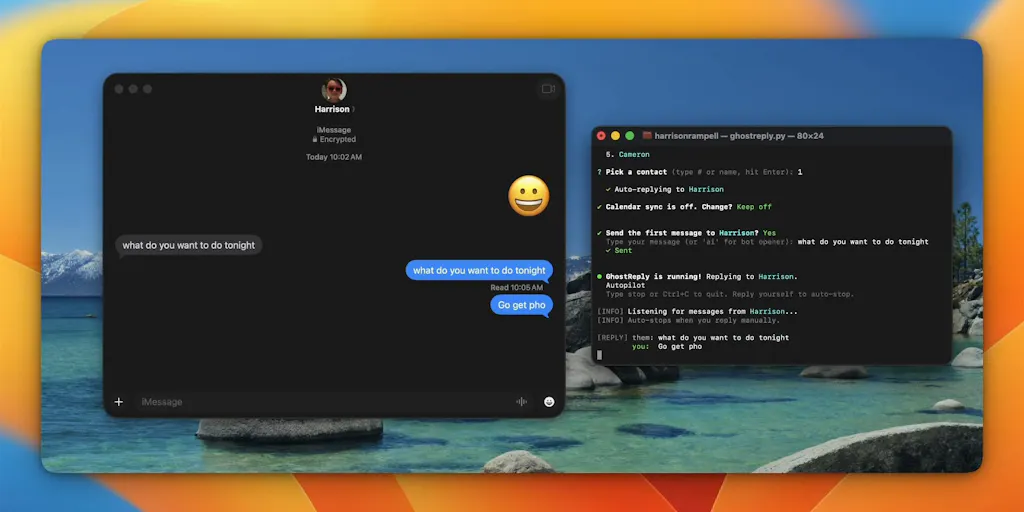
The maker, Harrison Rampell, frames GhostReply as a solution to a very specific annoyance: the small iMessage interruptions that break your flow. But read the launch description closely and you’ll see the real thesis. He didn’t build “AI that replies to your texts.” He built AI that reads your message history locally to learn how you text each person, then writes responses in your style. That’s a fundamentally different problem than what most AI SDR tools solve.
Most of the AI outreach tools I see pitched to sellers — the ones that plug into Apollo.io or Instantly — are built for scale. They blast 10,000 prospects with a “personalized” first line that mentions the prospect’s company name. The voice is uniform because the tool was built to sound like a brand, not like a human. GhostReply inverts that. It’s built for intimacy at the margin. It doesn’t want to sound like GhostReply. It wants to sound like you — specifically, the version of you that talks to your cousin versus the version that talks to your supplier.
For a cross-border seller, this distinction matters more than it might seem. Think about your Amazon Seller Central buyer-seller messaging thread. When a customer writes “Hey, is this gift-wrappable?” they’re not looking for a ticket number. They’re looking for the person they bought from. If you’re a solo operator or a small team, you are that person. And the moment you hand that conversation to a generic chatbot that says “Thank you for reaching out to our support team,” you’ve killed the trust that took twenty five-star reviews to build. GhostReply’s approach — learn the voice, then get out of the way when the human wants to step in — is the correct architecture for that problem. It’s not trying to replace you. It’s trying to handle the 80% of messages that are repetitive enough to be answered in your sleep, but personal enough that a canned response would feel like a betrayal.
Why Amazon Sellers Should Care More Than Shopify Ones
Here’s where I’ll be contrarian. The Shopify crowd — the DTC brands with a Klaviyo flow for everything — they have email and SMS automation figured out. They’ve got flows for abandoned carts, post-purchase surveys, win-backs. Their problem isn’t a lack of automation; it’s a surplus of it, and the resulting inbox fatigue. But Amazon sellers are in a different cage. On Amazon, you don’t own the customer relationship. You can’t email them after the sale. You can’t retarget them. Your only direct line is the buyer-seller messaging thread, which is clunky, monitored by Amazon, and time-limited.
For an Amazon FBA operator, the buyer-seller message thread is your only owned channel that isn’t mediated by the algorithm. And it’s the one channel where a human touch directly correlates with feedback and review rates. A generic auto-responder on Amazon feels like a trap. But a response that reads like it came from the actual person who packed your product? That’s the difference between a 4-star “as described” and a 5-star “the seller was so helpful.” GhostReply, or something like it, could theoretically be the bridge — a way to maintain a human voice in a channel where you can’t afford to be online 24⁄7. The challenge, of course, is that GhostReply is iMessage-only, and Amazon buyer-seller messaging doesn’t route to iMessage. But the principle — local, personal, style-matched AI — is exactly what Amazon sellers need and don’t have.
How GhostReply Differs from the Incumbent AI Reply Tools
To understand where GhostReply fits, you have to look at the two incumbent approaches to AI messaging that a cross-border seller would already know.
First, there’s the ChatGPT / Claude “copy-paste” approach. You get a message, you copy it into a prompt, you ask for a draft, you paste it back. It works, but it’s manual, it breaks your flow, and the output is generic unless you spend time engineering a persona prompt. The second approach is the “full auto-pilot” assistant like Motion or Reclaim.ai — but those are scheduling tools, not messaging tools. The closest real competitor might be something like TextExpander for snippets, but that’s not AI — it’s just canned text that still requires you to trigger it.
GhostReply sits in a different quadrant. It’s autonomous (it watches for new messages and writes responses), but it’s constrained (you choose the contacts and reply mode, and it gets out of the way if you reply manually). The launch notes that the biggest change in this release is hosted AI — the earlier version required users to bring their own AI API key, but now you can install it with one command, try 10 replies free, and start without creating any external AI account. That’s a significant UX shift. It moves GhostReply from “tool for developers who are comfortable with API keys” to “tool for normal humans who just want it to work.”
The other differentiator is the local-first setup. GhostReply runs in Terminal on macOS and reads your message history locally to learn your style. That’s a privacy architecture that matters. Most AI tools in this space are cloud-first — your messages go to a server, get processed, and come back. GhostReply’s local reading means your message history isn’t being uploaded to train some model. For a cross-border seller dealing with supplier pricing, customs numbers, and possibly sensitive customer data, that’s not a trivial feature. That’s a compliance feature.
Where the Math Breaks: The iMessage-Only Constraint
Here’s where I have to be honest about the limitations. GhostReply is iMessage-only, and it’s Mac-only, and it runs in Terminal. That’s a very specific sandbox. For the cross-border seller reading this, the immediate question is: what’s the ROI of setting up a Terminal-based AI for a channel that only works with other Apple users?
The math is tough. Your customers are on WhatsApp (huge in Europe and Latin America), WeChat (mandatory for China), and Telegram (popular in Eastern Europe and parts of Asia). iMessage penetration is highest in the US, but even there, it’s split between iPhone and Android users. So GhostReply, in its current form, is a tool for a US-centric, Apple-to-Apple conversation. That’s a small slice of the cross-border pie.
But here’s the thing — the architecture is what’s interesting. The idea of a locally-run, style-matching AI that handles a specific messaging channel without a subscription fee (the maker notes “no subscription”) is a template. If someone builds the same thing for WhatsApp Business API, or for Shopify Inbox, or for the Etsy messaging system, the cross-border application becomes immediately obvious. GhostReply is the proof-of-concept that the “personal AI receptionist” can be built cheaply, locally, and without a monthly SaaS tax. The fact that it’s iMessage-only right now is a feature for the maker (keeps it simple) but a bug for the global operator.
What Cross-Border Sellers Can Borrow from GhostReply’s Approach
Even if you never install GhostReply, there are three operational lessons worth stealing.
Lesson one: Voice is a feature, not a vibe. GhostReply’s core innovation isn’t the AI — it’s the style matching. It reads your history to learn how you text each person. That’s a level of personalization that most CRM tools don’t offer. For a cross-border seller, this translates to a simple audit: when you reply to a customer in Germany versus a supplier in Vietnam, does your tone change appropriately? Most sellers use the same template for everyone, which is a mistake. The German customer wants precision and directness. The Vietnamese supplier wants politeness and relationship maintenance. Your AI tools — if you use them — need to be able to distinguish between those contexts. GhostReply’s per-contact learning model is the right idea, even if the implementation is limited to iMessage.
Lesson two: Local-first is a selling point you should steal. GhostReply reads your message history locally. It doesn’t upload your data to a cloud server. In an era where every SaaS tool wants to ingest your data, this is a differentiator. For cross-border sellers, this is critical when handling supplier contracts, bank details, or customer PII. If you’re evaluating AI tools for your operation, ask the vendor: where does the data live? Is it used for training? Can you delete it? The GhostReply approach — local processing, no external AI account required — is the gold standard for privacy-sensitive operations. More tools should follow this path.
Lesson three: “Get out of the way” is the best feature. The maker notes that if you reply manually, GhostReply gets out of the way. That’s a design philosophy that most automation tools violate. They want to be the center of attention. They want to intercept every interaction. But the best AI tools are the ones that know when not to act. For a cross-border seller, this is the difference between an AI that handles the “where is my order” messages while you sleep, and an AI that tries to negotiate a bulk discount with a supplier and accidentally commits you to a 10,000-unit order. Automation should have an off-switch, and it should defer to the human when the human is present. GhostReply’s manual-reply override is the model.
The Tooling Stack Takeaway: This Is a Template, Not a Product
If I’m being brutally honest about my judgment here, GhostReply as a standalone product is a niche utility. It’s for a specific type of user: a Mac-owning, iMessage-heavy, privacy-conscious individual who gets too many texts and wants an AI receptionist that doesn’t sound like a robot. That’s a real use case, but it’s not a cross-border commerce use case.
What is a cross-border commerce use case is the underlying template. The stack is: local data reading + style-matched AI + manual override + no subscription. That combination is exactly what’s missing from the current crop of cross-border customer service tools. The incumbents — think Zendesk with its AI agents, or Intercom with its Fin bot — are powerful, but they’re built for scale, not for intimacy. They’re built for brands that want to deflect tickets, not for operators who want to build relationships. GhostReply’s approach is the opposite. It’s built for one person, one Mac, one messaging app. And it works precisely because it’s small.
For the seller reading this, the question isn’t “should I buy GhostReply?” It’s “who’s going to build the GhostReply for WhatsApp Business?” Because that’s the tool I’d actually pay for. A locally-run, style-matching AI that handles my supplier chats in Chinese and my customer chats in English, that learns my tone for each contact, that gets out of the way when I’m online, and that doesn’t charge me a monthly fee per seat — that’s a tool that would change my operation. GhostReply is the proof it can be done.
Where My Judgment Says It Falls Short
I’ve been generous with the architecture, so let me be equally clear about the gaps.
The platform risk is real. GhostReply runs in Terminal on macOS and relies on iMessage. Both of those are controlled by Apple. If Apple changes the iMessage API, or tightens the sandbox, or decides to build this feature natively (which they absolutely could — Siri is right there), GhostReply is dead. As a cross-border seller, you know platform risk intimately. You know what happens when Amazon changes a policy or when TikTok Shop shifts its algorithm. Building your customer communication strategy on a third-party tool that depends on a closed platform is risky. The maker has mitigated this by making it local and free, but the fundamental dependency remains.
The “no subscription” model is a double-edged sword. On one hand, it’s great for users — no recurring cost, no account to manage. On the other hand, it means the maker has no recurring revenue to fund ongoing development, support, or Apple API compliance. This is a passion project, not a business. For a cross-border seller, that means you can’t rely on it for mission-critical communication. If the maker gets bored or busy, the tool stops getting updated, and you’re left with a broken Terminal script. The “try 10 replies free” model suggests a path to monetization, but it’s not clear what happens after the 10 free replies — is it a one-time purchase? A donation? Not disclosed in the launch. That uncertainty is a red flag for enterprise use.
The tone-matching has a ceiling. GhostReply learns from your message history. That’s great if you’re a clear, consistent writer. But if you’re a seller who communicates in multiple languages, or if your tone shifts based on context (formal with suppliers, casual with customers), the AI might struggle to match the right register for the right contact. The launch notes that it learns “how you text each person,” which suggests per-contact models, but the accuracy of that matching is unproven. AI style-matching is still an emerging field, and the risk of the AI sounding almost like you but slightly off is real. In a customer service context, “almost right” can be worse than “clearly automated” because it feels uncanny.
What I’d Watch / Test Next
Here’s what I’d do this week if I were a cross-border operator reading this.
First, install GhostReply on a spare Mac and test it with a personal iMessage account — not your business one. The free 10 replies are enough to evaluate the tone-matching quality. Send yourself a few messages in your typical customer-service voice and see if the AI replicates it. If it does, you’ve validated the concept. If it doesn’t, you’ve saved yourself from a bad investment. The Product Hunt page has 82 reviews and no written reviews yet, so you’d genuinely be one of the first to test it.
Second, audit your own messaging channels for “voice leakage.” Go through your last 20 customer service replies across Amazon, Shopify, and Etsy. Ask yourself: does this sound like a human, or does it sound like a template? If it sounds like a template, that’s your opportunity. The GhostReply approach — style-matched, context-aware, human-deferring — is the bar you should hold your own customer service to, whether you use AI or not.
Third, watch the WhatsApp and Telegram API spaces for a GhostReply clone. If a developer builds a locally-run, style-matching AI for WhatsApp Business, that’s the tool that will actually move the needle for cross-border sellers. When you see it, test it immediately. GhostReply has proven the concept is viable. The next version, on the right platform, is the one worth paying for.