The retro Mac music player that accidentally teaches cross-border sellers how to build a moat
Every few weeks a Product Hunt launch lands in my feed that has nothing to do with e-commerce, and yet I forward it to three operators before lunch. GhostDeck is one of those. On paper it’s a niche macOS music player with a pixel font and low-poly album art — irrelevant to anyone running Shopify storefronts or Amazon FBA brands. In practice, it’s a masterclass in the exact positioning problem most DTC and marketplace sellers get wrong: how to be deliberately small in a category dominated by giants, and how to turn that smallness into a defensible moat instead of a growth ceiling. If you’ve ever watched your Helium 10 keyword list get cloned by fifteen identical suppliers in Shenzhen, this launch is worth ten minutes of your attention.
What GhostDeck actually is, and why the framing matters
GhostDeck is a native macOS music player built by independent maker Djordje Janjic. Version 1.1, announced on the Product Hunt forum, shipped as a free update to existing buyers and added FLAC tag and embedded cover support, gapless album playback, and a low power mode. The app is a one-time purchase on the Mac App Store — no subscription — and the whole thing weighs in at roughly 12 MB.
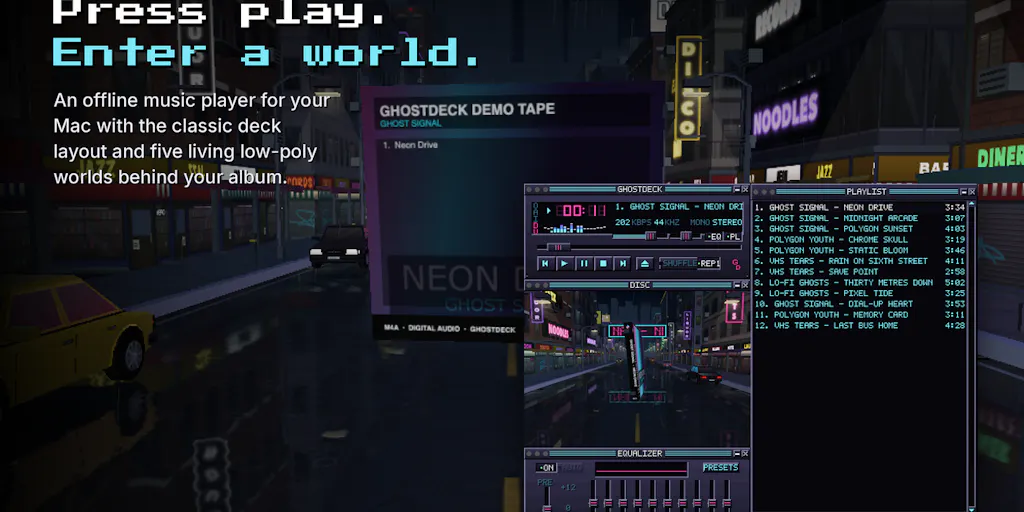
The pitch is nostalgia. The maker describes building “the player I wanted” after finding that every Mac player he tried was “either a huge library manager or a list with a play button.” The UI is a classic deck layout: a main deck, a ten-band EQ, and a playlist as separate windows that dock together magnetically, with a pixel font throughout. There’s also a 3D pane where the album cover becomes a jewel case rotating over one of five low-poly worlds — synthwave, a moonlit forest, dunes with a chrome skull, a rainy neon city, and a deep sea — each of which reskins the deck. Under the hood it’s native Swift with a hand-written Metal renderer, no engine and no web view. The maker is explicit that “almost everything is generated on your Mac at launch,” there is no account, no analytics, and no network access at all. Version 1.1’s feature list came directly from r/macapps feedback, and classic .wsz skin support is next on the roadmap.
Now strip away the nostalgia and look at what’s actually being sold: a deliberate refusal to compete on the axis the category is defined by.
Why this matters more to Amazon sellers than to Shopify ones
If you run a Shopify DTC brand, you already have some permission to be weird. You own the storefront, the email list, the brand voice. If you sell on Amazon Seller Central, you are renting shelf space in a search engine that rewards undifferentiated listings with more undifferentiated traffic. The natural gravity of Amazon is toward sameness: same hero image conventions, same A+ module layouts, same keyword-stuffed titles. GhostDeck is a reminder that “the category leader’s feature list” is not a strategy — it’s a checklist that every competitor also has. The sellers who escape the FBA race-to-the-bottom are the ones who pick one axis the incumbents are structurally unable to compete on, and then go all-in on it.
For a music player, that axis is “no network access, no account, no analytics.” For an Amazon brand, it might be “assembled in a country the category leaders don’t source from,” or “a refill model the category leaders can’t retrofit without cannibalizing their own SKUs,” or “a sizing system that assumes a body shape the incumbents ignore.” The point isn’t the specific axis. The point is that the axis has to be one the incumbent would have to blow up their own business model to copy.
How it differs from the incumbents — and where the comparison gets uncomfortable
The obvious competitors in the macOS music player category are Spotify, Apple Music, and VLC. Each of them is enormous, each is optimized for a different job, and none of them can credibly become GhostDeck without abandoning the thing that makes them money.
Spotify and Apple Music are streaming services first. Their business model depends on you not owning files — on you renting access, on the catalog being the product, on telemetry feeding recommendation engines. A “no account, no analytics, no network access” player is the exact opposite of their strategic direction. VLC is closer in spirit — open source, local files, no account — but VLC is a Swiss Army knife. It plays everything, it’s ugly on purpose, and it has no opinion about aesthetics. GhostDeck’s bet is that there’s a segment of file-owning Mac users who want VLC’s local-first ethos wrapped in something they actually enjoy looking at.
This is the same structural gap that exists in almost every consumer category. There’s the giant (optimized for scale), and there’s the utility player (optimized for coverage), and there’s usually a gap in the middle for “the version of this that respects the user’s taste.” Cross-border sellers live in that gap whether they realize it or not.
Where the math breaks
Here’s the uncomfortable part. GhostDeck’s positioning is beautiful and its addressable market is small. Mac-only, file-owning, FLAC-collecting, nostalgia-receptive, willing-to-pay-once users is a segment measured in the tens of thousands globally, not the millions. The maker has effectively traded TAM for defensibility, and that trade only works if the unit economics support it.
For a one-time-purchase app on the Mac App Store, Apple takes its standard commission, there’s no recurring revenue, and the only growth lever is word of mouth plus whatever discovery the App Store algorithm provides. That’s a hard business. It’s also, notably, the same math that kills most “premium, no-subscription” DTC brands: no LTV expansion, no subscription flywheel, every new customer has to be bought or earned from scratch. If you’re a cross-border operator reading this and thinking “I want to be the GhostDeck of my category,” you need to be honest about whether your category has enough file-owning Mac users to sustain the model — or whether you’re going to need a subscription, a refill, or a consumable to make the math work.
What cross-border sellers can actually borrow from this launch
Three things, in order of how quickly you can apply them.
First: the “no X” positioning frame. GhostDeck’s most powerful marketing line is what it doesn’t do. No account. No analytics. No network access. No subscription. Each “no” is a filter that attracts exactly the customer who’s been burned by the category’s default behavior. If you sell anything in a category where customers feel surveilled, upsold, or locked in — supplements, pet food, kids’ toys, home security, anything with a subscription option — try writing your listing copy as a list of things you refuse to do. It’s cheap to test and it cuts through the sameness of Amazon search results faster than another round of A+ image tweaking.
Second: the feedback loop as a feature roadmap. The maker is explicit that version 1.1’s features “came straight from r/macapps feedback.” That’s not a growth hack, it’s a product discipline. Cross-border sellers tend to treat reviews as a reputation problem to be managed rather than a roadmap to be mined. The next time you pull your Amazon review data or your Klaviyo post-purchase survey responses, sort by “what did they ask for that we don’t sell” instead of “what did they complain about.” The former is your v2. The latter is just noise.
Third: the aesthetic as moat. GhostDeck’s low-poly worlds and pixel font are not decoration — they’re the reason a customer chooses it over a technically superior free alternative. In cross-border e-commerce, aesthetics are usually treated as a cost center (better photography, better packaging) rather than a strategic asset. But the sellers who win in crowded categories — think of the brands that turned mundane categories like water bottles or dog leashes into lifestyle objects — understand that visual identity is one of the few things a Shenzhen copycat can’t replicate in a week. They can copy your specs. They can’t copy the taste that made someone choose you.
Why this matters more for TikTok Shop than for Etsy
The channel you sell on changes how much of this applies. On Etsy, aesthetic differentiation is table stakes — the whole platform is built around it. On TikTok Shop, aesthetics are compressed into a three-second hook and the algorithm decides whether anyone sees it. The GhostDeck playbook — deliberate smallness, refusal-based positioning, feedback-driven roadmap — translates best to channels where the customer is actively choosing between options and has time to read. That’s Amazon, Shopify, and to a lesser extent eBay. It translates worst to impulse-driven feeds where the only thing that matters is the first frame.
Where my judgment says this falls short
I want to be fair to GhostDeck because I think the positioning is genuinely smart, but I also think the launch narrative papers over two real problems.
The first is the “no network access” claim as a moat. It’s a moat today because the incumbents can’t match it without breaking their business models. But it’s also a moat that only appeals to a shrinking segment. File-owning music listeners are aging, and the next generation of Mac users has never bought an MP3. GhostDeck’s addressable market is not just small — it’s structurally declining. That’s fine if the maker is building a lifestyle business. It’s fatal if he’s building a venture-scale company.
The second is the one-time-purchase model. The maker is right that no subscription is a differentiator in 2025, and I respect the conviction. But one-time purchase plus Mac-only plus a declining niche is three constraints stacked on top of each other, and the only escape hatch is raising the price. GhostDeck’s current price isn’t disclosed in the launch thread, which is itself a tell — if the price were a selling point, it would be in the copy. My guess is the app is priced to be an impulse buy, and that’s a mistake given the positioning. A customer who cares enough about FLAC tags and no-analytics to seek this out is not price-sensitive. Charging $8 instead of $3 doesn’t lose you meaningful volume, and it doubles your revenue per user. That’s the same lesson cross-border sellers learn when they finally stop racing to the bottom on price and start pricing for the customer they actually want.
The subscription trap, and how to avoid it
Here’s the nuance I’d push back on: the maker frames “no subscription” as unambiguously good, and for the customer it is. For the business, it’s a choice with consequences. Cross-border sellers who’ve moved from one-time purchases to subscriptions — supplements, coffee, razors, pet food — know that the subscription is what makes the unit economics work at scale. The question isn’t “subscription good or bad.” The question is “does my category have a natural replenishment cycle, and if so, am I capturing it?” GhostDeck doesn’t, which is why no-subscription is the right call for GhostDeck. If you sell anything consumable, no-subscription is probably the wrong call for you, no matter how much your customers say they hate subscriptions.
What I’d watch / test next
Three concrete things an operator can do this week, in order of effort.
One: Open your top three competitor listings on Amazon and write down every feature they lead with. Then write down every feature they don’t have — the “no X” list. If any of those gaps map to a real customer frustration you’ve seen in reviews or support tickets, that’s your next listing test. Run it as an A+ module or a bullet-point rewrite before you touch the product.
Two: Pull your last 90 days of Klaviyo post-purchase survey responses or Amazon review text and tag every comment as either “complaint” or “request.” Count them. If requests outnumber complaints by more than 2:1, you have a roadmap hiding in your inbox and you’re ignoring it. If complaints dominate, you have an operations problem and no amount of positioning will fix it.
Three: Look at your pricing one more time. If you’re the cheapest option in your category, you are almost certainly leaving money on the table, and you are almost certainly attracting the customers who will churn, return, and leave one-star reviews. GhostDeck’s maker hasn’t disclosed his price, but the fact that it’s a one-time purchase on a niche Mac app suggests he’s underpriced. Don’t make the same mistake. Raise your price 15% on your best-selling SKU for 30 days and measure what actually happens to conversion. Most sellers who try this are surprised by how little it moves — and how much it improves everything downstream.