Why a Terminal-Based Document Tool Matters More to Your Supply Chain Than to Your Marketing Team
Every cross-border operator I know is drowning in the same paradox: we’ve automated the hell out of acquisition, but the documents that actually move money — supplier agreements, compliance checklists, freight quotes, Amazon appeal letters — are still static PDFs that go stale the moment they’re sent. You email a supplier a revised packing spec, they work off the old version for three weeks, and suddenly your FBA inbound is sitting in a warehouse in Long Beach with a customs hold. The problem isn’t that documents are hard to create anymore; it’s that they’re dead on arrival. They can’t answer questions, they can’t update themselves, and they definitely can’t tell you whether the person on the other end actually read the part about the new carton labeling requirement.
That’s why the launch of FluidDocs caught my attention — not because of the CLI gimmick, but because the underlying idea attacks a real operational pain: documents that keep working after you hit send. The company, FluidDocs, has been building interactive HTML documents for a while, and this new command-line interface is aimed squarely at the coding agents and automation workflows that are increasingly running the back office of modern e-commerce operations. If you’re a DTC brand running on Shopify or a private-label seller managing a dozen suppliers on Amazon, you should care less about the terminal and more about what this represents: documents as software, not as files.
The Document Is No Longer the Deliverable — the Answer Is
Here’s the core shift that matters for cross-border sellers: the value of a document used to be in its creation, but now the value is in its retrieval and interrogation. When you send a 40-page supplier agreement to a factory in Shenzhen, you don’t want them to read all 40 pages — you want them to find the clause about defect rates and payment terms without calling you at 2 a.m. Beijing time. FluidDocs turns that static document into something that can answer questions directly, which is a meaningful upgrade over the status quo.
The maker’s launch post makes a compelling point: more than half of the 1,000+ documents created on the platform were generated programmatically by coding agents working through their MCP, not by humans clicking in the app. That’s a signal. Your competitors are already using AI agents to draft supplier communications, product listings, and compliance paperwork. The question is whether those agents can also publish and maintain those documents in a way that keeps them live and interactive.
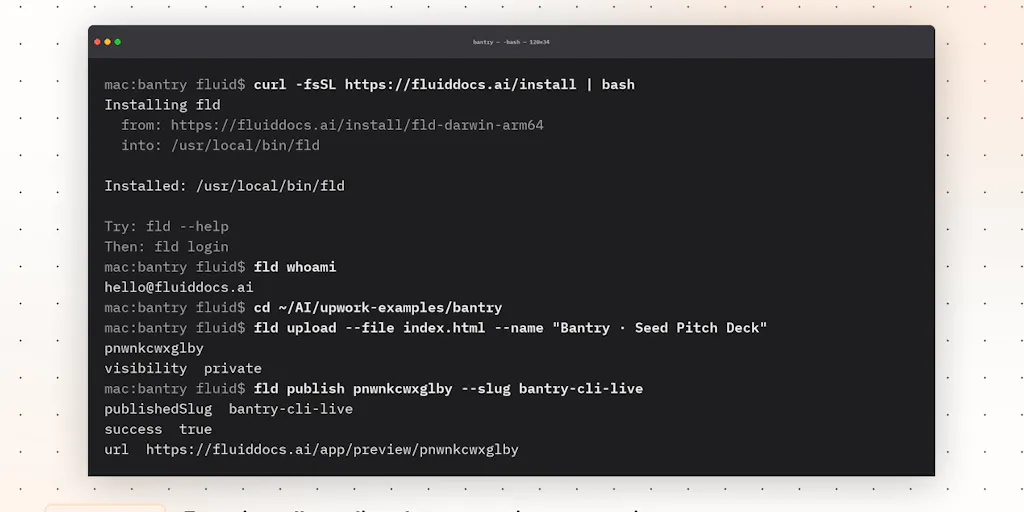
The CLI itself is straightforward: one line installs fld, and from there you can publish a file, a zip, or a whole directory as an interactive document, turn on reader Q&A, pull reader analytics back into the terminal, and edit the live document later with the same link updating. Every command supports --json output, which means your coding agent can run the entire flow unattended. For an operator who’s already using tools like Claude or other AI coding assistants to automate parts of the business, this is a workflow that slots into what you’re already doing.
But let’s be honest about what most cross-border sellers should take from this: the interactive document concept is the real innovation, and the CLI is just the distribution mechanism. The demo they point to — a SpaceX S-1 filing that you can ask questions against at https://share.fluiddocs.ai/spacex-s1 — is a great illustration. A 300-page static document becomes something you can interrogate. Now imagine that applied to your own vendor manuals, your Amazon compliance playbooks, or your international shipping guidelines.
Why Amazon Sellers Should Care More Than Shopify Ones
Shopify brand owners typically have fewer documents that need to stay live. Their world is product pages, email flows, and ads — all of which already have dashboards and analytics. Amazon sellers, on the other hand, live in a world of policy updates, appeal letters, and compliance documentation. Amazon changes its requirements constantly, and the difference between a suspended listing and a thriving one often comes down to whether your documentation is current and whether you can prove it to a support agent who doesn’t want to read a 30-page PDF.
The “same link updates” feature alone — which one commenter on the Product Hunt page flagged as a fix for wrong-version situations — is worth more to an Amazon operator than to almost anyone else. When you’re managing multiple SKUs across multiple marketplaces, version control on supplier specs and compliance documents is not a nice-to-have; it’s the difference between a clean FBA inbound and a pallet that gets rejected at the warehouse for a labeling error that was corrected in v3 but you accidentally sent v2.
How This Differs From the Incumbents You’re Probably Already Using
The obvious comparison is to the document tools you already have in your stack. Google Docs gives you collaboration but not interactivity. Notion gives you structure but not a clean way to share with external partners who don’t want to learn another app. Dropbox and Google Drive are just file storage — they don’t answer questions or track whether anyone actually opened your file.
The closer comparison is to the AI document Q&A tools that have been popping up, like ChatPDF or AskYourPDF. Those tools let you upload a PDF and ask questions against it, but they’re a one-way street: you upload, you interrogate, you’re done. FluidDocs is different because the document itself becomes the interface. The reader doesn’t need to go to a separate tool; they just ask questions in the document’s own Q&A interface, and the publisher gets analytics on who opened it, how far they got, and what they asked.
That analytics piece is underappreciated. In cross-border operations, knowing that your supplier opened the compliance document and asked a question about the new labeling requirement is actionable intelligence. It tells you where the friction is, what’s confusing, and where you need to follow up. No static document can give you that.
There’s also the question of the web app versus the CLI. The maker confirmed in the comments that there’s a full web app at https://fluiddocs.ai — the CLI is just one way to use it. That’s smart positioning. The terminal is for the automation crowd, and the web app is for everyone else. A commenter asked whether clients need an account to ask questions, and the answer was clear: no signup required, the link just works in the browser. For cross-border sellers dealing with overseas suppliers who won’t create an account for anything, that’s a critical detail.
What Cross-Border Sellers Can Borrow From This — Even If You Never Touch a Terminal
You don’t need to install the CLI to steal the ideas here. The broader lesson is about making your operational documents interactive and measurable. Start with the documents that cause the most friction in your business: supplier agreements, compliance checklists, freight forwarding instructions, and return policy explanations. If you can turn those into documents that answer questions and report back on reader behavior, you’ll reduce the back-and-forth that eats your team’s time.
The workflow that one of the makers described in the Product Hunt comments is particularly clever: using Claude Code plus the CLI to get the questions users have asked on a document’s Q&A chat, then using those questions to improve the document itself. That’s a feedback loop that static documents simply cannot provide. You learn what your suppliers or partners don’t understand by seeing what they ask, and then you fix the document so the next reader doesn’t have the same question.
For operators who are already using AI agents to handle parts of their workflow — whether that’s drafting supplier emails, generating Amazon listing copy, or summarizing competitor pricing — the CLI’s --json output and unattended operation mean you can build document publishing into your existing automation. Your agent can draft a compliance update, publish it as a FluidDoc, and push the link to your supplier list without any human intervention. That’s the kind of end-to-end automation that separates operators who scale from operators who stay stuck in manual processes.
Where the Math Breaks
Let me be the contrarian here. The pricing model is not disclosed on the launch page, and for a cross-border operator running on thin margins, that’s a real consideration. If the per-document or per-seat cost is too high, the analytics and interactivity might not justify the expense when you’re sending dozens of documents a week to suppliers who might not even engage with the Q&A feature. The value proposition depends entirely on whether your recipients actually use the interactive features. If you send a FluidDoc to a supplier who opens it once and never asks a question, you’re paying for analytics you don’t need and interactivity that goes unused.
There’s also the question of adoption inertia. Your suppliers and partners have workflows built around PDFs and email attachments. Getting them to click a link and engage with an interactive document is a behavioral change, and behavioral changes are slow in cross-border trade. The tool is elegant, but it’s fighting against decades of “just send me the PDF” habits.
My Judgment: Promising, But It’s a Workflow Tool, Not a Strategy
Here’s where I land: FluidDocs is not going to transform your business by itself, but it’s a sign of where document management is heading, and the operators who adopt this kind of tooling early will have an operational edge. The CLI launch is aimed at the automation crowd, and if you’re not already using coding agents in your workflow, the CLI itself is probably not for you — the web app is the entry point.
The bigger opportunity is to rethink your document strategy entirely. Stop treating documents as static files that you send and forget. Start treating them as assets that can answer questions, report on engagement, and improve themselves based on reader behavior. That’s a mindset shift that applies whether you use FluidDocs, build something similar in-house, or wait for the incumbents like Google and Notion to catch up.
The SpaceX S-1 demo is a nice showcase, but the real test is whether this works in the messy, low-tech world of cross-border trade. Can you get a factory manager in Dongguan to ask questions about your quality control document? Can you get a freight forwarder in Rotterdam to engage with an interactive bill of lading? If FluidDocs can crack that, it’s genuinely valuable. If not, it’s a tool for pitch decks and internal documentation — useful, but not the operational game-changer it could be.
What I’d Watch / Test Next
This week, take two concrete steps. First, go to https://share.fluiddocs.ai/spacex-s1 and ask it a few questions that you’d normally have to search through a long PDF to answer. Get a feel for the reader experience — this is what your suppliers would see, and you need to judge whether it’s simple enough for them to use without hand-holding.
Second, if you have a document that causes recurring friction — your Amazon compliance checklist, your supplier quality agreement, your freight forwarding instructions — try publishing it on https://fluiddocs.ai and send the link to one or two partners. Watch the analytics. See if they ask questions, and more importantly, see what those questions are. That feedback is gold, regardless of whether you stick with FluidDocs or apply the same logic to your existing tools.
The operators who win in cross-border e-commerce over the next few years won’t be the ones with the best products or the best ads — it’ll be the ones with the most efficient operations. And efficiency in operations increasingly means automation, feedback loops, and documents that work as hard as the people who send them. FluidDocs is an early example of that future. Whether it’s the tool you end up using is less important than whether you start thinking in that direction.