The “Messy Is the Product” Thesis — and Why It Should Bother Every Cross-Border Operator
Most cross-border sellers I know are running a losing race toward polish. Every listing photo gets retouched, every UGC clip gets cut to a 15-second hook, every ad creative gets A/B tested into oblivion — and the result is a feed of interchangeable, frictionless sameness that converts worse every quarter. So when a tiny indie app launches with the explicit pitch that the fumble is the feature, I pay attention, because it’s the same argument I’ve been making to DTC founders for two years: authenticity now outranks production value. Flipcorder is a $4.99 one-time iPhone app from solo maker Matt Brewer that turns your phone into a 1991 camcorder — 20-second flips, no editing, one dated tape per day, VHS or MiniDV export. On its face it has nothing to do with Amazon FBA or Shopify. On a second look, it’s a masterclass in constraint design, pricing psychology, and launch mechanics that cross-border operators should be stealing this week.
What Flipcorder Actually Solves (and What It Doesn’t)
Strip away the nostalgia and Flipcorder is a friction-removal tool disguised as a toy. Brewer’s stated problem is that “we have lost so much chasing perfection for social media, that the messiness of a camcorder is appealing and comforting.” That’s the whole thesis, and it’s the same one behind the resurgence of BeReal-style formats, lo-fi UGC, and the “shot on iPhone, unedited” creative briefs that now dominate TikTok Shop affiliate programs.
Mechanically, the app does four things:
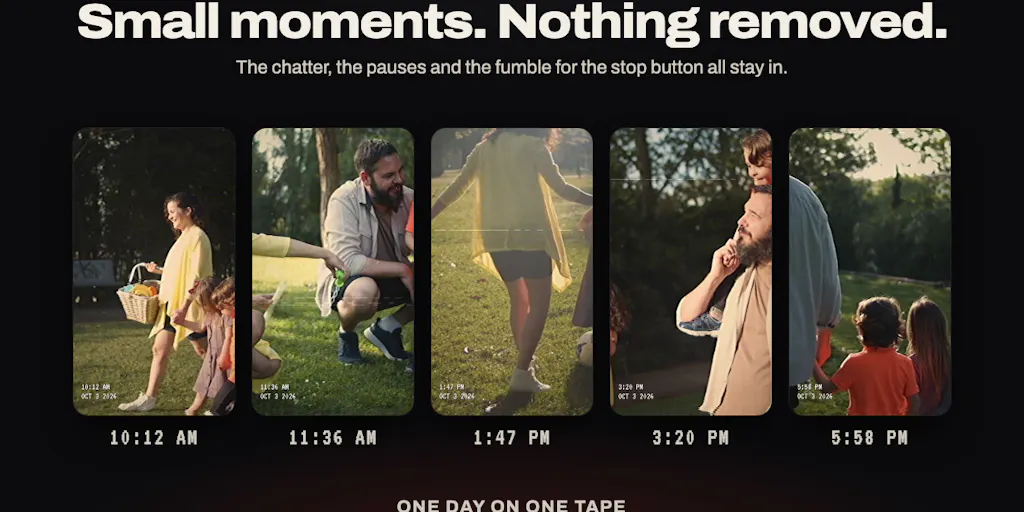
- 20-second flips by default, all landing on a single dated tape for the day. The day boundary is tied to midnight in your timezone and travels with you across timezones — a detail Brewer confirmed in the comments when asked whether the tape ends at midnight or a custom cutoff.
- No editing whatsoever. You can’t reorder clips, drop a bad take, or trim the pause where you fumbled for the stop button. Brewer is explicit that “there is no way to remove a flip or re-order things, that’s the entire point.”
- Look applied at export, not capture. Footage records and stores at 1080p on-device; the VHS or MiniDV grade is rendered only when you export the tape, so you can change the look later.
- Hardware-aware UX on the new foldable. Built around iPhone Duo: closed, the outer screen shows a lens cap; open it and the cap “comes off”; fully open, your subject sees themselves on the outer screen with a red REC light. On every other iPhone running iOS 26 or later, a glowing POWER key substitutes.
The commercial model is the part that should make SaaS-brained operators wince: $4.99 once, no subscription, no ads, no watermarks, no account required, and tapes stay on-device unless you share them. Brewer also shipped v1.1.0 with stickers, home-screen widget streaks, and in-app seasonal events — the kind of retention scaffolding most indie apps charge $9.99/month for.
Where the math breaks
Here’s my first skeptical note. A one-time $4.99 price with no subscription is a beautiful consumer story and a brutal business story. To sustain development, Brewer needs either enormous volume or a paid upgrade later — and he’s already hinted at “a lot planned.” The risk is the classic indie trap: build goodwill on a one-time price, then alienate the base when v2 needs recurring revenue. For cross-border operators, the lesson isn’t “copy the price.” It’s that one-time pricing works brilliantly as a launch wedge and poorly as a growth engine — which is exactly why so many DTC brands now run a hero SKU at near-cost and monetize the subscription replenishment behind it.
How It Differs From the Incumbents You’d Actually Compare It To
The obvious comparison set is messy, because Flipcorder sits at the intersection of three categories that don’t usually share a shelf.
Against mainstream camera apps like Apple’s native Camera and Instagram Stories: those optimize for immediacy and distribution, not artifact. Flipcorder optimizes for the artifact — a dated tape you keep. That’s a different job.
Against retro-filter apps like VSCO or the various 8mm/VHS filter packs on the App Store: those are post-production tools. You shoot clean, then grade. Flipcorder inverts it — the constraint happens at capture, and the grade is a rendering choice at export. That inversion is the product.
Against social-first video tools like CapCut and TikTok’s native editor: those are editing suites with a social graph attached. Flipcorder deliberately has neither. Brewer’s whole bet is that removing the edit bay and the feed produces something the edit bay and the feed can’t.
Against journaling and memory apps like Day One: closest in spirit, furthest in form. Day One wants text and structure; Flipcorder wants 20-second fragments and zero structure.
The honest positioning is: Flipcorder is a capture-constraint product, not a creation product. That’s a small category, and small categories are where indie apps either find a cult or die quietly. The #3 Top Paid Photo & Video ranking in the US App Store over launch weekend suggests the cult is forming.
What Cross-Border Sellers Should Steal From This Launch
This is where the essay earns its keep. Four transferable plays, in order of how fast you can deploy them.
1. Sell the constraint, not the capability
Every Flipcorder talking point is a limit: 20 seconds, no editing, one tape per day, midnight cutoff. Brewer even told a commenter he hopes “people enjoy the 20 second limit per ‘flip’” and that the constraint “removes the pressure to be perfect.” Cross-border sellers spend all their creative energy listing capabilities — 12 colorways, 6 sizes, 40 features. The Flipcorder lesson is to name the constraint and make it the promise. A skincare brand that says “one ingredient, one job” is doing Flipcorder math. A luggage brand that says “carry-on only, forever” is doing Flipcorder math. Constraints are memorable; capabilities are forgettable.
2. Price for the wedge, not the lifetime
The $4.99 one-time price is a wedge. It removes the subscription objection entirely at the moment of purchase, which is exactly what a cold-traffic TikTok Shop or Amazon listing needs. The cross-border translation: your first-purchase SKU should be priced to remove friction, not to maximize margin. Bundle the margin into replenishment, accessories, or the second order. This is standard DTC practice, but indie launches like this one show how aggressively you can push it without destroying perceived value — Brewer’s “no ads, no watermarks, no account needed” list is essentially a trust-building price fence.
3. Treat launch day as a community event, not a press release
Brewer did three things on launch day that most cross-border brands botch:
- He answered every substantive comment with a real answer, including admitting he “hadn’t given much thought” to custom day boundaries. That honesty is a conversion asset.
- He dropped five free redeem codes in the comments with a simple social contract: reply with which code you took so the next person doesn’t waste time. One commenter, Greg Alonso, did exactly that.
- He shipped a v1.1.0 within days of launch, with stickers, widget streaks, and seasonal events. Momentum compounds.
For a cross-border seller, the analog is a launch-week playbook: seed codes to your best affiliates, run a live Q&A on the platform where your buyers actually are, and ship a visible product update inside the first seven days so the algorithm and the audience both see motion. Shopify merchants can replicate the code-drop mechanic with discount codes and a public comment thread; Amazon Seller Central sellers can approximate it with a Vine or influencer seeding push plus a fast listing refresh.
4. Build for the hardware cycle, not against it
Flipcorder was built around iPhone Duo on the weekend it launched. That’s an operator’s instinct: ride the new device’s novelty while it’s still novel. Cross-border sellers who ignore hardware cycles — new phone form factors, new wearable categories, new smart-home protocols — leave free traffic on the table. The moment a new device ships, there’s a search-demand spike and an accessory-demand spike. Be the listing that’s already there.
Why Amazon sellers should care more than Shopify ones
Shopify operators already live in a world of creative differentiation, so the “authenticity” lesson is familiar. Amazon FBA sellers live in a world of commoditized listings and review-driven trust, which makes the Flipcorder playbook more urgent, not less. The constraint framing (“one tape per day”) maps directly onto the Amazon A+ content and bullet-point discipline that separates converting listings from dead ones. The code-drop mechanic maps onto review seeding and influencer programs. And the fast-iteration habit maps onto listing refresh cadence — the sellers who update images and copy every few weeks consistently outperform the set-and-forget crowd. If you’re running Helium 10 or Jungle Scout for research, add a calendar reminder for “creative refresh” the same way you have one for “reorder.”
Where My Judgment Says It Falls Short
Three honest reservations.
First, the retention question is unresolved. Streaks on a home-screen widget and seasonal stickers are good starts, but the core loop — film a flip, watch the tape at night — depends on a daily habit that most people won’t sustain past week two. Brewer’s own framing (“removes the pressure to be perfect”) is a double-edged sword: low pressure also means low urgency. Compare to BeReal, which solved urgency with a synchronized daily notification window. Flipcorder has no such forcing function. The widget streaks are a nudge, not a trigger.
Second, the export-only grading is a smart technical choice with a UX cost. Because the look is applied at render, the “tape” you watch in-app and the file you share may not match what you previewed. Brewer says you can change the look whenever you like, which is flexible — but it also means the artifact isn’t fixed until you decide it is. For a product whose entire promise is “authentic, unedited, done,” that’s a small philosophical inconsistency.
Third, the one-time price caps the roadmap. “A lot planned” is exciting until you realize the unit economics of $4.99 one-time don’t fund a team. Either Brewer keeps it a solo project forever, or he introduces a paid upgrade that risks the goodwill he’s building now. Neither is fatal; both are worth watching.
Where the cross-border analogy breaks
Don’t over-index on the nostalgia. Flipcorder’s appeal is partly cultural — VHS and MiniDV are Western millennial touchstones. A cross-border seller targeting Southeast Asia or Latin America can’t assume the same reference frame. The principle (constraint as promise, authenticity as differentiator) travels; the aesthetic (1991 camcorder) does not. Localize the principle, not the skin.
What I’d Watch / Test Next
Three concrete moves for this week.
Test a constraint-led listing. Pick one SKU and rewrite the top three bullets around a single limit — “one ingredient,” “one size,” “one job” — and measure conversion against the control for 14 days. If constraint framing wins, roll it across the catalog. If it loses, you’ve learned something cheap.
Run a launch-week code drop. Seed 5–10 discount codes to your best affiliates or a public community thread with the same social contract Brewer used: claim one, reply which. Track redemption rate and, more importantly, the comment-to-purchase path. This is a Klaviyo flow waiting to happen.
Schedule a creative refresh inside seven days of any launch. Whatever you ship this month — a new bundle, a new market, a new ad angle — put a calendar block for day seven to ship a visible v1.1. Momentum is a mechanic, not a mood.
And if you want to see the playbook in its purest form, download Flipcorder for $4.99 and film your next product unboxing on it. The tape will be messier than your agency’s cut. It’ll probably convert better.