Why a MacBook Notch Utility Is Actually a Masterclass in Cross-Border Product Thinking
Here’s the thing that should grab every cross-border seller’s attention about Fide Island, a new macOS utility that turns the MacBook notch into an interactive command center: it’s not the code, the features, or even the design that matters most. It’s the positioning. In a market where we’re all fighting for attention on Amazon, TikTok Shop, or Shopify, this app demonstrates a fundamental truth about product-market fit that transcends software: you don’t win by building the most feature-rich product; you win by owning a specific, underserved piece of real estate—whether that’s a customer’s desktop or a search results page. For sellers drowning in the race to the bottom on price, Fide Island is a reminder that the moat is often in the perception of utility, not the utility itself. Let’s break down what this launch tells us about differentiation, pricing, and the brutal reality of customer acquisition in 2024.
The Problem: It’s Not About the Notch, It’s About Context Switching
The creator, Sergey Murzak, identifies a pain point that every knowledge worker—and by extension, every e-commerce operator—feels acutely: the cost of context switching. He notes that for tiny tasks like a quick calculation or a currency conversion, he’d have to open Calculator, switch to a browser, or jump between apps. For a cross-border seller, this isn’t just an annoyance; it’s a tax on your most valuable asset: your attention. When you’re juggling Amazon Seller Central, a Shopify dashboard, and a TikTok Shop analytics page, every second spent alt-tabbing is a second not spent on optimizing your ad spend or your listing.
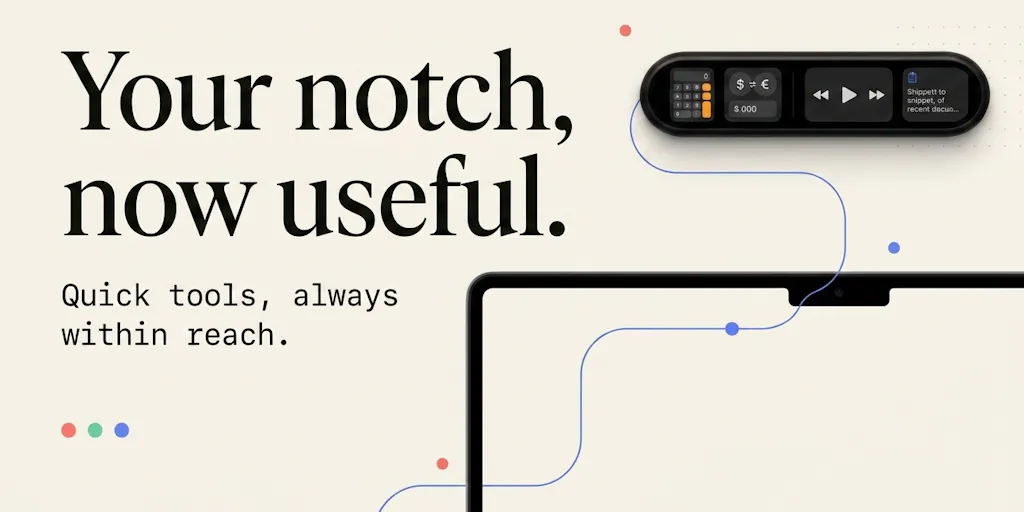
Fide Island is built on the thesis that the MacBook’s notch—often dismissed as a hardware limitation—is prime, always-visible UI space. Instead of letting it sit idle, the app turns it into a utility dock for quick calculations, currency conversions, media controls, calendar events, and clipboard history. The core value proposition isn’t the individual features; it’s the elimination of friction. For an operator running a global brand, that friction is multiplied by the number of tools you touch daily. The app is essentially a productivity hack for your operating system, and it’s a compelling argument for why we should be looking for friction points in our own workflows, not just in our customers’ shopping journeys.
Why This Feels Familiar: The “Helium 10” of Desktop Utilities
The comparison to the e-commerce tooling stack is almost too easy. We use Helium 10 or Jungle Scout to consolidate keyword research, product tracking, and niche analysis into one dashboard. We use Klaviyo to centralize our email and SMS marketing. The value of these platforms isn’t that they do one thing exceptionally well; it’s that they aggregate multiple workflows into a single context, reducing the cognitive load of switching between tabs. Fide Island is trying to do the same thing for the macOS environment. It’s a micro-SaaS play that understands the value of a “command center” mentality, even if the command center is just a few hundred pixels wide.
How It Differs: Polish, Price, and the “Everyday Utility” Play
The Product Hunt comments reveal a crowded market. One commenter, Gal Dayan, points out that notch utilities are a crowded lane, counting “at least 3-4 similar apps on this same page.” This is the classic “Red Ocean” scenario that Amazon sellers know all too well—a saturated niche where everyone is selling the same thing. So how does Fide Island differentiate? The maker’s response is telling: “a polished UI, a very accessible price, and small but genuinely useful features you can use every day.”
This is a masterclass in a differentiation strategy that doesn’t rely on a single “killer feature.” It’s a combination of:
- Perceived Quality: The “polished UI” is a signal of professionalism. On Amazon, this is your main image and your A+ content. On the Mac App Store, it’s the design language.
- Pricing Strategy: “A very accessible price” is a low-barrier-to-entry tactic. This is the same logic behind loss leaders or budget-friendly versions of expensive tools. It’s easier to get a user to try a $2 app than a $20 one.
- Frequency of Use: The focus on “everyday” features ensures the app is top-of-mind. It’s the difference between a product you buy once for a specific problem and a product you integrate into your daily routine.
This is a direct contrast to incumbents that might offer a free version with limited features or a more complex, feature-heavy (and expensive) suite. Fide Island is betting that for a utility, simplicity and immediacy are the true value drivers.
The “Apple” Comparison: Dynamic Island vs. the MacBook Notch
The maker explicitly states his inspiration: “When Apple introduced Dynamic Island on iPhone, I loved the idea of turning a hardware limitation into something useful and interactive.” This is a crucial point. Apple’s Dynamic Island is a hardware feature that was designed to be interactive. The MacBook notch, on the other hand, is a camera housing that protrudes into the display. The creator is essentially creating a third-party solution to a problem Apple hasn’t fully addressed. This is a lesson in opportunism. For sellers, this is akin to finding a product gap that the big brands have ignored. It’s about looking at the “notch”—the awkward, ignored space in your market—and asking, “What can I build there?”
What Cross-Border Sellers Can Borrow: The “Glanceable” Data Principle
The most actionable takeaway from Fide Island isn’t for your product development; it’s for your daily operations. One commenter, Lisa from Softorino, asks a brilliant question: “a glanceable progress bar up there would earn its spot.” She’s talking about file transfers, but the principle applies directly to e-commerce.
We are drowning in data. Sales figures, ad spend, inventory levels, shipping times, customer reviews. The problem isn’t a lack of data; it’s the attention required to parse it. The future of e-commerce operations isn’t more complex dashboards; it’s glanceable information. Imagine a world where your MacBook notch or a similar peripheral displays your real-time Amazon sales rank, your ad budget burn rate, or a critical inventory alert without you having to open a single app. That’s the “progress bar” for our industry.
This concept is already being explored in the SaaS world. Tools like Lifx or other smart-home devices can be programmed to change color based on sales thresholds, but the desktop is still an underutilized surface. Fide Island is a nudge toward building or adopting tools that surface critical data at the periphery of our vision, allowing us to stay in a flow state while still keeping a pulse on the business.
Where the Math Breaks: The Cold Start Problem and Trust
For all its clever positioning, Fide Island has a significant hurdle that mirrors the challenges of launching a new product on a marketplace: the cold start problem. The most telling comment in the thread is from Soumyadip Banerjee, who says, “Unfortunately, I couldn’t install it on my mac as it flagged for malicious files.”
This is a trust issue, and it’s a killer. The maker’s response is transparent: the app isn’t signed or notarized by Apple because he doesn’t have a Developer Account. For a tech-savvy Product Hunt audience, this is a minor inconvenience—a simple right-click and “Open Anyway.” But for the broader market, a “malicious file” warning is an immediate deal-breaker. It’s the digital equivalent of a product arriving with a broken seal or a listing with a low rating. The “math” of conversion breaks down because the perceived risk outweighs the perceived value.
This is a critical lesson for cross-border sellers. Your product can be the best on the market, but if your listing has spelling errors, your brand registry isn’t complete, or your reviews are full of complaints about shipping, you’re triggering the same “malicious file” warning in the customer’s brain. Trust is the ultimate conversion rate optimizer, and it’s built on a foundation of seemingly small details: Amazon Seller Central account health, Shopify store SSL certificates, and clear, honest return policies.
Why Amazon Sellers Should Care More Than Shopify Ones
There’s a distinct difference in how this applies to sellers on different platforms. For a Shopify DTC brand, the “notch” is your checkout page. It’s the space between “Add to Cart” and “Order Complete.” The friction here is high—abandoned carts are the bane of our existence. A tool like Fide Island, or the philosophy behind it, could be applied to creating a “glanceable” checkout that shows progress, guarantees, and trust badges without requiring a page load.
However, for an Amazon FBA seller, the “notch” is the entire Amazon product page. You have less control. The “glanceable” data for you is your PPC campaign performance or your inventory levels. The lesson here is less about UI and more about operational efficiency. You can’t change the Amazon interface, but you can change your own interface with the platform. Tools that aggregate your seller central data into a clean, at-a-glance dashboard are your Fide Island. The need for a “command center” is more acute for Amazon sellers because the platform is a black box—you need your own tools to see what’s happening. The launch of Fide Island, while a consumer app, highlights the ongoing need for operator-focused dashboards that reduce the cognitive load of managing a complex business.
The Verdict: A Niche Utility with a Big Idea
Fide Island is not going to revolutionize e-commerce. But it’s a perfect case study in product thinking. It finds a piece of dead space and asks, “What if?” It doesn’t try to replace your browser or your calculator; it just tries to make them one step closer.
Where it falls short is in the execution layer of trust and distribution. The lack of notarization is a significant barrier that will cap its growth in the short term. The “crowded lane” comment is also a warning—without a truly unique feature, it risks being a “me-too” product that gets lost in the shuffle, much like a generic product on Amazon that doesn’t have a clear differentiator.
But the *idea*—the idea of reducing friction, of making the essential glanceable, of turning a limitation into an asset—is spot on. It’s the same idea that drives the best DTC brands, the best Amazon listings, and the best marketing campaigns. It’s about respecting the user’s time and attention.
What I’d Watch / Test Next
As an operator, I’m not going to buy Fide Island to manage my Amazon store. But I am going to steal its core principles. Here are three concrete steps you can take this week:
Audit Your Own “Notch”: Spend 30 minutes identifying the top five tasks you do daily that require switching between tabs or apps. Are you checking inventory in one tab, ad spend in another, and email in a third? This is your operational friction. Look for a tool that consolidates this, or if you’re technical, consider building a simple dashboard. The goal is to reduce the number of “alt-tabs” per task by 50%.
Test the “Glanceable” Principle: Sign up for a service that offers real-time alerts via desktop notification or a simple dashboard widget. For example, set up a Google Alert for your brand name or a notification in Helium 10 for keyword rank changes. The point is to get critical data to the periphery of your attention without a full context switch. Start with one metric—like a price drop on a key competitor—and see how it changes your response time.
Analyze Your Product’s “Trust Bar”: Take a hard look at your product listings or storefront. What is the first “malicious file” warning you’re giving customers? Is it a slow-loading page? A confusing return policy? A lack of social proof? Fix one thing this week that adds a layer of trust—whether it’s adding a video review to your product page or clarifying your shipping times from China. The goal is to remove any friction between interest and conversion.
The next big win in e-commerce won’t come from a magical new ad platform or a fulfillment hack. It will come from the small, invisible efficiencies we build into our own workflows—and the trust we build into every pixel of our customer’s experience. Fide Island is a small piece of software, but it’s a big reminder of that truth.