Why a YC-Backed Procurement Tool Matters More to Your Supply Chain Than to Your Finance Team
I’ve spent the last six years watching cross-border operators burn cash on the back end because procurement scales like a tumor. You find a supplier on Alibaba, negotiate pricing in WhatsApp, email a PDF purchase order to an agent in Shenzhen, then wait while an accounts payable intern manually matches that PDF against an invoice sent weeks later. Every platform—Amazon, Shopify, TikTok Shop—has a different vendor onboarding form, and none of them talk to each other. The result? Lost units, duplicate orders, and chargebacks that eat 3–5 % of gross margin. When I saw Saldor on Product Hunt, I didn’t see a finance tool. I saw a supply-chain-ops wedge that, if it works, could finally automate the mess of buying inventory from 20 different manufacturers across three continents. The core thesis: procurement is still stuck in 1999, and the AI-native approach that Saldor is building out of Y Combinator could cut the procurement cycle from weeks to hours for the kind of complex, multi-step purchases that define cross-border sourcing.
What Problem Saldor Actually Solves (and Why You Should Care)
The launch post from maker Jacob Bland nails the friction: “Buying something at a company is rarely as simple as placing an order.” He describes the chain—request, procurement checks, finance review, legal, PO creation, vendor follow-up, invoice matching—that many companies still manage through email and spreadsheets. If that sounds familiar, you’ve probably run the same gauntlet when ordering custom packaging from a factory in Vietnam or booking a 40-foot container from a freight forwarder in Ningbo. The problem is worse for cross-border sellers because the stakeholders are distributed across time zones, languages, and trust networks.
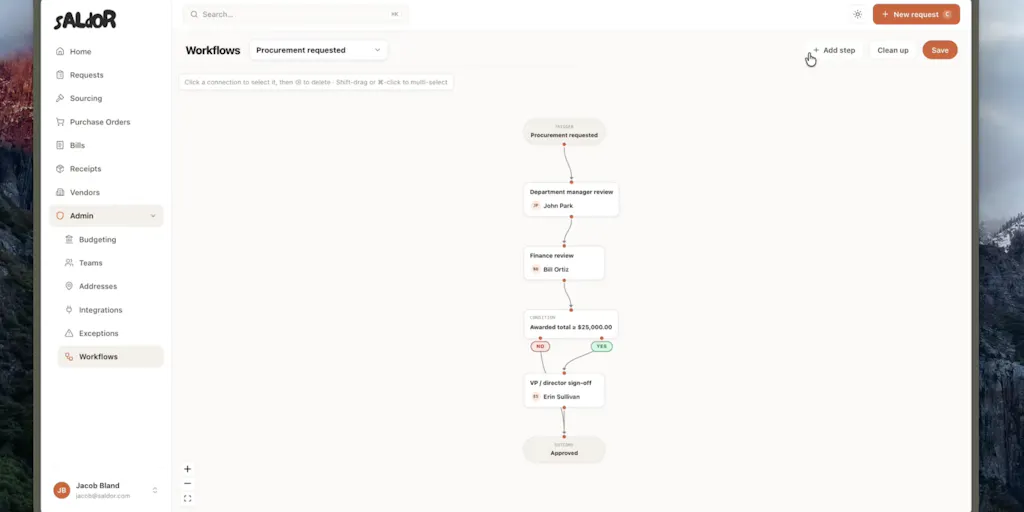
Saldor claims to replace that process with a hands-free email and calendar interface, plus an AI agent that can pull purchase requests from Slack or Claude Code. The agent checks policy, routes approvals, generates POs, and eventually matches invoices to orders automatically. For a DTC operator buying 10,000 units of a new SKU from a supplier you’ve never worked with before, that’s the difference between a three-week procurement cycle and a three-day one. The product is still early—the PH comments show users asking about ERP integration and invoice exception handling—but the direction is smart. Instead of layering a UI on top of aging systems, Saldor is building a procurement copilot that lives where your team already works: email, Slack, code. That’s the same pattern that made Ramp and Brex successful on the spend side, but Saldor is focused on the buying side, which is where supply chain operators live.
How Saldor Differs from the Incumbents (Coupa, SAP Ariba, and the Spreadsheet Mafia)
The procurement software market is dominated by two flavors: the enterprise behemoths (Coupa, SAP Ariba) that cost “hundreds of thousands of dollars just to implement” and require dedicated teams to operate, and the garage-startup alternative of email + Google Sheets. Neither works for a mid-market cross-border seller scaling from $5M to $50M in revenue. You don’t have the budget for Coupa, and you can’t afford the mistakes a spreadsheet will breed when you’re managing 40 suppliers across six currencies.
Saldor positions itself as a lightweight, AI-first alternative. Where Coupa requires you to map your entire vendor database into a rigid schema, Saldor seems to ingest unstructured requests (email, Slack message) and route them through a policy engine. The Slack and Claude Code entry points that commenter Gal Dayan highlighted are the key differentiator: if a purchase request can originate from an agent acting on behalf of an employee, the approval workflow can start before a human touches a form. For a brand owner who just instructed Claude to source a better fabric for next season’s flagship product, that agent could generate a purchase request and submit it through Saldor without anyone copying and pasting order numbers.
The other differentiation is the automatic invoice-to-PO matching. In the PH comments, a user asks “How well does it handle messy real world exceptions?” That’s the right question, because cross-border invoices are notoriously messy—partial shipments, currency mismatches, incoterms that change mid-order. If Saldor can handle exceptions better than the manual process (which usually involves three emails and a screenshot), it’s worth a trial. But if it breaks on the first freight forwarder invoice that includes both ocean freight and customs clearance on the same line item, it’s just another toy.
What Cross-Border Sellers Can Borrow from Saldor (Even Without Buying It)
You don’t have to sign up to adopt the mental model. Here are three principles from Saldor’s approach that apply directly to your supply chain operations:
Move approval logic closer to the request. The biggest bottleneck in cross-border procurement isn’t finding the supplier; it’s getting the PO signed off by the right person in your organization. If you’re using Klaviyo flows for marketing automation but still emailing PDFs for purchase approvals, you’re leaving cycle time on the table. Set up a Slack bot or a simple Zapier workflow that alerts the purchasing manager the moment a request hits $5,000 or crosses a currency threshold. Saldor’s agent-native approach is just a fancier version of that idea.
Automate PO-invoice matching at the line-item level. Most cross-border sellers still use QuickBooks or Xero and manually reconcile every supplier invoice. Saldor’s pitch—“matches the invoice against what was ordered and received”—is gold if it works. Even a 50 % hit rate on automatic matching would save hours per week. If you can’t integrate with Saldor yet, at least set up rules in your accounting software to flag mismatches before you pay. Better yet, use a tool like Finaloop or Bench that leans on AI for that matching, but cross-reference with your procurement data.
Build a policy engine, not a form. The reason procurement systems feel slow is that they treat every purchase as a full-process application. Saldor’s difference is that it applies policy checks dynamically based on the request type (vendor, amount, category). You can replicate that with a simple tiered approval matrix in your standard operating procedures: orders under $2,000 auto-approve for existing vendors; orders between $2,000–$20,000 require a single approval; orders over $20,000 need finance + operations. Write it down, share it with your team, and stop asking for permission on every reorder of packing tape.
Why Amazon Sellers Should Care More Than Shopify DTC Operators
If you’re selling on Amazon Seller Central, your procurement isn’t just about buying inventory—it’s about compliance, lead times, and inbound shipment windows. A single PO to a supplier for Amazon FBA includes not just the product but the pallet configuration, the case labels, the UCC codes, and the ship window that matches your Amazon replenishment algorithm. A procurement tool that can automatically generate that PO with the correct incoterms and send it to the supplier via email or API would save you from the single costliest mistake in FBA: receiving inventory at the wrong time (leading to long-term storage fees) or the wrong quantity (leading to stockouts). Shopify DTC operators, by contrast, can usually order just-in-time from a 3PL and tolerate a looser procurement process because they control the fulfillment. Amazon sellers operate under a clock that punishes late or misaligned inbound shipments. Saldor’s agent-driven approval workflow could ensure that every Amazon PO passes through a compliance check before it leaves your system—a feature that Coupa can do but at a price that kills your unit economics.
Where the Math Breaks (My Skepticism)
I want to believe Saldor will work for operators like us, but I see three potential failure points:
Pricing is undisclosed. The launch page doesn’t list pricing, and Jacob Bland’s post only says to “email us.” That’s typical for early B2B SaaS, but for a cross-border seller evaluating a tool, opacity on price usually means the per-seat or per-transaction cost is high enough to disqualify you if you’re under $10M in revenue. If Saldor costs $5,000/month (a guess), it’s only viable for brands that process 50+ POs per month. If it’s per-transaction, the unit economics get ugly for low-margin categories like home goods or fashion.
International vendor onboarding is hard. Saldor is built on a model that assumes vendors have email and can follow a structured PO. Many of the factories I work with in Bangladesh and Guatemala use WeChat for everything and treat a PO as a formality after the verbal order is placed. Saldor’s Slack and Claude Code entry points are elegant for an office environment, but they don’t solve the cultural and infrastructure gap in developing-world supply chains. The tool might work brilliantly for your industrial parts supplier in Texas and fail entirely for your garment factory in Dhaka.
Invoice matching in multi-currency environments. A user on PH asked about automatic pushing to NetSuite or QuickBooks. If Saldor can’t handle the foreign exchange variance between the PO in USD and the invoice in CNY (with a 2% float), the matching will produce false positives. My hunch is that Saldor’s early users are domestic, enterprise customers, and the multi-currency edge cases are still being built. Until I see a demo with a CNY invoice matched against a USD PO with a spread, I’m skeptical.
What I’d Watch / Test Next
This week, do three things:
Sign up for Saldor’s waitlist ([email protected] per the launch post) and ask for a demo that walks through a cross-border supplier PO with a non-English invoice. If they can’t show it in the demo, don’t buy. If they can, ask about pricing for 30 POs/month in three currencies.
Run a parallel test on your most repetitive PO. Pick a supplier you use twice a month (e.g., packaging vendor), create a manual PO as usual, and also feed the same requirements into Saldor’s email interface if they give you a trial. Time both processes from request submission to approved PO ready to send. If Saldor saves more than 30 minutes on that one PO, the math works.
Audit your current approval workflow against the three principles above. If you’re still getting approval via email threads, switch to a Slack-based approval bot tomorrow. Butterfly and Kissflow have lightweight approval add-ons. Start before you need a full procurement system.
Saldor is not going to replace your freight forwarder or fix your supplier relationship management. But for the cross-border operator who is tired of cutting POs by hand and reconciling invoices by eye, it’s a signal that the AI wave is finally washing into procurement. The early adopters who test it now will be the ones who level up their supply chain cycle time before their competitors realize the spreadsheet has to go.


