The Real Asset in Cross-Border E-Commerce Isn’t Your Product — It’s Your Playbook
For years, cross-border sellers have treated their competitive moat as a mix of product selection, ad spend efficiency, and supply chain relationships. But watch any seasoned operator for a week and you’ll see the actual edge: the judgment — the undocumented sequence of decisions that turns a generic Amazon listing into a category winner, or a Shopify store into a repeat-purchase machine. That judgment lives in spreadsheets, Slack threads, and the heads of a few key people. When they leave, or when you try to scale from 5 to 50 employees, the moat evaporates. This is the exact problem Expertise AI is trying to solve, and while it’s aimed at GTM (go-to-market) experts, the underlying thesis — that expertise can be packaged, protected, and monetized as an AI skill rather than given away as a PDF — has profound implications for how we run our e-commerce operations. The tool isn’t built for us, but the idea absolutely is.
The Problem: Your Best Processes Are Leaking Value
Ask yourself this: what happens when your top Amazon PPC manager runs a campaign diagnostic? They don’t just look at ACOS numbers. They check search term relevance, review velocity, competitor pricing shifts, and inventory turnover — then they make a call that no spreadsheet formula can replicate. Now ask what happens when you try to train a new hire to do the same thing. You probably hand them a Google Doc. Maybe a Loom video. The document sits in a downloads folder, untouched, as one reviewer on the Expertise AI launch page put it, because “the moment something’s free, its perceived value drops to zero.”
The deeper issue is that the process — the judgment — has no infrastructure. Money has banks. Content has platforms. Code has repos. But the way the best operators share what they know hasn’t changed in decades: you give it away as content, spend hours explaining it on calls, or hand over a file and lose control of it forever. That’s the gap founder Hao Sheng identified when building Expertise AI: “The moment your playbook leaves your hands, it stops being yours.”
For a cross-border seller, this isn’t abstract. Your sourcing playbook for vetting suppliers in Shenzhen, your listing optimization framework that consistently beats Amazon’s A9 algorithm, your TikTok Shop content calendar that turns viral moments into sales — these are all playbooks. And right now, they’re either locked in someone’s head or leaking out as free advice in Facebook groups and YouTube tutorials.
What Expertise AI Actually Does (and Why It’s Different)
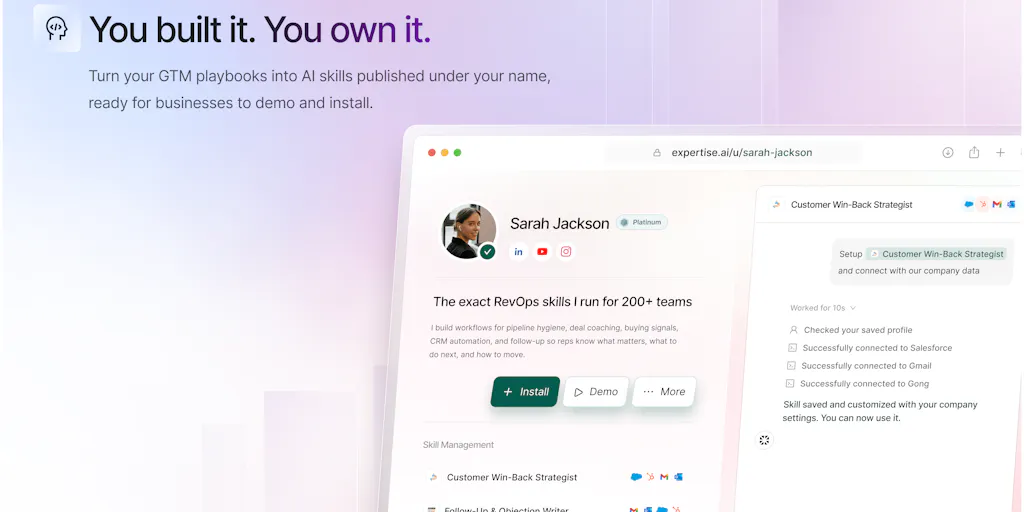
The product itself is straightforward on the surface: Expertise AI lets GTM experts publish their playbooks as “skills” that businesses can demo for free, install in one click, and run on their own AI agents. The skill personalizes itself to the buyer’s business, ICP, and stack — no setup calls required. But the crucial differentiator is the IP protection model. The founder’s launch comment makes the pitch clear: “You choose whether your playbook stays locked so nobody can ever see inside it, or goes open-source for the world. Either way, your name is on it, and you get paid while it runs.”
This is a deliberate reaction to the failure of prompt marketplaces and open skill catalogs. The team’s forum thread spells out the logic: “A playbook written as text is just a string, and a string gets copied the moment it’s worth copying.” Worse, in the AI age, “every framework posted publicly becomes something an agent runs tomorrow with your name stripped off. You’re not sharing with a community anymore, you’re training your replacement one prompt at a time.”
So instead of selling a Markdown file, Expertise AI sells access to a running system. The IP can’t be copied or owned — only run. The expert gets paid per use or per install, and the buyer actually uses the skill because it’s integrated into their workflow, not sitting in a folder.
Why Amazon Sellers Should Care More Than Shopify Ones
If you’re a Shopify DTC operator, your playbooks are largely about brand voice, email flows, and paid social creative — all things that can be partially encoded in tools like Klaviyo or Triple Whale. But if you’re an Amazon FBA seller, your playbook is your entire survival mechanism. The Amazon Seller Central environment changes constantly: algorithm updates, fee changes, listing policy shifts, and the ever-present threat of suppression. The sellers who win are the ones with the most up-to-date, battle-tested judgment about how to navigate that chaos.
That judgment is exactly what Expertise AI wants to package. Imagine a “Listing Rescue” skill from a seller who’s recovered 200 suppressed listings. Or a “PPC Triage” skill that knows when to pause a campaign vs. lower a bid vs. change match type — based on inventory levels, not just ACOS. The fact that the skill is locked means the expert can share it without fear of it becoming a commodity. The fact that it personalizes to your account means it’s not just generic advice.
How It Differs From Existing Options
The obvious comparison is to the current state of AI agent builders. As one commenter noted on the launch page, “There are plenty of agent builders now, but fewer products focused on distributing the judgment and process behind a good agent.” Tools like Zapier or Make let you automate workflows, but they don’t capture the decision-making logic — the “3-D picture” that one maker on the team describes as the part no document ever captures.
The other comparison is to consulting and coaching. Platforms like Clarity.fm let you buy an expert’s time by the minute. But that’s still selling hours, not assets. Expertise AI’s bet is that experts would rather build a storefront of skills that run without them — a form of passive income from their judgment. The team’s marketing lead describes the moment it clicks for experts: “They’d light up describing a playbook they’d refined over years, then catch themselves with some version of ‘but I can’t just hand that out.’… For most of them, the thing that sold it wasn’t the monetization pitch, it was seeing the lock on their own skill for the first time.”
There’s also a philosophical difference from open-source movements. The founder’s forum post acknowledges that open-sourcing used to be a career move — people would fork your work, cite you, hire you. Now, AI consumes open content without attribution or reciprocity. Expertise AI’s locked model is a direct response to that shift.
What Cross-Border Sellers Can Borrow (Without Buying the Product)
You don’t need to install Expertise AI to benefit from its thesis. Here’s what I’d steal from this launch for your own operation:
1. Audit Your Playbooks for “Skill-ification”
Go through your standard operating procedures and identify the workflows that rely on judgment, not just steps. For each one, ask: could this be encoded as a decision tree that an AI agent could run? If yes, you have a candidate for internal automation. If no, you have a candidate for documentation — but document it as a system, not a PDF.
2. Stop Giving Away Your Best Content for Free
This is the hardest lesson for cross-border sellers, because we’re trained to build authority by sharing “insider tips.” But the Expertise AI team’s review makes a sharp point: “GTM experts who’ve run workflows manually every day are giving away those skills as free MD files sitting in someone’s downloads folder, never opened.” If you’re going to share your sourcing checklist or your listing optimization framework, don’t give away the full executable version. Give away the outcome and charge for the process — either through a consulting engagement, a paid community, or a tool you build.
3. Build an Internal “Skill Store” for Your Team
Even without an external marketplace, you can adopt the mindset. Create a shared repository where your top operators encode their judgment as structured playbooks — with conditions, decision points, and “if this, then that” logic. The repeatability insight from the launch comments is key: “Getting a good AI result once is easy; getting the whole team to reproduce it is much harder.” Your goal should be making your best operator’s judgment reproducible across your entire team.
4. Protect Your IP Like It’s a Product
The founder’s core belief — “you built it, you own it” — should apply to your internal processes. If you’ve developed a proprietary method for vetting suppliers or forecasting demand, don’t post it in a public forum. Treat it like trade secret. The moment it’s public, an AI agent will absorb it, and your edge becomes everyone’s baseline.
5. Consider the “Expert as a Service” Model
If you’re a solo operator or a small agency serving other sellers, Expertise AI’s storefront model is worth studying. Instead of selling your time as a consultant, could you package your methodology as a subscription skill? The team’s founding expert offer — “we’ll build your first skills with you and migrate your existing files free” — suggests they’re looking for exactly this kind of partner.
Where the Math Breaks
For all the promise, there are real problems with the Expertise AI model — and they’re the same problems that will hit any attempt to productize e-commerce expertise.
The personalization paradox. The product claims skills “personalize themselves to their business, their ICP, their stack.” But true e-commerce expertise is deeply contextual. A PPC playbook that works for a $50 beauty product on Amazon won’t work for a $2,000 furniture item on Shopify. The “personalization” is only as good as the variables the skill asks for. If it can’t capture the nuance of your specific category, margin structure, and competitive landscape, you’re getting a generic framework dressed up as expertise.
The verification problem. Anyone can claim to be an expert. The 5.0 rating on the launch page is based on just two reviews — both from people connected to the product. For a marketplace to work, there needs to be a trust layer that verifies outcomes, not just claims. In e-commerce, where results are measurable (revenue, ROAS, ranking), this is actually easier than in GTM — but it’s still unsolved.
The “locked skill” trust issue. The entire model depends on buyers trusting that the skill is actually good without seeing inside it. That’s a hard sell. The demo-first approach helps, but a demo is not the same as running the skill on your real data. For a cross-border seller, the risk isn’t just wasting money — it’s acting on bad advice that costs you inventory, ranking, or ad spend.
The commoditization ceiling. If Expertise AI succeeds, the best playbooks become widely available. That’s good for buyers but bad for the experts who built them — and for the sellers who use them. An edge that everyone has is not an edge. The platform’s locked model slows copying, but it doesn’t stop the underlying knowledge from becoming table stakes once enough people run the same skill.
Where the Math Breaks: A Concrete Example
Let’s say you buy a “TikTok Shop Product Research” skill from an expert. It runs, identifies 20 potential products, and you launch one. It flops. Was the skill bad, or did you execute poorly, or was the market timing off? You can’t tell. The skill is a black box. In e-commerce, where outcomes are stochastic, this attribution problem is fatal for trust. A skill that works 60% of the time is genuinely valuable — but you’ll never know it’s 60% because you only see your one outcome.
What I’d Watch / Test Next
This week, you can start applying the Expertise AI thesis without touching the product. Here’s my concrete plan:
Inventory your judgment. Sit down with your top operator — your head of Amazon PPC, your sourcing lead, your content strategist — and ask them to walk you through their most valuable decision. Record it. Transcribe it. Then try to encode it as a decision tree with “if-then” logic. You’ll immediately see where the judgment lives and where the documentation gaps are.
Test a locked-skill mindset. Pick one playbook you currently share freely — maybe your supplier vetting checklist or your listing optimization framework. Stop sharing the full version. Create a teaser that shows the outcome, not the process. If you get pushback, that’s the signal that the playbook had value you were giving away.
Explore Expertise AI as a buyer. Even if you don’t have GTM skills to sell, browse the expert storefronts and demo a skill. See how the personalization works, how the lock functions, and whether the output feels genuinely expert-level or just AI-generated. This will tell you more about the future of this space than any review.
Watch the open vs. locked debate. The forum thread is genuinely interesting — it’s a real philosophical question about AI, attribution, and value. For cross-border sellers, the answer is probably: lock your operational playbooks, open your educational content. But the line is blurring, and it’s worth revisiting quarterly.
Build a small internal “skill.” Use a tool like Claude or ChatGPT to encode one of your repeatable processes — say, a listing QA checklist — and test it on your team. Measure whether it reduces errors or speeds up work. If it works, you’ve just built your first internal skill, and you’ll understand the Expertise AI model from the inside.
The bottom line: Expertise AI is not a tool for cross-border sellers — yet. But it’s a mirror for how we think about our own expertise. The sellers who win the next decade won’t be the ones with the best products; they’ll be the ones who figure out how to encode, protect, and scale their judgment. Whether that happens on Expertise AI or on your own internal systems, the direction is clear. Start treating your playbooks like the assets they are.