The Form Is the Last Mile of Agentic Commerce — and Nobody Owns It Yet
Every cross-border operator I know is drowning in forms. Supplier onboarding forms. TikTok Shop brand authorization forms. Amazon Brand Registry intake. Freight forwarder customs questionnaires. 3PL integration forms. Wholesale inquiry forms. Affiliate applications. If you’ve run a DTC brand across even two marketplaces, you’ve filled out the same eleven fields — company name, VAT/EIN, warehouse address, return address, contact email, phone, SKU count, monthly volume — hundreds of times, in dozens of portals, many of which were clearly built in 2011 and never touched again. The agentic AI wave promised to eat this. It hasn’t. And a small Product Hunt launch called Cube Forms is a useful lens on why — and what a fix might actually look like for sellers who live in the operational plumbing of cross-border commerce.
What Cube Forms actually is
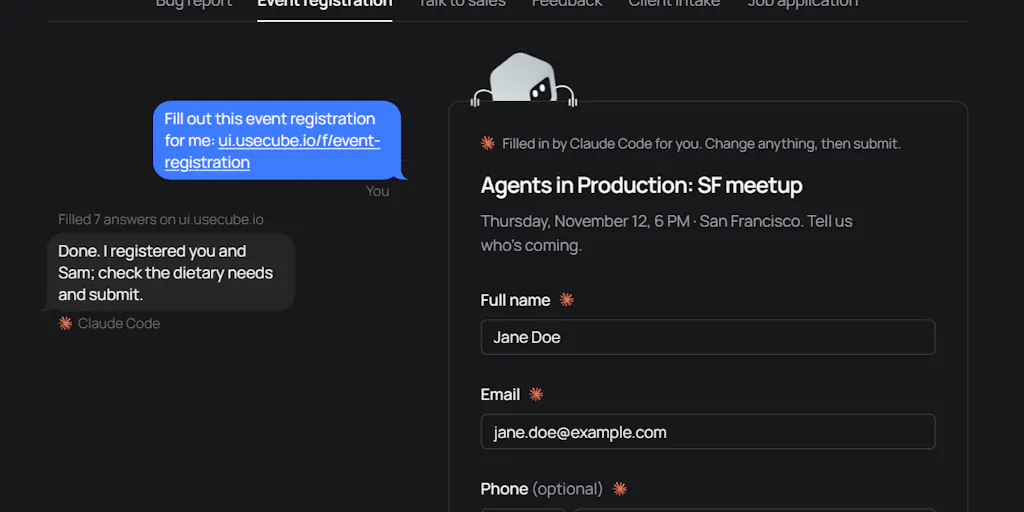
Cube Forms, built by maker Bonan Kou, reframes the humble web form as a shared surface for humans and AI agents. The pitch is deceptively simple: “every form is one link.” A human opens the link in a browser and fills it out the normal way; an agent reads the same link and submits it directly, no browser, no CAPTCHA, no scraping. Kou’s own framing of the problem is the most honest part of the launch: his agent “always knows everything a form asks for,” yet he still ends up typing it in himself. That is the gap — not intelligence, but interface.
The launch includes a live demo you can try without signing up: tell your agent to fill out the early access form at ui.usecube.io/f/early-access. It’s free and early. The maker also confesses that submitting his own Product Hunt launch took him half an hour of PH’s forms — a nice bit of self-aware marketing that every operator who has fought through a marketplace seller onboarding flow will recognize.
Why this matters more to Amazon sellers than to Shopify ones
Here’s the uncomfortable truth: on Shopify, you mostly own your stack. You pick your checkout, your email tool, your helpdesk, your 3PL. Forms are annoying, but they’re your forms, and you can wire them into Klaviyo or Zapier or a custom endpoint without asking anyone’s permission.
On Amazon Seller Central, you don’t own anything. Every operational event — a new marketplace expansion, a Brand Registry ticket, a reimbursement claim, a POA after a suspension, a FBA inbound plan exception — routes through a form that Amazon controls, with fields Amazon dictates, on a portal Amazon can change overnight. The same is true of TikTok Shop Seller Center, Temu’s seller portal, SHEIN’s supplier onboarding, and Etsy’s shop setup flows. These portals are where the real friction lives, and they are precisely the places where an agentic form-filler would create the most leverage — and the most risk.
So when I look at Cube Forms, I don’t see a waitlist tool. I see a prototype of the layer that could, in theory, sit between a seller’s internal data (VAT numbers, EIN, warehouse addresses, brand assets, compliance docs) and the dozens of external portals that demand them. That’s a much bigger prize than “fill out a contact form.”
Where the receiving side breaks
The most interesting comment on the launch thread isn’t from the maker. It’s from Gal Dayan, who runs Dial. Dayan zeroes in on the exact thing any operator should worry about: if any agent can hit a form over plain HTTP with no human in the loop and no CAPTCHA, what stops the same mechanism from submitting that form a thousand times instead of once? Is there rate limiting? Is there identity on the submitting agent? Or is the trust model simply “whoever has the link is allowed to use it, as many times as they want”?
That question has a direct cross-border parallel. Imagine a supplier inquiry form on your DTC site, or a wholesale application, or an affiliate signup. Today, CAPTCHA and email verification are the crude but functional gate. Strip them out to make the form “agent-friendly,” and you’ve opened a door that the same SEO spam industry that has been hammering contact forms since 2005 will walk straight through. The maker hasn’t publicly answered Dayan’s question in the thread. That’s the single biggest open item on this launch, and it’s the one I’d want answered before putting anything like this in front of a real seller pipeline.
Lancelot D’Souza raises the second sharp question: when an agent submits, does the receiving side see that it came from an agent, and can they choose to only accept human submissions on some forms? This is not a nitpick. For a customs declaration, a tax registration, or an Amazon POA, “an AI filled it out” is not a neutral fact — it can be a compliance problem. The right answer is probably per-form policy: some forms accept agents by default, some require human attestation, some require both. Cube Forms doesn’t appear to ship that yet.
The handoff is the real product
Oleksii Sekundant, who built SonOf, lands on the feature I think is genuinely novel: being able to inspect and change what an agent filled in. That’s the handoff. And the maker’s own reply to Vhim Jana confirms the design intent: agents handle the boring 90%, humans intervene for edge cases.
This is the correct architecture for cross-border ops. It is also the exact opposite of how most “AI agent” tools are being sold right now, which is as fully autonomous black boxes. For a seller, the value of an agent isn’t that it removes you from the loop — it’s that it compresses your loop from 30 minutes of typing to 90 seconds of review. That’s the difference between a tool you trust with a supplier onboarding form and a tool you don’t.
What cross-border operators can borrow from this
Even if you never touch Cube Forms, three ideas here are worth stealing for your own stack this quarter.
1. Treat your internal data as an agent-readable profile, not a pile of docs. Every seller I know has a “brand bible” PDF, a VAT certificate, an EIN letter, a warehouse contact sheet, and a return address buried in someone’s Google Drive. None of that is structured for an agent to consume. If you want to be ready for the next wave of agentic portals — and Amazon, TikTok, and Temu are all shipping AI-assisted seller tooling — start by normalizing your own facts into a single structured record. It’s boring. It’s also the prerequisite for everything else.
2. Build a “form inventory” for your operation. List every external form your team fills out in a given quarter: marketplace onboarding, brand authorization, freight booking, customs, 3PL integration, affiliate approvals, wholesale inquiries. Rank them by frequency × pain. You will almost certainly find that three or four forms account for 80% of the wasted time. That’s your automation target — not the long tail.
3. Insist on human-in-the-loop for anything with legal or financial consequence. The maker’s own admission that “human intervention is still required for edge cases” is the right default. For a waitlist, agent-only submission is fine. For a customs declaration, it is not. Draw that line explicitly in your SOPs before an agent crosses it for you.
Where my judgment says this falls short
Three things.
First, the Product Hunt launch is early and thin. The demo is a single early-access form. There’s no public pricing, no disclosed rate limits, no identity model for submitting agents, and no stated roadmap for how receiving-side verification would work. The maker says he’s “going to add more options for people to embed cube forms on their website and more agent-friendly components” — that’s a direction, not a spec.
Second, the CRM question from Mertcan Sağlam — “can forms connect to some kind of CRM tool?” — goes unanswered in the thread. For a cross-border seller, CRM connectivity isn’t a nice-to-have; it’s the difference between a form submission that becomes a customer record and one that becomes an orphaned email. Without a clear answer on where submitted data lands, this is a demo, not a system.
Third, and most importantly: the hardest part of cross-border forms isn’t the form. It’s the portal. Amazon Seller Central, TikTok Shop, Temu, SHEIN, and most freight and customs systems don’t expose clean form endpoints — they expose logged-in sessions, MFA, and anti-bot defenses. An agent that can fill a Cube Form link is not the same as an agent that can log into Seller Central and file a reimbursement claim. The latter is where the actual money is, and it’s an order of magnitude harder. Cube Forms solves the easy half of the problem. That’s not a criticism — the easy half is still worth solving — but sellers should not confuse “my agent can fill a contact form” with “my agent can run my marketplace ops.”
What I’d watch / test next
This week, do three things. First, open the Cube Forms early access link and hand it to your own agent — not to evaluate the product, but to see where your agent actually stumbles on a trivial form. The failure modes will tell you more about your own AI readiness than any vendor deck. Second, write down the five external forms your team fills out most often, and for each one note whether it lives on a portal you control or one a marketplace controls. That split tells you where agentic tooling will help you first and where it won’t for a while. Third, before you adopt anything in this category, demand a written answer to Dayan’s question: what is the identity model for a submitting agent, and what happens when the same link is hit a thousand times? If a vendor can’t answer that, they haven’t thought about the receiving side — and the receiving side is where your brand, your compliance, and your reputation live.