Why This Matters to Cross-Border Sellers
If you run an Amazon or Shopify operation, your day is a parade of repetitive tasks: rewriting product titles for six marketplaces, generating A+ content that doesn’t trigger a suppression, drafting listing copy for TikTok Shop that feels native, or parsing supplier quality reports across time zones. You’ve tried outsourcing, but the cost per SKU eats margin. You’ve looked at off-the-shelf AI tools, but they’re either too generic to respect your brand voice or too rigid to handle the variability across channels. What you really need is a way to build your own tiny, opinionated AI agents—one that knows your feed cost structure, another that reviews Amazon compliance rules, a third that generates localized ad copy—without needing a full-time platform engineer to keep them running. That’s the promise baked into HarnessRouter, a new backend that says it can let you swap between Claude Code, Codex, and other agents behind a single API. If it delivers, it could turn every e-commerce operator into someone who deploys custom automation without a dedicated infrastructure team. But the devil, as always, lives in the sandbox.
What Problem HarnessRouter Actually Solves
The most honest paragraph in the entire launch thread comes from the maker’s own introduction: “Building an AI agent backend yourself takes months: a sandbox per run, agent runtime, tool orchestration, files and artifacts, sessions and streaming, retries and timeouts, permissions, cost controls.” Anyone who has tried to duct-tape a GPT call into a Python script that writes Amazon flat files knows exactly what they mean. The problem isn’t that Large Language Models aren’t capable—it’s that wiring one into a production workflow is a software engineering project, not a configuration exercise.
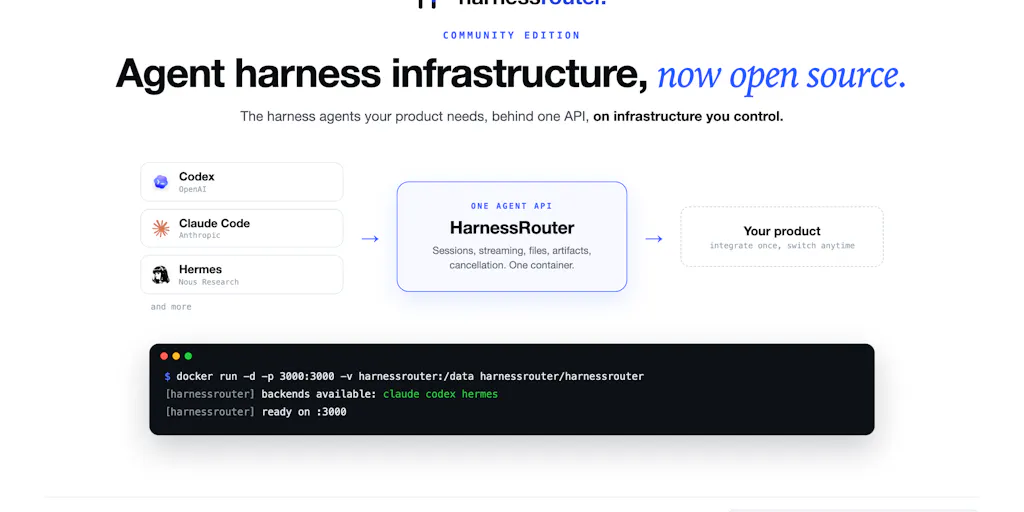
HarnessRouter abstracts that plumbing. Your app sends a task, HarnessRouter routes it to a chosen agent (Claude Code, Codex, Hermes), and returns finished work—code, files, videos, structured data. The sandbox is isolated per run, the agent is stateless, and the output is renderable, not a chat log. For the cross-border seller, this turns a project like “automate my product listing review pipeline” from a six-week dev sprint into a weekend experiment.
What makes this different from, say, wiring your own LangChain chain? LangChain forces you to choose a model and build around its quirks. HarnessRouter claims it can switch harnesses with “one line of config” (as stated in the launch comments). The key insight from the team’s response to a comment about portability: they use portable “skills” and “typed tools” that are not prompt-tuned to a specific model, and an eval suite that re-runs when you swap the underlying agent. That’s where the abstraction earns its keep—you don’t have to rewrite your entire automation logic when OpenAI releases a new model or Anthropic deprecates an endpoint.
How It Differs from Existing Options
The incumbents most cross-border sellers encounter are either all-in-one automation platforms like Zapier (good for simple triggers, terrible for multi-step agentic loops) or purpose-built AI tools like Jasper (great for copy, but locked into their own model). Neither gives you the freedom to define your own tool boundaries or to route tasks programmatically across different AI backends.
HarnessRouter’s differentiation lies in three architectural choices:
True sandbox isolation with full egress control – In the Q&A thread, Priya K. asked about outbound internet access. The team confirmed each sandbox runs in its own VM with outbound access (configurable allowlists on the roadmap). For a seller who wants an agent to scrape competitor pricing, that’s critical. For a seller who wants to keep supplier data from leaking, the eventual deny-by-default egress policy will be non-negotiable.
Data residency that doesn’t require a trust exercise – When a healthcare compliance company asked about patient data, the response was refreshingly honest: workflow runs execute inside the customer’s private network, documents are mounted read-only, and the workspace is destroyed after the task. What persists is the audit trail, not the source documents. For a seller handling supplier contracts, returns data, or customer PII, that architecture means you can test HarnessRouter without sending sensitive flat files to a third-party cloud.
Swappable agent harnesses with a built-in evaluation loop – The team didn’t claim magical portability. Instead, they described how switching from Claude Code to Codex works in practice: every harness config ships with an eval suite, real domain cases scored against rubrics. You re-run the suite, fix what surfaces (usually tool-boundary discipline), and move on. That’s miles ahead of the “just change model name in the config and hope” approach that most DIY setups use.
## What Cross-Border Sellers Can Borrow Right Now
You don’t need to ship a full product to HarnessRouter’s API to benefit from the mental model it demonstrates. Here’s what I’d take from this launch and apply next week:
Build your own “typed tool” inventory
The team talked about typed tools: each tool exposes a strict input schema, and the agent is forced to fill it correctly. In e-commerce terms, that means defining a “Fetch Amazon product page” tool that expects an ASIN and returns structured JSON (title, price, bullet points, variations, category path). A separate “Validate UPC” tool that checks digits against the GS1 database. A “Translate to German” tool that respects your brand glossary. Once you define these schemas, any agent—Claude, Codex, or a future model—can call them reliably because the contract is with the tool, not the model’s idiom. This is basically what agency teams build when they wire up Helium 10’s API, but now you can own the logic.
Automate cross-listing without buying another SaaS
One use case I’d test immediately: a multi-step workflow that takes a new product from your ERP, generates a draft Amazon listing using one agent (optimized for Amazon’s style guide), then sends that draft to a second agent that converts it for eBay (different title length, price formatting, image rules). Because HarnessRouter runs tasks in isolated sandboxes that can communicate via file output, you don’t need Kafka or webhooks—just a simple workflow. The team’s showcase of a video marketing startup using it for content generation loops suggests the same pattern works for listing generation loops.
Run competitive analysis at scale
Another low-hanging fruit: feed the agent a list of competitor ASINs, have it scrape (with permission) publicly available product details, and then generate a structured report on pricing gaps, keyword opportunities, and missing bullet points. The sandboxed execution means you can run 50 parallel tasks without worrying about rate limits or cross-contamination. The team already confirmed in a comment about concurrency that it can support thousands of harnesses concurrently.
Why Amazon Sellers Should Care More Than Shopify Ones
Shopify sellers have the luxury of apps. There are dozens of listing optimizers, AI copywriters, and translation tools in the Shopify App Store. Amazon sellers, especially those using Amazon Seller Central, are stuck with a cruder toolset. You can’t just install an app that rewrites your A+ content—you need to feed it through your own compliance rules, brand guidelines, and category requirements. HarnessRouter’s ability to define custom tools (e.g., “Check title against Amazon’s 200‑character limit, enforce trademark symbols, and flag parenthetical brand mentions”) lets you build a compliance robot that is specific to your account, not a generic third-party tool that might miss nuances. The sandboxed execution also means you can run dozens of these checks overnight without locking up your local machine.
Where My Judgment Says It Falls Short
I respect the honesty in the launch thread—the team didn’t sugarcoat the limits. But as an operator, I see three real risks that should give sellers pause before building their entire automation stack on HarnessRouter.
Single point of failure, despite the failover claims
Omri Ben-Shoham pointed out that “one API across agents means you’re now the single point of failure.” The team answered that they handle provider failover within an agent loop and that the control plane is stateless and horizontally scaled. But the honest admission was: “If our control plane is down, calls through it are down.” For a seller who depends on automated repricing or listing refreshes during a Prime Day event, a thirty-minute outage could cost thousands in lost sales. The promised BYOK (bring-your-own-key) feature, which would let you route around their infrastructure, is still in the next minor release. Until that’s live, you’re trusting their uptime.
Pricing opacity and the “high message volumes” fear
The product listing for HarnessRouter’s sibling Epsilla received a notable complaint: “Downsides are mostly about pricing at higher message volumes.” HarnessRouter’s pricing is not disclosed beyond a 7-day free trial. For a seller running thousands of listing-generation tasks per day, the cost could spiral. The team’s architecture suggests they charge per task or per message, not per agent call. Without visibility into the unit economics, you’re making a bet that what seems cheap in a sandbox won’t turn into a line item that erases your margin. I’d want a pay-as-you-go estimator before scaling beyond a pilot.
The eval suite is not a substitute for real-world testing
The team’s emphasis on an eval suite that re-runs when you switch harnesses is smart engineering. But for a cross-border seller, the “real domain cases” you need to test are not just structured outputs—they include marketplace rejection errors, policy changes, unexpected input from supplier data. A tool that passes your eval suite today might suddenly produce a listing that violates Amazon’s prohibited claims policy because a model update changed its reasoning. The team is not responsible for your compliance. You own the eval suite, and building a comprehensive one (covering all 30 categories you sell in, all 5 marketplaces, all documented policy rules) is itself a months-long project. HarnessRouter reduces the infrastructure burden, but it does not eliminate the domain expertise burden.
Where the Math Breaks
Consider the economics of using AI agents for a typical Amazon listing task. A single agent run might consume 10,000–20,000 tokens in prompts and outputs, plus latency cost from the model provider. If you’re paying HarnessRouter a markup on top of that (as a SaaS margin), the per-listing cost quickly exceeds what a virtual assistant in the Philippines would charge. For low-margin, high-volume items (e.g., phone cases with 500 variations), the math does not work. HarnessRouter shines when the task is complex, requires multiple tool calls, or must be perfectly consistent across many products—think A+ content for 50 high-end kitchen appliances, not 5,000 cheap accessories. Know your margin before you sign up.
What I’d Watch / Test Next
I’m not going to ditch my current automation stack (a mix of Python scripts, Make, and manual QA) overnight. But here’s what I’ll test this week:
Take one high-margin product category (e.g., smart home devices) and define three tools: “Fetch product specs from my ERP CSV,” “Generate Amazon bullet points following the brand voice doc,” and “Translate bullets into German using the glossary.” Use HarnessRouter’s 7-day trial to run ten products through the API. Compare output quality and total cost against my current manual process.
Stress-test the eval suite promise. I’d create a small suite of ten edge cases (price format with decimals, special characters in titles, missing bullet points) and run it against both Claude Code and Codex via HarnessRouter. The team’s own commentary in the comment thread suggests they expect differences to surface at the tool-boundary discipline level. I want to see how many of those differences I have to fix by hand.
Watch for the BYOK release. The moment I can bring my own API keys to HarnessRouter (so my direct cost per task is just the LLM plus a small routing fee), the value proposition improves dramatically. Until then, the pricing risk is too high for volume operations.
Ask the team directly about data retention for seller-specific data. Their healthcare compliance answer was thorough, but for Amazon sellers who share catalog data through third-party APIs (like Pacvue or Feedvisor), I need a written policy on how long task logs containing ASINs and prices persist. That will determine whether this is a toy or a production tool.
HarnessRouter is not a silver bullet. But it’s the first backend I’ve seen that treats the AI agent as a swappable component rather than a fixed dependency. For the cross-border seller who wants to build custom automation without hiring a platform engineer, that’s worth a serious look—as long as you go in with your eyes open about where the costs and risks live. Start small, test the eval suite, and keep a manual override ready. That’s the playbook for any new tool in this industry.