The LinkedIn Inbound Signal Cross-Border Sellers Keep Ignoring
Most cross-border operators I talk to treat LinkedIn as a résumé site, not a sales channel. That’s a mistake with real money attached. When you’re sourcing overseas distributors, vetting a 3PL in Shenzhen, or recruiting a country manager for your EU entity, the buying signals show up on LinkedIn long before they show up in your inbox — someone posts about a fulfillment headache, engages with a customs-compliance thread, or reacts to a competitor’s launch. Bearconnect.io just shipped a V2 that tries to capture that intent and wire it into outbound. The interesting question for us isn’t whether the tool is good — it’s whether the inbound-plus-outbound loop it’s selling is the workflow Amazon FBA brands and DTC operators should be running at all.
What Bearconnect Actually Changed, and Why It’s a Signal
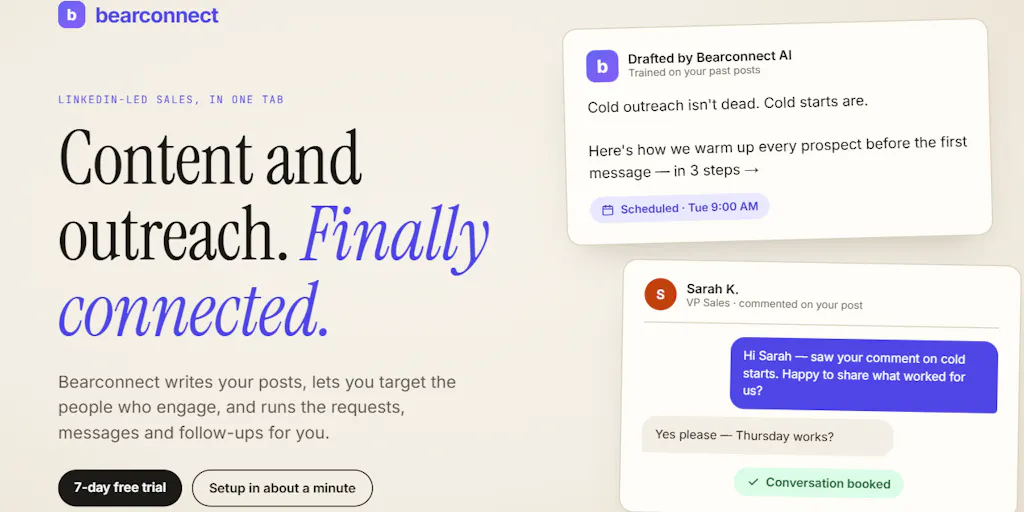
The maker, Mona Juneja, framed the V2 pivot plainly: a year ago the product launched as a pure LinkedIn outreach tool, but customer behavior pushed them toward the realization that “LinkedIn isn’t just about outbound outreach” — people already show intent through the content they create, engage with, and respond to. So the new version merges inbound and outbound workflows: content creation and scheduling on one side, prospect discovery from LinkedIn activity on the other, with connection requests, messages, and follow-ups stitched in between.
That’s a meaningful repositioning, and it maps onto something I’ve watched happen in cross-border sales over the last eighteen months. The old playbook — scrape a list, blast connection requests, hope for a reply — is dying for two reasons. First, deliverability and account safety on LinkedIn have tightened. Second, and more importantly, the reply rates on cold, context-free outreach have collapsed because everyone is doing it. The operators still getting meetings are the ones who can point to a specific reason they’re reaching out: “I saw you’re hiring a fulfillment lead in Rotterdam” beats “Hi, I’d love to connect” every single time.
Why Amazon sellers should care more than Shopify ones
Here’s a distinction I’d draw sharply. If you run a pure DTC brand on Shopify, your acquisition motion is largely paid and algorithmic — Meta, Google, TikTok. LinkedIn is a rounding error in your channel mix, useful mainly for B2B-adjacent categories or wholesale inquiries.
But if you’re an Amazon FBA brand owner, a huge chunk of your real business is B2B and relationship-driven. You’re negotiating with suppliers, freight forwarders, Amazon Seller Central account managers, agency partners, and increasingly with retail buyers for offline distribution. That’s a LinkedIn-shaped world. Same for anyone running a marketplace portfolio across TikTok Shop, Temu, SHEIN, Etsy, and eBay — the operational complexity grows, and so does the number of humans you need to coordinate with. Bearconnect’s inbound-plus-outbound loop is genuinely more relevant to that operator than to a solo Shopify dropshipper.
The Safety Math Is the Whole Product
The single most revealing exchange on the launch page was Muhammad Ahmed asking the obvious question: LinkedIn is stringent on automation, so what safety measures exist, and is there a limit? Juneja’s answer is the number you should write down: Bearconnect limits activity to 25 connection requests and 50 messages per day, and when it detects you’re approaching your LinkedIn weekly limit, it automatically pauses campaigns and resumes them when it’s safe to continue.
That’s the honest answer, and it’s also the ceiling on the product. Any LinkedIn automation tool lives or dies on this constraint. If you’re expecting to run a 5,000-contact outbound campaign in a week, no tool can do that without torching your account — and your account, for a cross-border operator, may be tied to years of supplier and partner relationships you can’t afford to lose.
Where the math breaks
Let’s do the arithmetic that vendors don’t like doing. At 25 connection requests per day, five days a week, you’re looking at roughly 125 per week, or about 6,500 a year — before you account for acceptance rates. A realistic acceptance rate on targeted B2B outreach sits somewhere in the 20–40% band depending on how good your targeting is. Call it 30%. That’s about 1,950 new connections a year. Then messages to those connections convert to actual conversations at maybe 10–20%. You’re looking at a few hundred real conversations annually, per seat, if you execute well.
Is that worth it? For a high-ticket B2B motion — a $50K wholesale order, a distribution deal, a recruiting pipeline — absolutely. For a $30 AOV DTC product, the unit economics never close. This is the filter I’d apply before anyone buys a LinkedIn tool: what’s the lifetime value of a single converted relationship? If it’s under a few thousand dollars, the daily caps make the channel structurally unprofitable.
What Cross-Border Operators Should Borrow From This
Three things, and none of them require buying the tool.
First, the intent-first prospecting model. Instead of building a list of titles and companies, build a list of behaviors. Who commented on a post about EU VAT changes? Who reacted to a freight-rate thread? Who published something about their brand expanding into Japan? That’s a warmer list than any filter-based export, and it’s the core insight behind the inbound-plus-outbound merge.
Second, brand-voice AI drafting as a floor, not a ceiling. Bearconnect’s V2 adds AI that creates posts and drafts inbox replies “in your own Brand Voice.” I’m skeptical of AI-written outreach as a final product — it reads fine and converts badly when it’s generic. But as a first-draft floor that a human then sharpens with one specific, researched detail, it’s a legitimate time-saver. Use it to get from blank page to 70%, then spend your saved time on the 30% that actually earns the reply.
Third, workspace and role-based access as an agency primitive. Oleksii Sekundant flagged the team workspaces and account access controls as the standout feature, and Juneja confirmed they were “built with agencies in mind” so teams can manage multiple client accounts and control who has access to each one. If you run an agency serving cross-border brands, or you’re a brand with regional teams across time zones, this matters more than any AI feature. Sharing passwords across a distributed team is an operational and security liability, and role-based access is the boring fix that prevents a very expensive incident.
The integrations list — HubSpot, Pipedrive, Make, and webhooks — is where I’d focus my evaluation. A LinkedIn tool that can’t push a qualified conversation into your CRM is a data silo. One that can, via webhooks, becomes a genuine top-of-funnel input to the same pipeline your Amazon wholesale and distribution deals flow through.
Where My Judgment Says It Falls Short
I’ll be direct about the gaps.
The daily caps are a hard ceiling, and the tool can’t change that. The 25⁄50 limits are sensible, but they mean Bearconnect is a precision instrument, not a volume machine. Anyone comparing it to email outreach platforms on cost-per-contact will be disappointed. That’s not a product flaw — it’s physics. But the marketing around “automation” tends to set the wrong expectation.
“Brand Voice” AI is unverifiable from the outside. I can’t tell from the launch material how the voice model is trained, whether it learns from your historical posts, or how much manual tuning it needs. The claim is there; the proof isn’t. Treat it as a feature to test in a trial, not a reason to buy.
Pricing and deliverability details are not disclosed. There’s no pricing on the launch page, no mention of how the tool handles LinkedIn’s detection systems beyond the pause-and-resume logic, and no published data on account-safety outcomes. For a tool that touches your most relationship-dense professional account, that’s a meaningful information gap. Ask hard questions before you connect it to a primary account — ideally, test on a secondary profile first.
The inbound content side is crowded. Scheduling and AI post-generation put Bearconnect in the same neighborhood as Buffer, Hootsuite, and Taplio. The differentiation is the merge with outbound prospecting, not the content tools themselves. If you already have a content scheduler you like, you’re buying this for the prospecting loop.
What I’d Watch / Test Next
This week, before you evaluate any LinkedIn tool, do the diagnostic first. Pull your last 50 meaningful business relationships — suppliers, 3PLs, agency partners, distribution buyers — and count how many originated on LinkedIn versus email or referral. If the number is near zero, this category isn’t your priority yet; fix your Amazon and paid channels first. If it’s meaningful, the inbound-plus-outbound model is worth a structured test.
Then run a two-week pilot on a secondary LinkedIn profile, not your primary. Set the caps conservatively — below Bearconnect’s own 25⁄50 limits — and measure three things: acceptance rate on intent-based connection requests versus your old list-based approach, reply rate on AI-drafted-then-human-edited messages versus fully manual ones, and whether conversations actually land in your CRM via the HubSpot or webhook integration. If reply rates on intent-based outreach don’t beat your baseline by a clear margin, the tool isn’t the variable — your targeting is, and you’ve saved yourself a subscription. If they do, you’ve found a channel most of your competitors are still treating as a résumé site.